Question
Why is it necessary to sub-divide a Journal? What are its advantages?

Answer

Business transactions are numerous and it becomes difficult to record all the transactions in one book of primary entry, i.e., Journal Book. For example, in a business, many transactions may relate to receipts and payments of cash, sale of goods and their purchase. It is convenient to maintain a separate book for each such class of transactions--one to record cash transactions, another to record credit purchase of goods and yet another to record credit sale of goods. Book of this type is called a book of original entry or primary entry-it is a special form of Journal, a sub-division of it.
Advantages of Subsidiary Books
The use of subsidiary books has following advantages:
  1. Division of Work: Since in place of one Journal, Subsidiary Books are maintained, accounting work can be divided among a number of persons.
  2. Specialisation and Efficiency: When the same work is handled by a particular person for a considerable time, he acquires knowledge and expertise in it. He Become more efficient in handling it. Thus, accounting is done more efficiently.
  3. Saving of Time: Various accounting processes can be undertaken simultaneously because of the use of number of books. Thus, it leads to completing the work timely.
  4. Availability of Information: Since a separate book is maintained for each class of transactions, information relating to each class is available at one place.
  5. Facility in Checking: In case, the Trial Balance does not agree, locating the error or errors is facilitated by the existence of separate books. Since the number of transactions is less in each Subsidiary Book as compared to only one Journal, is easy to locate the errors.
  6. Responsibility: Division of work results in assigning a particular job to a particular person. If an error is committed in recording, responsibility can be easily fixed.

Need a full question paper?

Generate a complete, print-ready paper with questions like this in minutes — across 16+ boards, with answer keys.

Start Generating Free

Similar questions

From the following information, ascertain the opening balance of Sundry Debtors and the closing balance of Sundry Creditors:
 
Sundry Creditors as on 31st March, 2017 20,600
Sundry Debtors as on 31st March, 2018 37,400
Stock as on 31st March, 2017 26,000
Stock as on 31st March, 2018 24,000
During the year ended 31st March, 2018:
Purchases 1,10,000
Discount allowed by creditors 800
Discount allowed to customers 1,100
Cash paid to sundry creditors 95,000
Bills Payable issued by them 14,000
Bills Receivable received from customers 16,500
Cash received from customers 1,30,000
Bills receivable dishonoured 1,900
Describe the series of SQL statements to produce trial balance data base design for Model-II is used.
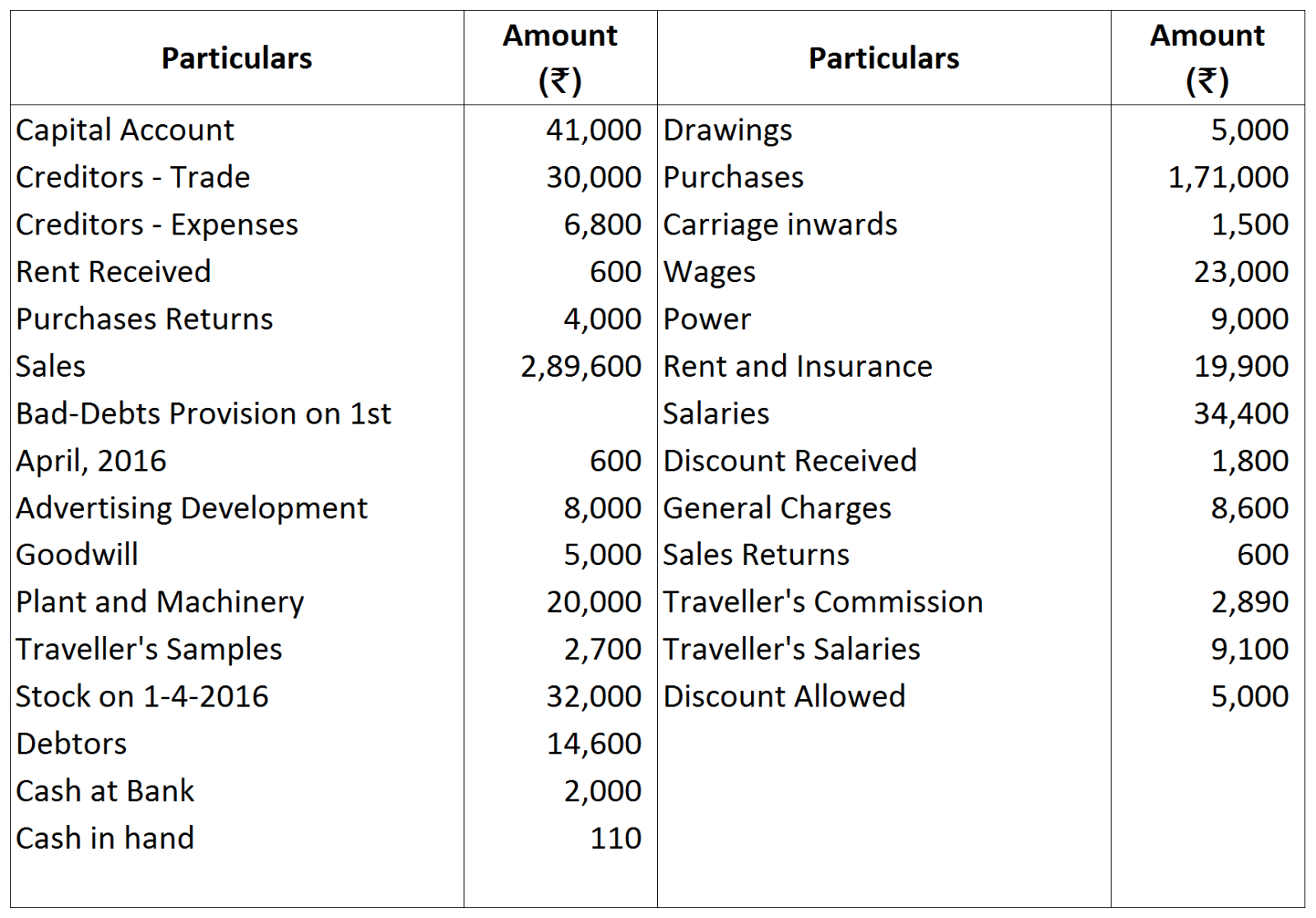
Prepare Trading and Profit and Loss Account and Balance Sheet as at 31st March, 2017 from the following Balances of Mr. Sardari Lal :

Adjustments: The Closing stock was ₹ 23,000 but there has been a loss by fire on 20th March, 2017, to the extent of ₹ 20,000, not covered by insurance. Depreciate Plant and Machinery by 10% and Traveller's Samples by $33\frac{1}{3}\%$ Increase the Bad-debts Provision to ₹ 2,000. Write 20% off Advertising Development Account. Annual premium on insurance expiring 1st June, 2017 was ₹ 1,200. Provide for Manager's commission @ 5% on Net Profits after charging such Commission.
What integrity constraints are specified on database schema? Why is each considered important?
How can the profit or loss of a trader be ascertained with the help of a statement of affairs?
​​On 1st April, 2016, X Ltd. purchased a machine costing ₹ 4,00,000 and spent ₹ 50,000 on its installation. The estimated life of the machinery is 10 years, after which its residual value will be ₹ 50,000 only. Find the amount of annual depreciation according to the Fixed Instalment Method and prepare Machinery Account for the first three years. The books are closed on 31st March every year.
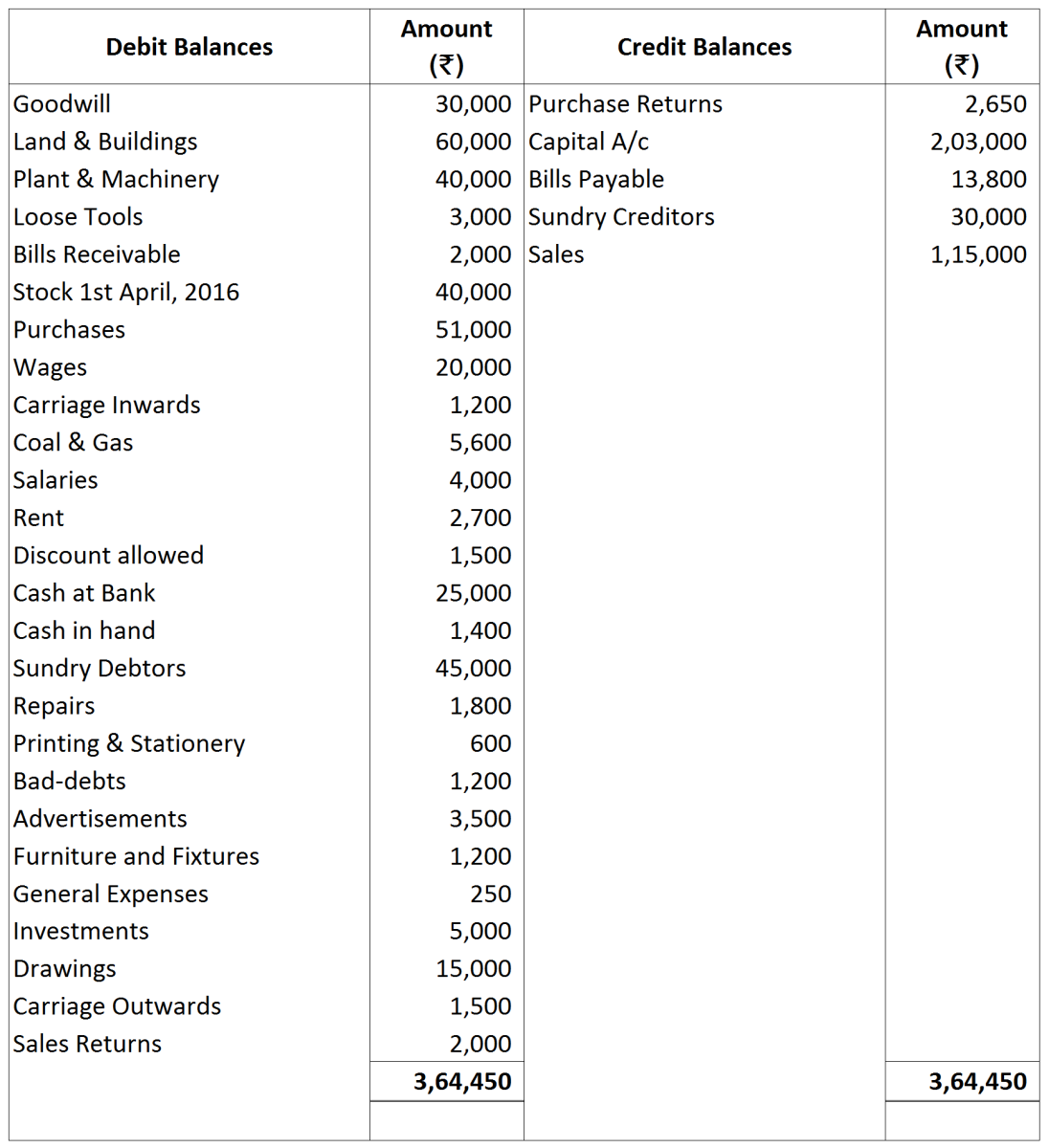
Following is the Trial Balance of Mr. Gautam as at 31st March, 2017:

You are required to prepare Final Accounts after taking into account the following adjustments:
  1. Closing Stock on 31st March, 2017 was ₹ 60,000.
  2. Depreciate Plant and Machinery at 5%, Loose Tools at 15% and Furniture and fixtures at 5%.
  3. Provide $2\frac{1}{2}\%$ for discount on Sundry Debtors and also provide 5% for Bad and Doubtful Debts on Sundry Debtors.
  4. Only three quarter's rent has been paid, the last quarter's rent being outstanding.
  5. Interest earned but not received ₹ 600.
  6. Write off $\frac{1}{4}\text{th}$ of Advertisement expenses.
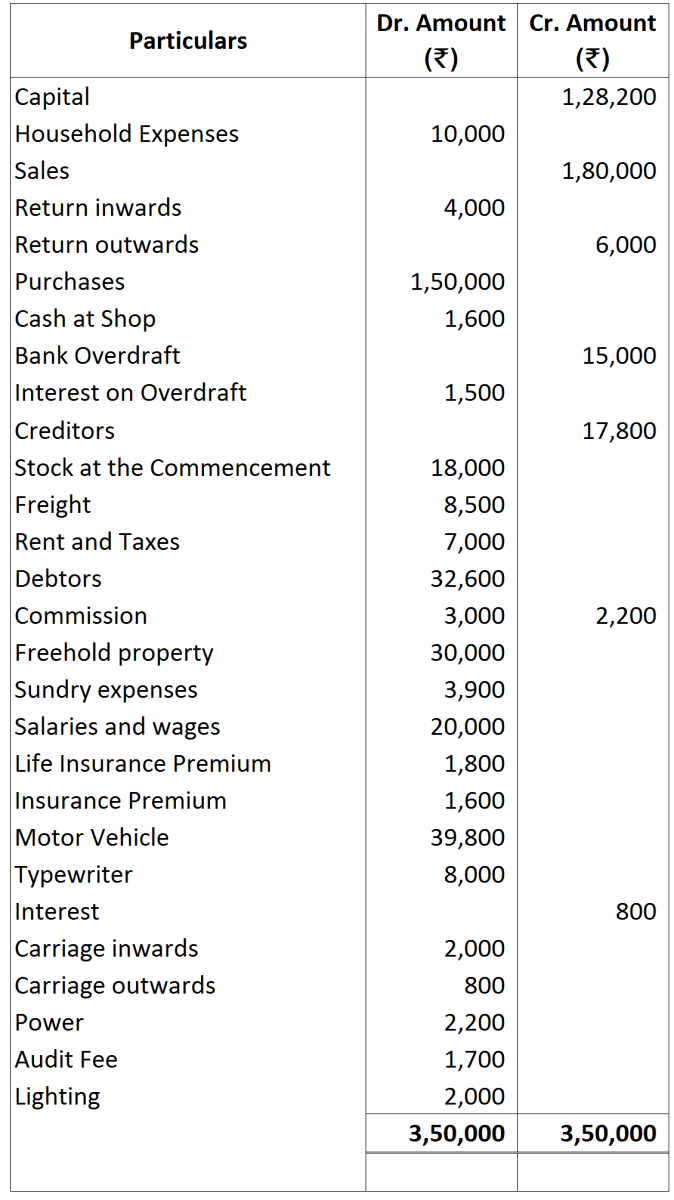
From the following balances extracted from the books of Sh. Badri Vishal on 31st March, 2017, prepare a Trading Account, P & L A/c and a Balance Sheet. Closing Stock valued on that date was ₹ 15,000.
Write a detailed note on Transaction Processing System (TPS).
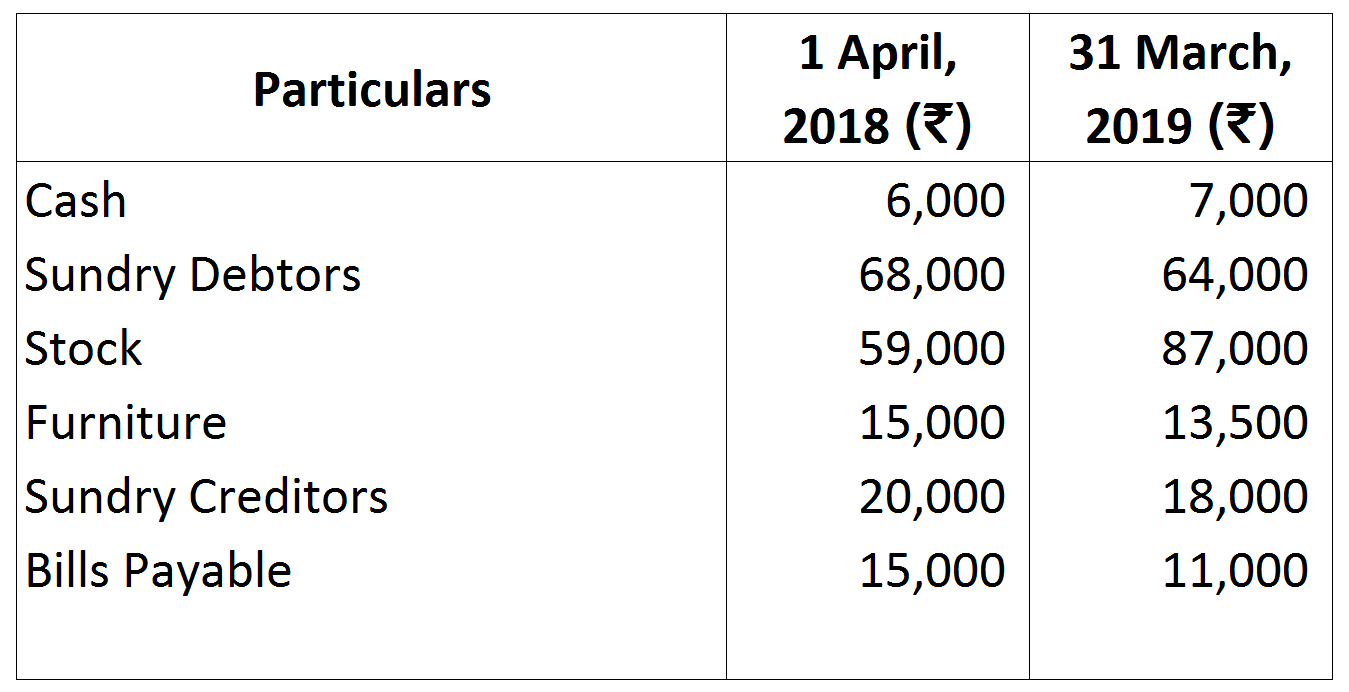
Following information is supplied to you by a shopkeeper:
During the year, he withdrew ₹ 2,500 per month for domestic purposes. He also borrowed from a friend at 9% a sum of ₹ 20,000 on 1st October, 2018. He has not yet paid the interest. A provision of 5% on debtors for doubtful debts is to be made. Ascertain the profit or loss made by him during the period.