Question
Why is it not possible to make permanent magnets from paramagnetic materials?

Answer

Permanent magnets are made from the material that are easily magnetized and retain the magnetization even reverse magnetizing field is applied (high coercivity). Paramagnetic materials get small magnetization, if they are placed in magnetic field, they lose their magnetization easily if the reverse field is applied. Hence, they are not used to make permanent magnet.

Need a full question paper?

Generate a complete, print-ready paper with questions like this in minutes — across 16+ boards, with answer keys.
Start Generating Free

Similar questions

A pole of length 1.00m stands half dipped in a swimming pool with water level 50.0 cm higher than the bed. The refractive index of water is 1.33 and sunlight is coming at an angle of 45° with the vertical. Find the length of the shadow of the pole on the bed.
Explain linear density, surface density and volume density for continuous charge distribution.
A wheel rotating at a speed of $600\ rpm ($revolutions per minute$)$ about its axis is brought to rest by applying a constant torque for $10$ seconds. Find the angular deceleration and the angular velocity $5$ seconds after the application of the torque.
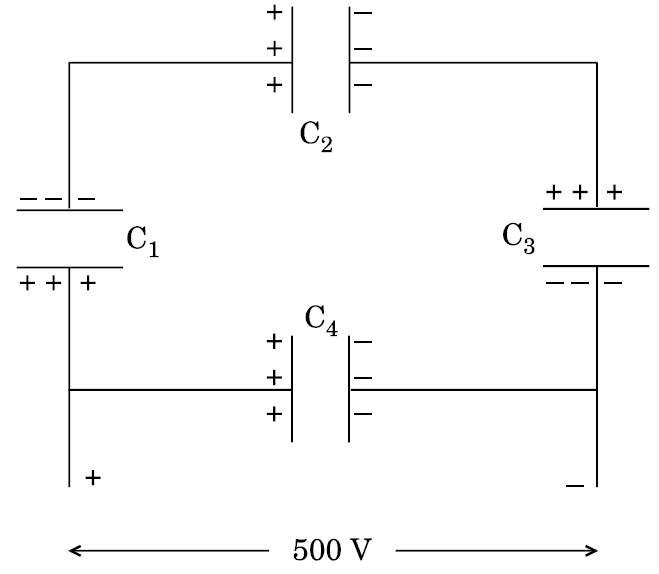
A network of four 10 $\mu$F capacitors is connected to a 500 V supply as shown in the figure. Determine the
  1. equivalent capacitance of the network and.
  2. charge on each capacitor.
Explain the construction of compound microscope with the help of figure and derive the equation of magnification.
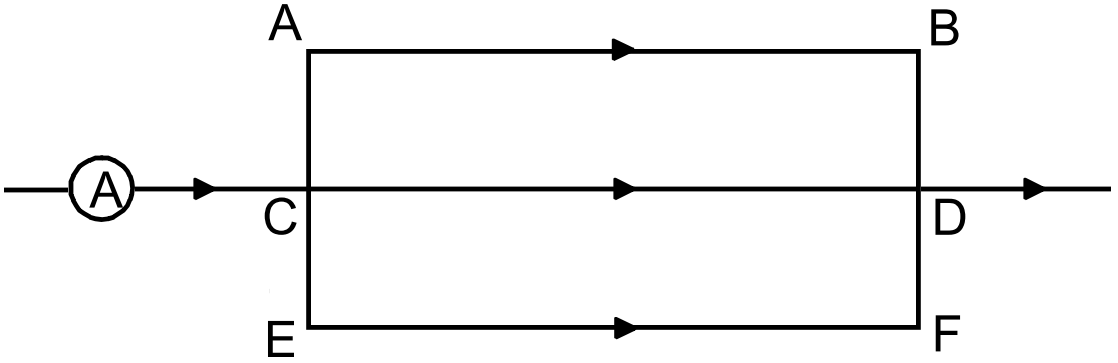
Figure shows a part of an electric circuit. The wires $AB, CD$ and $EF$ are long and have identical resistances. The separation between the neighbouring wires is $1.0\ cm$. The wires $AE$ and $BF$ have negligible resistance and the ammeter reads $30A$. Calculate the magnetic force per unit length of $AB$ and $CD$.
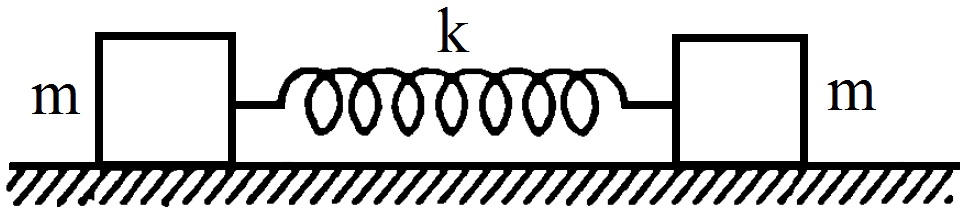
Consider the situation shown in figure Show that if the blocks are displaced slightly in opposite directions and released, they will execute simple harmonic motion. Calculate the time period.
Find the range of frequency of light that is visible to an average human being $(400\ \text{nm}<\lambda<700\ \text{nm}).$
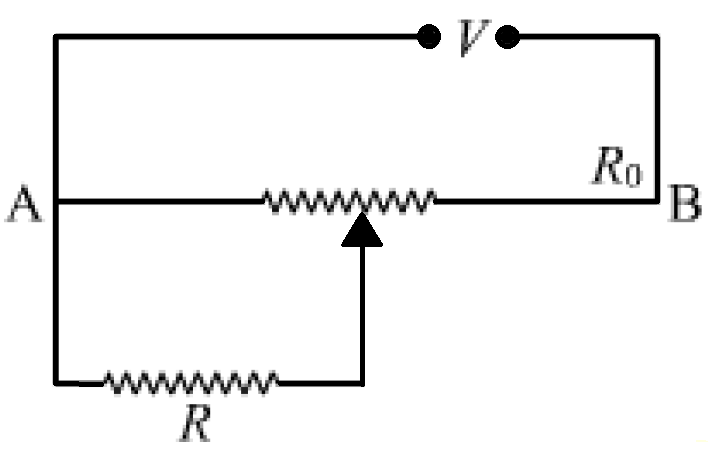
A resistance of $R$ draws current from a potentiometer. The potentiometer wire, $AB,$ has a total resistance of $R_o$. A voltage $V$ is supplied to the potentiometer. Derive an expression for the voltage across $R$ when the sliding contact is in the middle of potentiometer wire.
What length of a copper wire of cross$-$sectional area $0.01\ mm^2$ will be needed to prepare a resistance of $1\text{k}\Omega?$ Resistivity of copper $=1.7\times10^{-8}\Omega\text{-m}.$