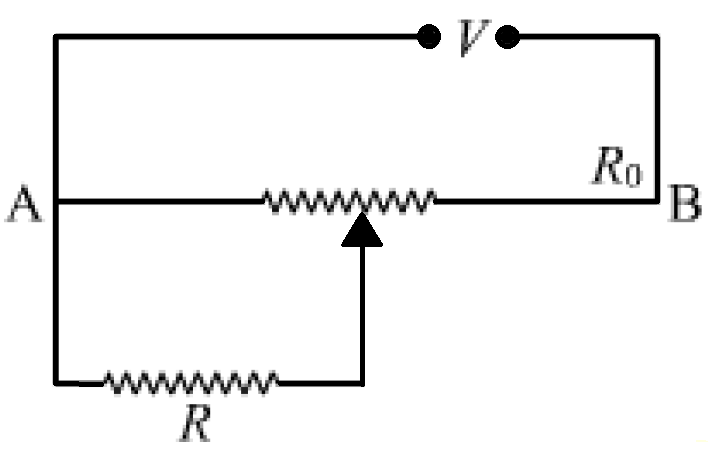
A resistance of $R$ draws current from a potentiometer. The potentiometer wire, $AB,$ has a total resistance of $R_o$. A voltage $V$ is supplied to the potentiometer. Derive an expression for the voltage across $R$ when the sliding contact is in the middle of potentiometer wire.
TEST PAPER 2006
Download our app for free and get started
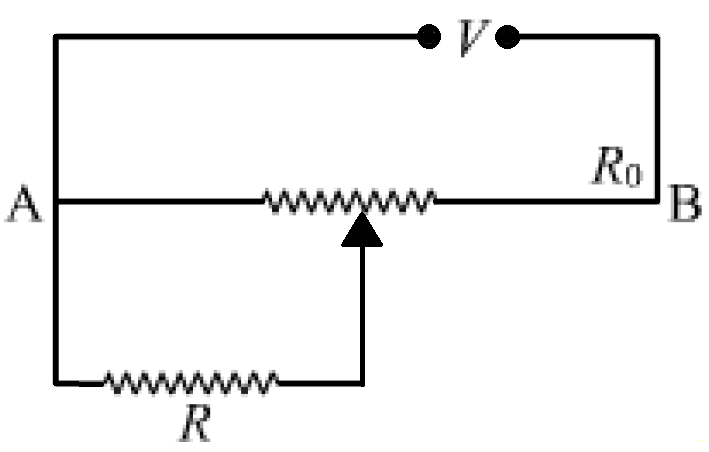
When the slide is in the middle of the potentiometer, only half of its total resistance i.e. $R_02 ($since resistance is directly proportional to length$)$ will be between $A$ and point of contact $(C),$ say $R_1,$ will be given by the following expression
$1R_1 = 1R + 1R_02$
$R1 = RR_02R + R_0$
The total resistance between $A$ and $B$ will be sum of the resistance between $A C$ and $C B$ ie$ R_1 + R_02$
Current flowing through the potentiometer will be
$I = VR_{1 }+ R_02= 2V2R_{1 }+ R_0$
The voltage $V_1$ taken from the potentiometer will be the product of current $I$ and the resistance $R_1$
$V_1 = IR_1 = 2V2R_1+ R_0 X R_1 = 2V_2RR_02R + R_0+ R_0 X RR_02R + R_0 = 2VRR_0 + 4R$

Download our appand get started for free
Experience the future of education. Simply download our apps or reach out to us for more information. Let's shape the future of learning together!No signup needed.*
Similar Questions
- 1What are the advantages of the null$-$point method in a Wheatstone bridge? What additional measurements would be required to calculate $R_{unknown}$ by any other method?View Solution
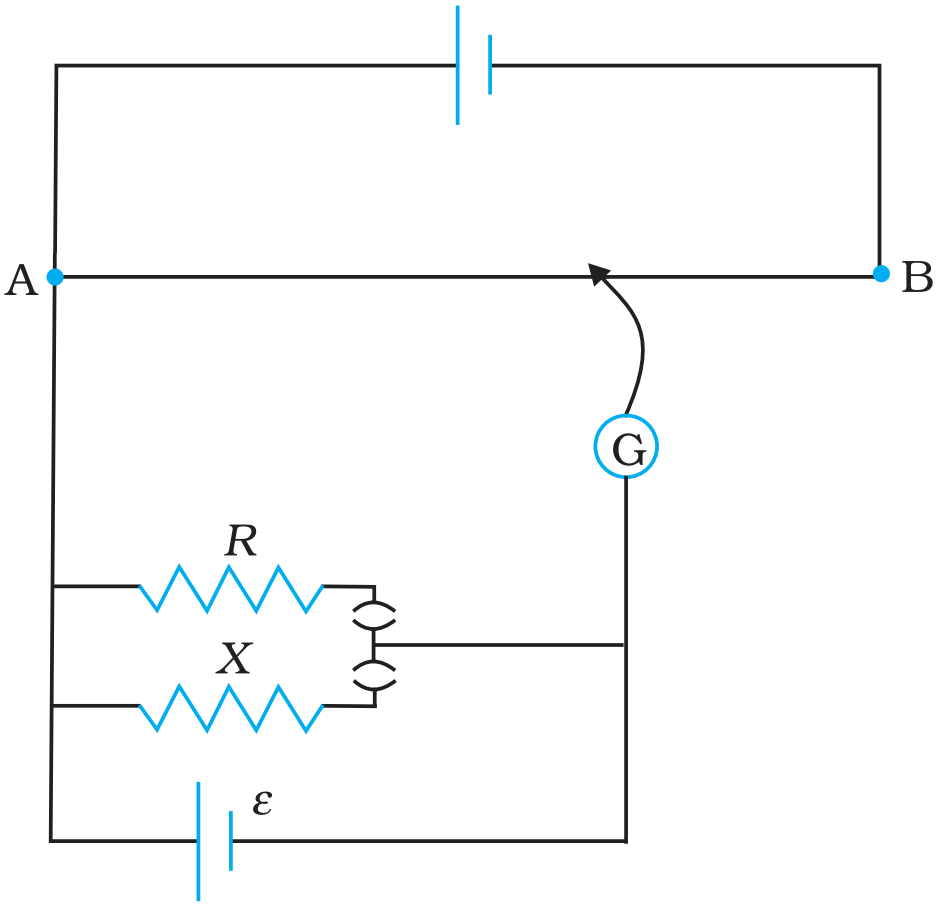
- 2Figure shows a potentiometer circuit for comparison of two resistances. The balance point with a standard resistor $\text{R}=10.0\ \Omega$ is found to be $58.3 \ cm,$ while that with the unknown resistance $X$ is $68.5 \ cm$. Determine the value of $X$. What might you do if you failed to find a balance point with the given cell of emf $\varepsilon?$View Solution
- 3View SolutionDefine the terms (i) drift velocity, (ii) relaxation time.
A conductor of length L is connected to a dc source of emf ε. If this conductor is replaced by another conductor of same material and same area of cross-section but of length 3L, how will the drift velocity change? - 4View SolutionA potentiometer wire of length 1 m is connected to a driver cell of emf 3 V as shown in the figure. When a cell of 1.5 V emf is used in the secondary circuit, the balance point is found to be 60 cm. On replacing this cell and using a cell of unknown emf, the balance point shifts to 80 cm.
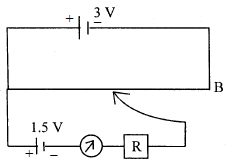
- Calculate unknown emf of the cell.
- Explain with reason, whether the circuit works, if the driver cell is replaced with a cell of emf 1 V.
- Does the high resistance R, used in the secondary circuit affect the balance point? Justify your answer.
- 5The potential difference across a resistor $‘r\ ’$ carrying current $‘I\ ’$ is $Ir.$View Solution
- Now if the potential difference across $‘r\ ’$ is measured using a voltmeter of resistance $‘RV\ ’,$ show that the reading of voltmeter is less than the true value
- Find the percentage error in measuring the potential difference by a voltmeter.
- At what value of $RV,$ does the voltmeter measures the true potential difference?
- 6View SolutionA cylindrical metallic wire is stretched to increase its length by 10%. Calculate the percentage increase in its resistance.
- 7An ideal battery sends a current of 5A in a resistor. When another resistor of value $10\Omega$ is connected in parallel, the current through the battery is increased to 6A. Find the resistance of the first resistor.View Solution
- 8View SolutionWhy are alloys used for making standard resistance coils?
- 9View SolutionAnswer the following:
- Why are the connections between the resistors in a meter bridge made of thick copper strips?
- Why is it generally preferred to obtain the balance point in the middle of the meter bridge wire?
- Which material is used for the meter bridge wire and why?
- 10A wire of length 1m and radius 0.1mm has a resistance of $100\Omega.$ Find the resistivity of the material.View Solution