Why it is more hotter for same distance over the top of a candle than it in the side of its flame?
Easy
Download our app for free and get started
(d)
On the sides heating is only due to Radiation but over the top heating is due to Radiation as well as convection.

Download our appand get started for free
Experience the future of education. Simply download our apps or reach out to us for more information. Let's shape the future of learning together!No signup needed.*
Similar Questions
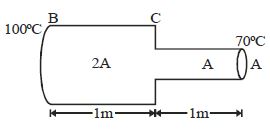
- 1A metal rod of length $2\, m$ has cross-sectional areas $2A$ and $A$ as shown in the following figure. The two ends are maintained at temperatures $100\,^oC$ and $70\,^oC$. The temperature of middle point $C$ is ........ $^oC$View Solution
- 2View SolutionNewton’s law of cooling, holds good only if the temperature difference between the body and the surroundings is
- 3The 'Kangri' is an earthen pot used to stay warm in Kashmir during the winter months. Assume that the 'Kangri' is spherical and of surface area $7 \times 10^{-2} \,m ^{2}$. It contains $300 g$ of a mixture of coal, wood and leaves with calorific value of $30 \,kJ / g$ (and provides heat with $10 \%$ efficiency). The surface temperature of the 'Kangri' is $60^{\circ} C$ and the room temperature is $0^{\circ} C$. Then, a reasonable estimate for the duration $t$ (in h) that the 'Kangri' heat will last is (take the 'Kangri' to be a black body)View Solution
- 4A body takes $4$ minutes to cool from ${100^o}C$ to ${70^o}C$. To cool from ${70^o}C$ to ${40^o}C$ it will take ........ $\min.$ (room temperature is ${15^o}C$)View Solution
- 5View SolutionAccording to ‘Newton’s Law of cooling’, the rate of cooling of a body is proportional to the
- 6The radiation emitted by a star $A$ is $10,000$ times that of the sun. If the surface temperatures of the sun and the star $A$ are $6000 K$ and $2000 K$ respectively, the ratio of the radii of the star $A$ and the sun isView Solution
- 7View SolutionA solid cube and a solid sphere of identical material and equal masses are heated to the same temperature and left to cool in the same surroundings. Then,
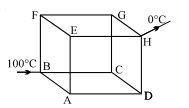
- 8Twelve conducting rods form the riders of a uniform cube of side $'l'.$ If in steady state, $B$ and $H$ ends of the rod are at $100^o C$ and $0^o C$. Find the temperature of the junction $'A'$ ....... $^oC$View Solution
- 9A cane is taken out from a refrigerator at $0°C$ . The atmospheric temperature is $25°C$ . If $t_1$ is the time taken to heat from $0°C$ to $5°C$ and $t_2$ is the time taken from $10°C$ to $15°C$, thenView Solution
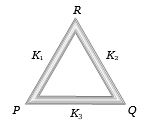
- 10hree rods of same dimensions are arranged as shown in figure they have thermal conductivities ${K_1},{K_2}$ and${K_3}$ The points $P$ and $Q$ are maintained at different temperatures for the heat to flow at the same rate along $PRQ$ and $PQ$ then which of the following option is correctView Solution