Question
Why length, mass and time are chosen as base quantities in mechanics?

Answer

Normally each physical quantity requires a unit or standard for its specification, so it appears that there must be as many units as there are physical quantities. However, it is not so. It has been found that if in mechanics we choose arbitrarily units of any three physical quantities we can express the units of all other physical quantities in mechanics in terms of these. So, length, mass and time are chosen as base quantities in mechanics because.
  1. Length, mass and time cannot be derived from one another, that is these quantities are independent.
  2. All other quantities in mechanics can be expressed in terms of length, mass and time.

Need a full question paper?

Generate a complete, print-ready paper with questions like this in minutes — across 16+ boards, with answer keys.
Start Generating Free

Similar questions

A rod, when suspended in a magnetic field, stays in the east-west direction. Can we be sure that the field is in the east-west direction? Can it be in the north-south direction?
Find the speed at which the kinetic enei:gy of a particle will differ by 1% from its nonrelativistic value $\frac{1}{2}\text{m}_0\text{v}^2$
Two sitar strings $A$ and $B$ playing the note ‘Ga’ are slightly out of tune and produce beats of frequency $6Hz$. The tension in the string $A$ is slightly reduced and the beat frequency is found to reduce to $3Hz$. If the original frequency of A is $324Hz$, what is the frequency of $B$?
Suppose the particle of the previous problem has a mass m and a speed v before the collision and it sticks to the rod after the collision. The rod has a mass $M$:
  1. Find the velocity of the centre of mass C of the system constituting ''The rod plus the particle''.
  2. Find the velocity of the particle with respect to C before the collision.
  3. Find the velocity of the rod with respect to C before the collision.
  4. Find the angular momentum of the particle and of the rod about the centre of mass C before the collision.
  5. Find the moment of inertia of the system about the vertical axis through the centre of mass C after the collision.
  6. Find the velocity of the centre of mass C and the angular velocity of the system about the centre of mass after the collision.
what is work? How to find the work done by the variable force? Explain with examples.
  1. State laws of limiting friction.
  2. Calculate the acceleration of body sliding down a rough inclined plane.
OR
  1. Why does a horse pull a cart harder during the first few steps of its motion?
  2. Sudden motion on a blanket removes the dust particles from blanket. Why?
  3. A batsman deflects a ball by an angle 45° without changing its initial speed which is equal to 54km/ h.
What is the impulse imparted to the ball? Mass of the ball is 0.15kg.
What is the principle of superposition? On what factors frequency and amplitude of the resultant wave depend? What effect can be produced by the superposi- tion of two sound waves? Exaplain interference of sound wave and analyze it mathematically.
From a certain apparatus, the diffusion rate of hydrogen has an average value of $28.7cm^3 s^{-1}$. The diffusion of another gas under the same conditions is measured to have an average rate of $7.2cm^3 s^{-1}$. Identify the gas. [Hint: Use Graham’s law of diffusion $\frac{\text{R}_1}{\text{R}_2}=\Big(\frac{\text{M}_2}{\text{M}_1}\Big)^{\frac{1}{2}},$ where $R_1 , R_2$ are diffusion rates of gases 1 and 2, and $M_1$ and $M_2$ their respective molecular masses. The law is a simple consequence of kinetic theory]
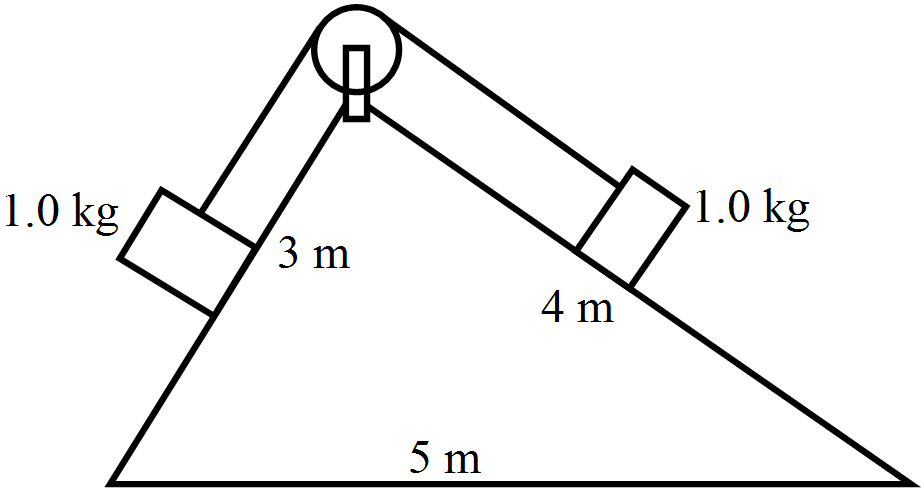
Consider the situation shown in figure. All the surfaces are frictionless and the string and the pulley are light. Find the magnitude of the acceleration of the two blocks.
A person stands on a spring balance at the equator.
  1. By what fraction is the balance reading less than his true weight?
  2. If the speed of earth's rotation is increased by such an amount that the balance reading is half the true weight, what will be the length of the day in this case?