Question
Why length, mass and time are chosen as base quantities in mechanics?

Answer

Normally each physical quantity requires a unit or standard for its specification, so it appears that there must be as many units as there are physical quantities. However, it is not so. It has been found that if in mechanics we choose arbitrarily units of any three physical quantities we can express the units of all other physical quantities in mechanics in terms of these. So, length, mass and time are chosen as base quantities in mechanics because.
  1. Length, mass and time cannot be derived from one another, that is these quantities are independent.
  2. All other quantities in mechanics can be expressed in terms of length, mass and time.

Need a full question paper?

Generate a complete, print-ready paper with questions like this in minutes — across 16+ boards, with answer keys.
Start Generating Free

Similar questions

Two billiard balls each of mass 0.05kg moving in opposite directions with speed 6ms-1 collide and rebound with the same speed. What is the impulse imparted to each ball due to the other?
The bob of a stationary pendulum is given a sharp hit to impart it a horizontal speed of $\sqrt{3\text{gl}}.$ Find the angle rotated by the string before it becomes slack.
 An electric kettle used to prepare tea, takes 2 minutes to boil 4 cups of water (1 cup contains 200cc of water) if the room temperature is 25C.
  1. If the cost of power consumption is Rs. 1.00 per unit (1 unit - 1000 watt-hour), calculate the cost of boiling 4 cups of water.
  2. What will be the corresponding cost if the room temperature drops to 5°C?
Considering the pressure p to be proportional to the density, find the pressure p at a height h if the pressure on the surface of the earth is p0.
In Millikan’s oil drop experiment, what is the terminal speed of an uncharged drop of radius 2.0 × 10⁻⁵m and density 1.2 × 10³ kg m–3. Take the viscosity of air at the temperature of the experiment to be 1.8 × 10⁻⁵ Pa s. How much is the viscous force on the drop at that speed ? Neglect buoyancy of the drop due to air.
A uniform wheel of radius R is set into rotation about its axis at an angular speed $\omega.$ This rotating wheel is now placed on a rough horizontal surface with its axis horizontal. Because of friction at the contact, the wheel accelerates forward and its rotation decelerates till the wheel starts pure rolling on the surface. Find the linear speed of the wheel after it starts pure rolling.
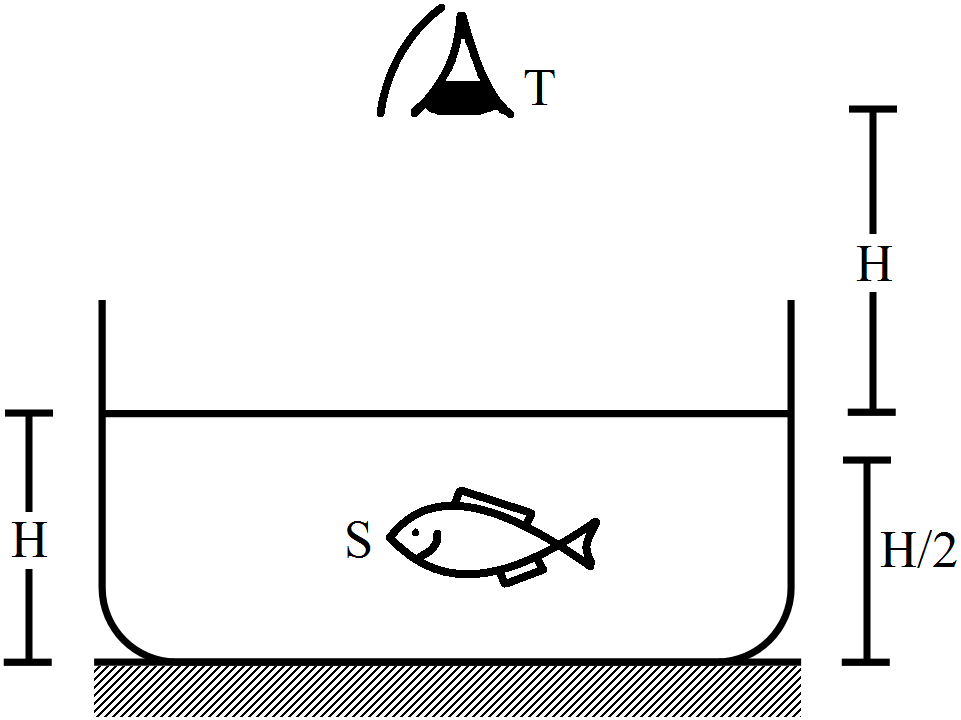
Consider the situation in figure. The bottom of the pot is a reflecting plane mirror, S is a small fish and T is a human eye. Refractive index of water is.
  1. At what distance(s) from itself will the fish see the image(s) of the eye?
  2. At what distance(s) from itself will the eye see the image(s) of the fish.

The electric field in a region is given by $\overrightarrow{\text{E}}=\frac{\text{E}_0\text{x}}{\text{l}}\vec{\text{i}}.$ Find the charge contained inside a cubical volume bounded by the surfaces x = 0, x = a, y = 0, y = a, z = 0 and z = a. Take E0 = 5 × 10³Nc-1, l = 2cm and a = 1cm.
Let $\text{X}=\overline{\text{ABC}}+\overline{\text{BCA}}+\overline{\text{CAB}}.$ Evaluate X for:

  1. $\text{A}=1,\text{B}=0,\text{C}=1$

  2. $\text{A}=\text{B}=\text{C}=1$

  3. $\text{A}=\text{B}=\text{C}=0$

Locate the centre of mass of a system of particles of mass m1 = 1kg, m2 = 2kg and m3 = 3kg, situated at the corners of an equilateral triangle of side 1.0 metre.