MCQ
Why sun has elliptical shape on the time when rising and sun setting $?$ It is due to
  • Refraction
  • B
    Reflection
  • C
    Scattering
  • D
    Dispersion

Answer

Correct option: A.
Refraction
a
(a) In the morning or evening, the sun is at the horizon and refractive index in the atmosphere of the earth decreases with height.

Due to this, the light reaching the earth's atmosphere, bends unequally, and the image of the sun get's distorted and it appears elliptical and larger.

Need a full question paper?

Generate a complete, print-ready paper with questions like this in minutes — across 16+ boards, with answer keys.
Start Generating Free

Similar questions

For adiabatic process, wrong statement is
In circular motion, the centripetal acceleration is given by
Assuming earth to be a sphere of a uniform density, what is the value of gravitational acceleration in a mine $100\, km$ below the earth’s surface ........ $m/{s^2}$. (Given $R = 6400 \,km$)
In a Fresnel baptism experiment, the two positions of lens give separation between the slits as $16 \;cm$ and $9\; cm$ respectively. What is the actual distance of separation (in $cm$)?
Aplanet of mass $m$ is in an elliptical orbit about the sun $(m < < M_{sun})$ with an orbital period $T.$ If $A$ be the area of orbit, then its angular momentum would be :
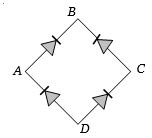
In the diagram, the input is across the terminals $A$ and $C$ and the output is across the terminals $ B $ and $D$, then the output is
The coefficient of linear expansion of a crystalline substance in one direction is $2 \times 10^{-4} /{ }^{\circ} C$ and in every direction perpendicular to it is $3 \times 10^{-4} /{ }^{\circ} C$. The coefficient of cubical expansion of crystal is equal to ........... $\times 10^{-4} /{ }^{\circ} C$
Substance $A$ has atomic mass number $16$ and half life of $1$ day. Another substance $B$ has atomic mass number $32$ and half life of $\frac{1}{2}$ day. If both $A$ and $B$ simultaneously start undergo radio activity at the same time with initial mass $320\,g$ each, how many total atoms of $A$ and $B$ combined would be left after $2$ days $.........\times 10^{24}$
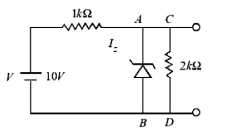
In the given circuit, the breakdown voltage of the Zener diode is $3.0 \mathrm{~V}$. What is the value of $\mathrm{I}_z$ ?
An alternating voltage $E = 200\sqrt 2\, \sin\, (100\,t)$ is connected to a $1$ microfarad capacitor through an ac ammeter. The reading of the ammeter shall be......$mA$