Question
Why the group 17 (halogen) elements of periodic table have more negative value of electron gain enthalpy?

Answer

The following reasons are responsible for the more negative value of electron gain enthalpy of group 17 elements : (i) Small atomic size (ii) More effective nuclear charge (iii) $ns ^2 np ^5$ configuration.
Hence their electron gaining tendency is more and they accept an electron and gain the stable electronic configuration $\left( ns ^2 np ^6\right)$ like noble gases.

Need a full question paper?

Generate a complete, print-ready paper with questions like this in minutes — across 16+ boards, with answer keys.

Start Generating Free

Similar questions

Use the periodic table to answer the following questions.
Identify an element that would tend to lose two electrons.
Out of H and $\mathrm{H}_2$, the latter has higher first ionisation energy while out of 0 and $\mathrm{O}_2$, the former has higher first ionisation energy. Explain why?
Write resonating structures of $\text{O}_3$.
Classify the following into elements, compounds and mixtures : water, tea, silver, steel, carbon dioxide and platinum.
Give four differences between 3p and 4p subshell.
Give reasons:
A mixture of dilute NaOH and aluminium pieces is used to open drain.
The relation between pressure exerted by an ideal gas ( $\left(\mathrm{P}_{\text {ideal }}\right)$ and observed pressure $\left(P_{\text {real }}\right)$ is given by the equation $P_{\text {ideal }}=P_{\text {real }}+\frac{a n^2}{v^2}$
If pressure is taken in $\mathrm{N} \mathrm{m}^{-2}$, number of moles in mol and volume in $\mathrm{m}^3$, Calculate the unit of ' $a$ '. What will be the unit of ' $a$ ' when pressure is in atmosphere and volume in $\mathrm{dm}^3$ ?
Use the data given in the following table to calculate the molar mass of naturally occuring argon isotopes:
Isotope
Isotopic molar mass
Abundance
${ }^{36} \mathrm{Ar}$ $35.96755 \mathrm{g} \mathrm{~mol}^{-1}$
0.337%
${ }^{38} \mathrm{Ar}$ $37.96272 \mathrm{g} \mathrm{~mol}^{-1}$
0.063%
${ }^{40} \mathrm{Ar}$ $39.9624 \mathrm{g} \mathrm{~mol}^{-1}$
99.600%

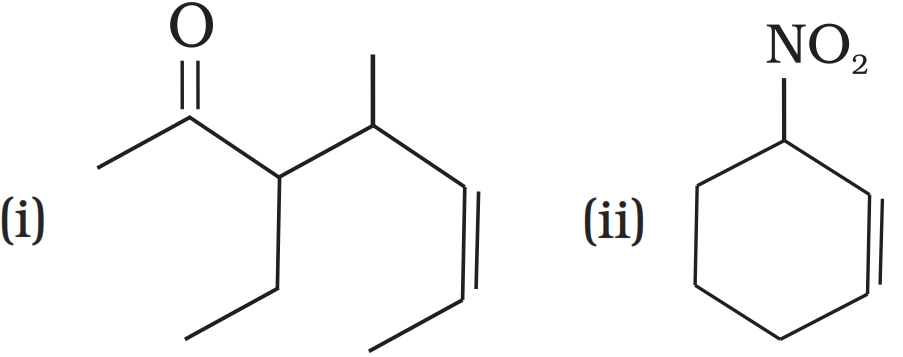
Name the compounds whose line formulae are given below:
Define hybridisation. Explain the structure of $\mathrm{C}_2 \mathrm{H}_2$ with orbital diagram.