Question
Why the tansition elements are hard and have high melting and boiling points?
Answer

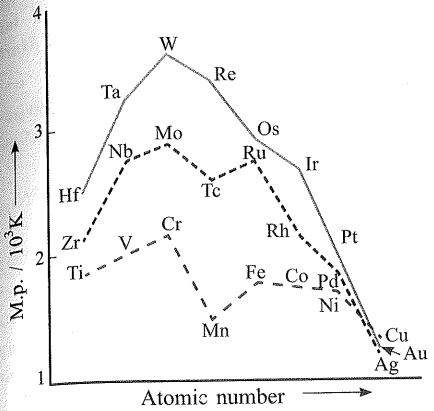
→ The high melting points of these metals are attributed to the involvement of greater number of electrons from (n-1)d in addition to the ns electrons in the interatomic metallic bonding.
→ In any row the melting points of these metals rise to a maximum at d5 except for anomalous values of Mn and Te and fall regularly as the atomic number increases.
Image
Trends in melting points of transition elements
→ Zn, Cd, and Hg are soft and volatile and they have low melting point because all these elements have no unpaired electrons.

Need a full question paper?

Generate a complete, print-ready paper with questions like this in minutes — across 16+ boards, with answer keys.

Start Generating Free

Similar questions

Give the structure of chromate and dichromate ions, and explain interconvertible property of these ions.
Explain the effect of catalyst on rate of reaction. And also give its characteristics.
Write the reactions of (i) aromatic and (ii) aliphatic primary amines with nitrous acid.
Note: In the following questions a statement of assertion followed by a statement of reason is given. Choose the correct answer out of the following choices.
  1. Both assertion and reason are true and the reason is the correct explanation of assertion.
  2. Both assertion and reason are true and the reason is not the correct explanation of assertion.
  3. Assertion is true but the reason is false.
  4. Both assertion and reason are false.
  5. Assertion is false but reason is true.
Assertion: Cu is less reactive than hydrogen.
Reason: $\text{E}^{\ominus}_{\text{Cu}^{2+}/\text{Cu}}$ is negative.
During nuclear explosion, one of the products is 90Sr with half-life of 28.1 years. If 1μg of 90Sr was absorbed in the bones of a newly born baby instead of calcium, how much of it will remain after 10 years and 60 years if it is not lost metabolically.
Explain Lanthanoid contraction.
(i) Write the equation for the reaction of $CH _3 I$ with $KNO _2$ and $AgNO _2$.
(ii) Write the Friedel-Crafts reaction to prepare toluene from benzene.
Give the structure of A, B and C in the following reaction:

$\text{CH}_3\text{CH}_2\text{I}\xrightarrow[]{\text{NaCN}}\text{A}\xrightarrow[\text{Partial hydolysis}]{\text{OH}^+}\text{B}\xrightarrow[]{\text{NaOH}+\text{Br}_2}\text{C}$
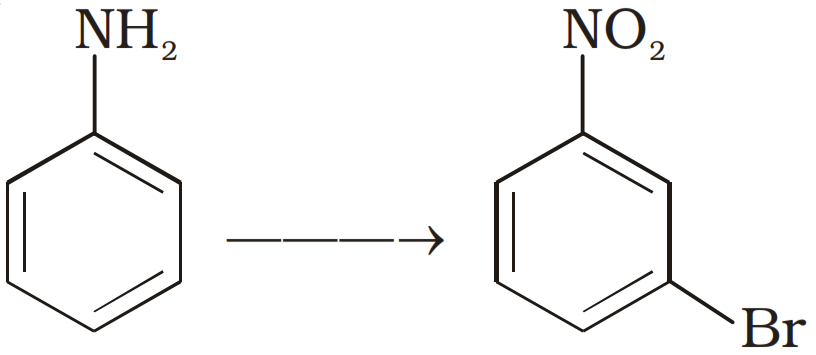
How will you carry out the following conversion?

What are interstitial compounds? Why are such compounds well known for transition metals?