Question
Will a charged body attract a nearby uncharged body?

Answer

Yes, a charged body, by induction, produces a charge of opposite nature on the nearby surface of the un- charged body and of the same nature on the distant surface, due to which a net attractive force starts appearing between them.

Need a full question paper?

Generate a complete, print-ready paper with questions like this in minutes — across 16+ boards, with answer keys.
Start Generating Free

Similar questions

What is meant by dielectric? Which is the dielectric among silicon, mica and carbon?
The vertical component of Earth’s magnetic field at a place is $ \sqrt{3}$ times the horizontal component. What is the value of angle of dip at this place?
Write the value of the electric field due to an electric dipole at a point situated on its axis.
Answer carefully:Two large conducting spheres carrying charges $Q_1$ and $Q_2$ are brought close to each other. Is the magnitude of electrostatic force between them exactly given by $\frac{\text{Q}_1\text{Q}_2}{{4}\pi\epsilon_{0}\text{r}^{2}}$, where r is the distance between their centres$?$
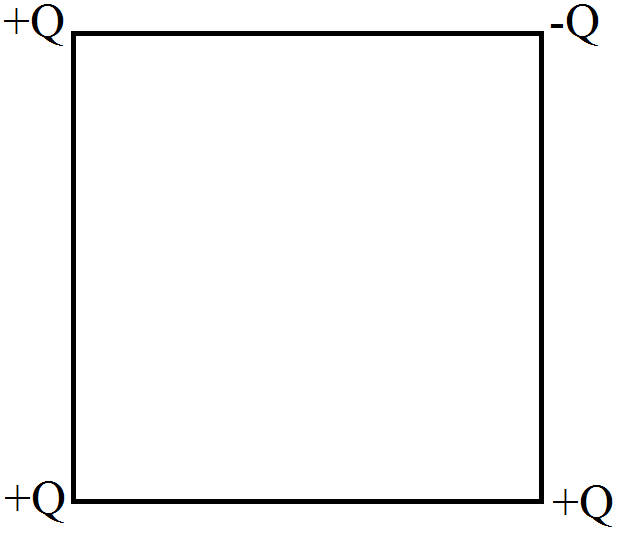
Show diagrammatically the arrangement of four point electric charges of equal magnitude placed at four corners of a square such that the electric field as well as the electric potential at the centre of the square is non-zero.
Write the formula to determine the value of electric field intensity due to a uniformly charged thin spherical shell.
A charged particle oscillates about its mean equilibrium position with a frequency of $10^9 Hz$. What is the frequency of the electromagnetic waves produced by the oscillator?
The density of a rod $AB$ continuously increases from $A$ to $B$. Is it easier to set it in rotation by clamping it at $A$ and applying a perpendicular force at $B$ or by clamping it at $B$ and applying the force at $A$?
The stopping potential in an experiment on photoelectric effect is 1.5 V. What is the maximum kinetic energy of the photoelectrons emitted?
Volt $-$ second is unit of which physical quantity?