Questions · Page 1 of 2

1 Marks Question

Take a timed test

50 questions · self-marked practice — reveal the answer and mark yourself.

Question 11 Mark
Write the formula to determine the value of electric field intensity due to a uniformly charged thin spherical shell.
Answer
(i) Electric field outside shell: $E =\frac{q}{4 \pi \epsilon_0 r^2}$
Here, $q=4 \pi R^2 \sigma$ is the total charge on spherical shell
Vector form $\vec{E}=\frac{q}{4 \pi \epsilon_0 r^2} \vec{r}$
(ii) Electric field inside the shell : Due to a uniformly charged thin spherical shell, the electric field at all points inside it is zero.

View full question & answer
Question 21 Mark
Write the value of the electric field due to an electric dipole at a point situated on its axis.
Answer
$E=\frac{1}{4 \pi \epsilon_0} \times \frac{2 p}{r^3}$
View full question & answer
Question 41 Mark
Can a metal sphere of radius 1 em be given a charge of IC?
Answer
No, electric field at the bottom of the sphere
$E =\frac{1}{4 \pi \epsilon_0} \times \frac{q}{ R ^2}$
$=9 \times 10^9 \times \frac{1}{(0.01)^2}$
$=9 \times 10^{13} V / m$
If the electric field intensity in air is $3 \times 10^6 V / m$, air will be ionized and the charge of the sphere will be destroyed in air Therefore the sphere will not be able to hold a charge of 1 C.
View full question & answer
Question 51 Mark
The flux inside a balloon of radius 7.0 cm is 2.0 - $10^3 NmC ^{-1}$. If the radius of the balloon is doubled, what will be the value of flux?
Answer
This value will remain unchanged because the charge enclosed by the Gaussian surface remains the same.
View full question & answer
Question 61 Mark
A Gaussian surface has change $-q+3 q$ and $-2 q$. Calcualte the resultant electric flux through the surface.
Answer
Total charge enclosed by the Gaussian surface
$ \begin{aligned} & =-q+3 q-2 q=0 \\
\phi & =\frac{q}{\epsilon_0}=0 \quad
\because q=0 \end{aligned} $
View full question & answer
Question 71 Mark
Can a metal sphere of radius one meter be given a charge of 1 coulomb?
Answer
No, because
$\begin{aligned}
E=  \frac{k q}{R^2}=\frac{9 \times 10^9 \times 1}{1^2} \\
E=9 \times 10^9 \frac{\text { Volt }}{\text { meter }}\end{aligned}$
will occur on the surface of the sphere.
If the electric field in the air exceods $3 \times 10^6$ Volt/ meter, the air will get ionized due to which the charge of the sphere will get destroyed in the air.
View full question & answer
Question 81 Mark
How does the electric field due to point charge and line charge change with distance?
Answer
Due to point charge
$E =\frac{1}{4 \pi \epsilon_0}\left(\frac{q}{r^2}\right)$
$E \propto \frac{1}{r^2}$
And due to linear charge $E =\frac{\lambda}{2 \pi \epsilon_0 r} \Rightarrow E \propto \frac{1}{r}$
View full question & answer
Question 91 Mark
Write the value of electric flux due to a point charge located outside the surface of a sphere.
Answer
From Gauss theorem $\phi=\frac{q}{\epsilon_0}$ $\because q=0$, therefore $\phi=0$
View full question & answer
Question 101 Mark
The value of electric flux through a closed surface is zero. What does this mean?
Answer
It means that the value of electric flux towards inside is equal to the electric flux towards outside.
View full question & answer
Question 111 Mark
When an electric dipole is placed in a non- uniform electric field, does it experience a force?
Answer
Yes, it experiences a force in a non-uniform electric field.
View full question & answer
Question 121 Mark
If we walk barefoot on a nylon mat for some time and touch the metal handle of a door, we get an electric shock. Why does this happen?
Answer
While walking, our feet rub on the mat, due to which our body gets charged. When we touch the handle, electric charge from our body flows into it, due to which we get a shock.
View full question & answer
Question 131 Mark
If an electric dipole is placed at an angle of $30^{\circ}$ to an electric field of intensity $2 \times 10^5 N / C$, a torque of 4 Nm is applied on it. If the length of the dipole is 2 cm , then what will be charge?
Answer
 $\tau= pE \sin \theta$
$4=p \times 2 \times 10^5 \sin 30^{\circ}$
$p=4 \times 10^{-5} C - m$
$q \times 2 \times 10^{-2}=4 \times 10^{-5}$
$q=2 \times 10^{-3} C$
$\because p=q \times 2 l$
View full question & answer
Question 141 Mark
Two point charges are placed at a distance d from each other. Due to these, the electric field intensity at any point is zero. But the point is not in the middle of these charges although on the line connecting them, write two necessary conditions for this to happen.
Answer
(i) Both the charges should be of opposite nature.(ii) The magnitude of the charge located near that point should be less and the magnitude of the other charge should be greater.
View full question & answer
Question 151 Mark
A sample of $\text{HCl}$ gas is placed in an electric field of $3 \times 10^4 N / C$. The dipole moment of each molecule of $\text{HCl}$ is $6 \times 10^{-30} C \times m$. What will be the maximum torque acting on the molecule?
Answer
Torque on dipole $\tau= P \times E$
$ \tau=P E\ \sin \theta $
For maximum value, $\theta=90^{\circ}$
$ \tau_{\max }=6 \times 10^{-30} \times 3 \times 10^4 \sin 90^{\circ}$
$\tau_{\max }=18 \times 10^{-26} Nm $
View full question & answer
Question 161 Mark
Write two differences between charge and mass.
Answer
(1) Charge can be zero, positive or negative but mass is always positive.
(ii) Electric charge does not depend on the velocity of motion of the particle whereas mass also depends on the velocity of motion of the particle.
View full question & answer
Question 171 Mark
Two protons and two electrons are hanging freely at equal distances. Compare the repulsion force between proton and electron.
Answer
The repulsion forces between two protons and two electrons will be equal because the magnitude of charge on the proton and electron is equal and the distances between them are also equal.
View full question & answer
Question 181 Mark
An electron and a proton are placed in a uniform electric field. Which will have greater acceleration and why?
Answer
Electron, because the mass of electron is less.
View full question & answer
Question 191 Mark
What will be the change in the force acting on a point charge placed on its axis if its distance is doubled?
Answer
Force $F =q E$
$=q \times \frac{1}{4 \pi \epsilon_0} \times \frac{2 p}{r^3}$
Hence, the force will remain $\frac{1}{8}$ th of the previous value.
View full question & answer
Question 201 Mark
There is a potential of 10V on the surface of a charged spherical shell of radius 10 cm. Write the value of potential at a distance of 5 cm from its centre.
Answer
The potential is the same at all points within the spherical surface and its value is the same as that on the surface of a spherical charge, that is, the value of the potential at a distance of 5 cm from its centre will be 10 Volt.
View full question & answer
Question 211 Mark
An electric dipole of charge $\pm 1 \mu C$ is located inside a spherical Gaussian surface of radius 1 cm . Write the value of electric flux emerging from the Gaussian surface.
Answer
Electric flux emerging out of Gaussian surface $\phi=\frac{q}{\epsilon_0} $Here, $\epsilon_0$ is the electrical conductivity of air or vacuumIn the given question the algebraic sum of charges is zero.
Therefore the value of electric flux emmiting from the Gaussian surface will be zero.
View full question & answer
Question 221 Mark
Write any two properties of electric field lines.
Answer
(i) The tangent drawn at any point to the line of electric force expresses the direction of the resultant electric field at that point.
(ii) Electric lines of force run from positive charge and end at netative charge.
Note: Students can also write other properties of electric field lines.
View full question & answer
Question 231 Mark
Write the formula to find the value of electric field due to a uniformly charged infinite plane sheet.
Answer
$\overrightarrow{ E }=\frac{\sigma}{2 \epsilon_0} \hat{n}$
Here $\hat{n}$ is the unit vector moving away from it perpendicular to the plane.
View full question & answer
Question 241 Mark
Can a solid conducting sphere of the same radius be charged more than a hollow sphere? Give the reason also.
Answer
No, because the entire charge of a charged conductor is always on the outer surface of the conductor.
View full question & answer
Question 261 Mark
What is the importance of Gaussian surface?
Answer
The principle of Gaussian surface helps in finding the intensity of electric field due to symmetric charge distribution.
View full question & answer
Question 271 Mark
What is a Gaussian surface?
Answer
It is a region around a charge in which the electric field intensity is equal at all points and the electric flux is always perpendicular to the surface.
View full question & answer
Question 281 Mark
What is Gauss' law?
Answer
The total value of electric flux passing through a closed surface in free space is $\frac{1}{\epsilon_0}$ times the charge enclosed by the surface.
Electric flux passing through a closed surface S
$ \phi=\frac{q}{\epsilon_0} $
Here $q$, is the total charge enclosed bv the surface S .
View full question & answer
Question 291 Mark
What is the magnitude of the torque and also give its direction.
Answer
Magnitude of torque $=q E \cdot 2 a \sin \theta$
$=2 q a E \sin \theta$
The direction of $\vec{p}$ normal to the plane of $\overrightarrow{ E }$ is given by the right hand screw rule. But $p=2 a q$
$\therefore \quad$ Magnitude of torque $=p E \sin \theta$
View full question & answer
Question 301 Mark
What is the relationship between the electric field intensities due to a small electric dipole on its axis and abscissa?
Answer
$E _{\text {axial }}=2 E _{\text {uniaxial }}$
View full question & answer
Question 321 Mark
What is the direction of the electric dipole moment vector quantity?
Answer
From negative to positive charge.
View full question & answer
Question 331 Mark
A dipole of dipole moment $\vec{P}$ is placed in a uniform electric field $\vec{E}$. Write the value of the angle between $\vec{P}$ and $\vec{E}$ for which the torque experienced by the dipole is minimum.
Answer
$\theta=0^{\circ} \  (\because  t=P E \sin \theta \text { for } \tau_{\min} \ \left. \sin \theta=0, \theta=0^{\circ}\right)$
View full question & answer
Question 341 Mark
In which configuration will an electric dipole be in (i) permanent and (ii) temporary equilibrium when placed under a uniform electric field?
Answer
(i) When the electric dipole moment $\overrightarrow{ P }$ and the electric field intensity $\vec{E}$ have the same direction.
(ii) When $\overrightarrow{ P }$ and $\overrightarrow{ E }$ are in opposite directions.
View full question & answer
Question 351 Mark
Define electric dipole. Write its unit.
Answer
A pair of very close point charges, equal in magnitude and opposite in nature, is called an electric dipole. Its unit is Coulomb meter.
View full question & answer
Question 361 Mark
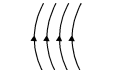
What is the nature of electric lines of force in a uniform electric field?
Answer
In a uniform electric field, the lines of force are straight lines, parallel and at equal distances. As shown in the Fig

Image
Also see question 30. i.e. the non-uniform electric field.
View full question & answer
Question 371 Mark
Define electric flux.
Answer
The electric flux $\overrightarrow{\Delta S}$ passing through an area element $\Delta \phi$ is detined as follows :
$ \Delta \phi=\vec{E} \cdot \overrightarrow{\Delta S}=E \Delta S \cos \theta $
Here, $\theta$ is the angle between the area element $\overrightarrow{\Delta S}$ and $\overrightarrow{ E }$
View full question & answer
Question 381 Mark
What type of electric field is shown by the lines in the figure?
Image
Answer
Both the magnitude and direction of the electric field are variable. i.e. the electric field is non-uniform.
View full question & answer
Question 391 Mark
Why can't two lines of electric force intersect each other?
Answer
Lines of force do not intersect each other, because if they intersect then two tangent lines at the intersection point will express two resultant fields, which is impossible.
View full question & answer
Question 411 Mark
Is the electric field intensity a scalar or a vector quantity?
Answer
Electric field intensity is a vector quantity
View full question & answer
Question 421 Mark
What is the force acting on a charge Q placed in an electric field E?
Answer
$\vec{F}=\overrightarrow{Q E}$
View full question & answer
Question 441 Mark
Two equal point charges are placed at a dis- tance of 1 meter from each other, experience a force of 8N. If these charges are kept in water at the same distance, then how much force will be felt between them?
Answer
We know$F_{m}=\frac{F_{a}}{m}=\frac{8 N}{80}=0.1 N$
View full question & answer
Question 451 Mark
Define the dielectric constant of a medium.
Answer
The ratio of absolute permittivity of a medium and permittivity of air or vacuum is called dielectric constant (relative permittivity) of the medium.
Therefore, $\epsilon_{ r }=\frac{\epsilon}{\epsilon_0}$ or $\epsilon=\epsilon_{ o } \epsilon_{ T }$
View full question & answer
Question 461 Mark
What does it mean for an object to be positively and negatively charged?
Answer
Compared to the normal state, the lack of electrons in an object shows that it is positively charged and the excess of electrons shows that it is negatively charged.
View full question & answer
Question 471 Mark
How will the force between two point charges change, if the dielectric constant of the medium in which they are kept increases?
Answer
If the dielectric constant of any one medium increases. So the force between the point charges will decrease.
View full question & answer
Question 481 Mark
One Coulomb charge is equal to how many electrons?
Answer
$n=\frac{q}{e}=\frac{1}{1.6 \times 10^{-19}}=6.25 \times 10^{18}$
View full question & answer
Question 491 Mark
Will a charged body attract a nearby uncharged body?
Answer
Yes, a charged body, by induction, produces a charge of opposite nature on the nearby surface of the un- charged body and of the same nature on the distant surface, due to which a net attractive force starts appearing between them.
View full question & answer
Question 501 Mark
Define the S.1. unit of electric charge (coulomb).
Answer
One Coulomb charge is a charge which, if kept at a distance of 1 meter from itself in air or vacuum, repels its similar charge with a force of $9 \times 10^9$ Newton.
View full question & answer
1 Marks Question - Physics STD 12 Science Questions - Vidyadip