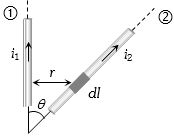
Wires $1$ and $2$ carrying currents ${i_1}$ and ${i_2}$respectively are inclined at an angle $\theta $ to each other. What is the force on a small element $dl$ of wire $2$ at a distance of $r$ from wire $1$ (as shown in figure) due to the magnetic field of wire $1$
AIEEE 2002,AIIMS 2013, Medium
Download our app for free and get started
(c) Length of the component dl which is parallel to wire $(1)$ is $dl\cos \theta $, so force on it.
$F = \frac{{{\mu _0}}}{{4\pi }}.\frac{{2{i_1}{i_2}}}{r}(dl\cos \theta ) = \frac{{{\mu _0}{i_1}{i_2}dl\cos \theta }}{{2\pi r}}$
$F = \frac{{{\mu _0}}}{{4\pi }}.\frac{{2{i_1}{i_2}}}{r}(dl\cos \theta ) = \frac{{{\mu _0}{i_1}{i_2}dl\cos \theta }}{{2\pi r}}$

Download our appand get started for free
Experience the future of education. Simply download our apps or reach out to us for more information. Let's shape the future of learning together!No signup needed.*
Similar Questions
- 1The magnetic moment of a circular orbit of radius $‘r’$ carrying a charge $‘q’$ and rotating with velocity $v$ is given byView Solution
- 2A charge $Q$ is moving $\overrightarrow{dl}$ distance in the magnetic field $\overrightarrow{ B }$. Find the value of work done by $\overrightarrow{ B }$.View Solution
- 3A tightly wound $100$ turns coil of radius $10 \mathrm{~cm}$ carries a current of $7 \mathrm{~A}$. The magnitude of the magnetic field at the centre of the coil is (Take permeability of free space as $4 \pi \times 10^{-7} \mathrm{SI}$ units):View Solution
- 4View SolutionIn a moving coil galvanometer, to make the field radial
- 5View SolutionThe sensitiveness of a moving coil galvanometer can be increased by decreasing
- 6View SolutionMagnetic effect of current was discovered by
- 7Consider the two idealised systems $(i)$ a parallel plate capacitor with large plates and small separation and $(ii)$ a long solenoid of length $L >> R$, radius of cross-section. In $(i)\, E$ ideally treated as a constant between plates and zero outside. In $(ii)$ magnetic field is constant inside the solenoid and zero outside. These idealised assumptions, however, contradict fundamental laws as belowView Solution
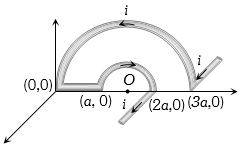
- 8In the given figure net magnetic field at $O$ will beView Solution
- 9Two similar coils of radius $R$ are lying concentrically with their planes at right angles to each other. The currents flowing in them are $I$ and $2I$, respectively. The resultant magnetic field induction at the centre will beView Solution
- 10The figure shows the cross section of a long cylindrical conductor through which an axial hole of radius $r$ is drilled with its centre at point $A$ . $O$ is the centre of the conductor. If an identical hole were to be drilled centred at point $B$ while maintaining the same current density the magnitude of magnetic field at $O$View Solution