MCQ
With increase in temperature the conductivity of:
- AMetals increases and of semiconductor decreases.
- BSemeconductors increases and metals decreases.
- CIn both metals and semiconductors increases.
- DIn both metal and semiconductor decreases.
Generate a complete, print-ready paper with questions like this in minutes — across 16+ boards, with answer keys.
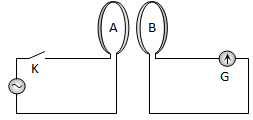
The diagram below shows two coils A and B placed parallel to each other at a very small distance. Coil A is connected to an ac supply. G is a very sensitive galvanometer. When the key is closed
|
(a) Constant deflection will be observed in the galvanometer for 50 Hz supply |
|
(b) Visible small variations will be observed in the galvanometer for 50 Hz input |
|
(c) Oscillations in the galvanometer may be observed when the input ac voltage has a frequency of 1 to 2 Hz |
|
(d) No variation will be observed in the galvanometer even when the input ac voltage is 1 or 2 Hz |
By ammeter, which of the following can be measured
|
(a) Electric potential |
(b) Potential difference |
(c) Current |
(d) Resistance |
Field inside a solenoid is
|
(a) Directly proportional to its length |
|
(b) Directly proportional to current |
|
(c) Inversely proportional to total number of turns |
|
(d) Inversely proportional to current |
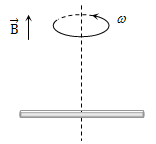
A conducting rod of length 2l is rotating with constant angular speed w about its perpendicular bisector. A uniform magnetic field  exists parallel to the axis of rotation. The e.m.f. induced between two ends of the rod is
|
(a) Bω |
(b) |
(c) |
(d) Zero |


