Question
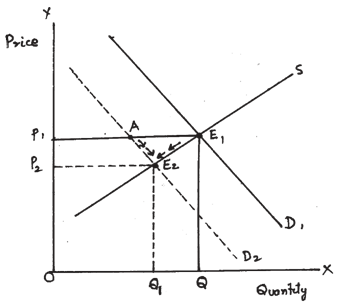
With the help of a diagram explain the effect of “decrease” in demand of a commodity on its equilibrium price and quantity.
Answer

Decrease in demand means less demand at the same price. This leads to shift of demand curve to the left from $D_1$ to $D_2$.
  • Given equilibrium at $E1$ shift of demand curve leads to excess supply $= AE_1$ at price $OP_1$.
  • This creates a situation where producers are not able to sell all they want to sell at price $OP_1$. They start offering lower price. As a result price starts falling.
  • As price falls, supply begins to fall along the supply curve S and demand begins to rise along the demand curve $D_2$​​​​​​​.
This continues till the new equilibrium at $E_2​​​​​​​$.
  • At new equilibrium, price falls to $OP_2$ and quantity falls to $OQ_1​​​​​​​$​​​​​​​.

Need a full question paper?

Generate a complete, print-ready paper with questions like this in minutes — across 16+ boards, with answer keys.

Start Generating Free

Similar questions

The price elasticity of demand of good X is half the price elasticity of demand of Good Y. A 25% rise in the price of good Y reduces its demand from 400 units to 300 units. Calculate percentage rise in demand of good X when its price falls from ₹ 10 to ₹ 8 per unit.
From the following information about a firm, find the firms equilibrium output in terms of marginal cost and marginal revenue. Give reasons. Also find profit at this output.
Output
(Units)
Total Revenue
(₹)
Total Cost
(₹)
1 7 8
2 14 15
3 21 21
4 28 28
5 35 36
Explain with the help of diagram the effect of the following changes on the demand of a commodity.
  1. A rise in the price of a complementary good.
  2. A rise in the price of substitute good.
Market for a good is in equilibrium. Explain the chain of reactions in the market if the price is (i) higher than equilibrium price and (ii) lower than equilibrium price.
Explain the effect of the following on demand for a good:
  1. Fall in Income for Normal.
  2. Fall in Income for Inferior.
What is the relationship between marginal product and marginal cost?
Explain how price is determined in a perfectly competitive market with fixed number of firms.
A consumer consumes only two goods. Explain his equilibrium with the help of utility approach.
Explain why is an indifference curve (a) downward sloping and (b) convex.
A consumer consumes only two goods X and Y whose prices are ₹ 4 and ₹ 5 per unit respectively. If the consumer chooses a combination of the two goods with marginal utility of X equal to 5 and that of Y equal to 4, is the consumer in equilibrium? Give reasons. What will a rational consumer do in this situation? Use utility analysis.