Question
  1. With the help of a simple case of an object moving with constant velocity show that the area under velocity$-$time curve represents the displacement over a given time interval.
  2. Establish the relation
$\text{c}=\text{v}_0\text{t}+\frac{1}{2}\text{at}^2$ graphically.
  1. A car moving with a speed of $126\ km/ h$ is brought to a stop within a distance of $200m$. Calculate the retardation of the car and the time required to stop it.
Answer

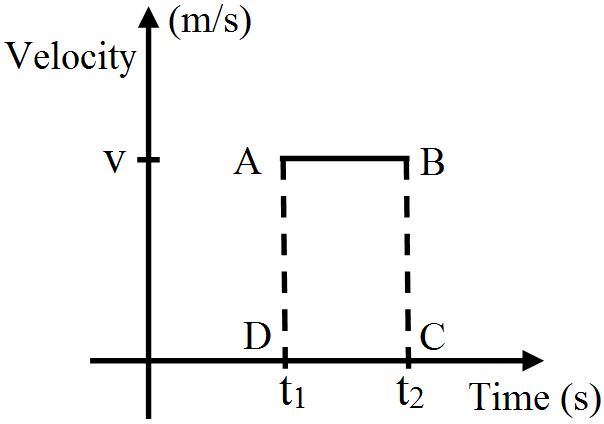
  1. Let a body with constant velocity $v$, between time $t_1$ and $t_2$ as shown in graph.
Area below $=$ area $\text{ABCD} = v(t_2 - t_1)$
Also, the displacement $=$ velocity $\times $ time = $y(t_2 - t_1)$.
Thus proved.
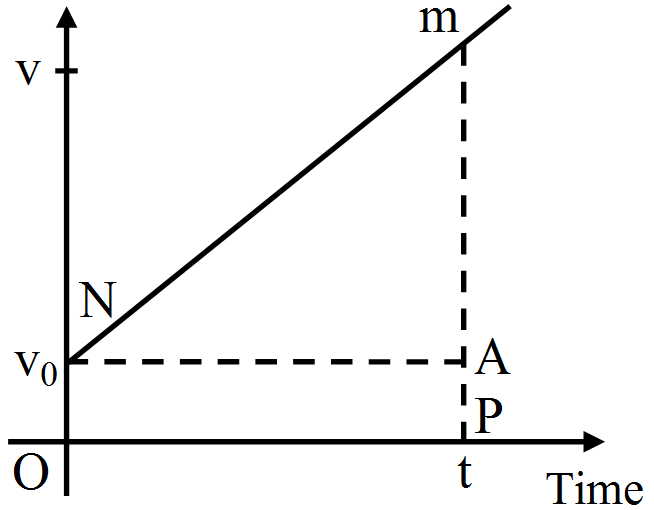
  1. Slope of $v - t$ graph is constant. So there is uniform acceleration. Area below the graph gives the displacement $(x).$

Displacement $=$ Area of trapezium
$=\text{ON}\times\text{OP}+\frac{1}{2}\text{NA}\times\text{MA}$
$=\text{v}_0\times\text{t}+\frac{1}{2}(\text{t})(\text{v}-\text{v}_0)$
Since $\text{a}=\frac{\text{v}-\text{v}_0}{\text{t}}$
We have, $\text{x}=\text{v}_0\text{t}+\frac{1}{2}\text{t at}=\text{v}_0\text{t}+\frac{1}{2}\text{at}^2$
  1. $u 126\ km/hr = 35m/ sec, v = 0, s = 200m.$
using, $\text{v}^2=\text{u}^2+2\text{as},$
$\text{a}=\frac{\text{v}^2-\text{u}^2}{2\text{s}}=\frac{35^2}{2\times200}$
$=-3.00\ \text{ms}^{-2}$
$\text{v}=\text{u}+\text{at}$
$0=35-3\times\text{t}$
$\text{t}=\frac{35}{3}=11.66\text{ sec.}$

Need a full question paper?

Generate a complete, print-ready paper with questions like this in minutes — across 16+ boards, with answer keys.

Start Generating Free

Similar questions

Mercury has an angle of contact equal to $140^{\circ}$ with soda lime glass. A narrow tube of radius $1.00$ mm made of this glass is dipped in a trough containing mercury. By what amount does the mercury dip down in the tube relative to the liquid surface outside? Surface tension of mercury at the temperature of the experiment is $0.465 \mathrm{~N} \mathrm{~m}^{-1}$. Density of mercury $=13.6 \times 10^3 \mathrm{~kg} \mathrm{~m}^{-3}$.
What is change of state? What are the two special things for this and what are the main activities of change of state?
Two particles each of mass m and speed v travel in opposite direction along parallel lines, separated by a distance d. Show that vector angular momentum of the two particles system is same whatever be the point about which angular momentum is taken.
What is the gravitational potential and gravitational potential energy of a body of $0.2kg$ at a height $1600km$ above the surface of the earth? ($G= 6.67 \times 10^{-11}Nm^2kg^{-2}$, mass of the earth = $6 \times 10^{24}kg$ and radius of the earth = $6400km$).
A progressive wave is given by $\text{y}(\text{x, t})=8\cos(300\text{t}-0.15\text{x})$ where x in m, y in cm and t in second. What is the-
  1. Direction of propagation?
  2. Wavelength?
  3. Frequency?
  4. Wave speed?
  5. Phase difference between two points 0.2m apart?
What is meant by resolution of a vector? Prove that a vector can be resolved along two given directions in one and only one way.
For the harmonic travelling wave $\text{y}=2\cos2\pi(10\text{t}-0.0080\text{x}+3.5)$ where x and y are in cm and t is second. What is the phase difference between the oscillatory motion at two points separated by a distance of:
What is the phase difference between the oscillation of a particle located at x = 100cm at t = T and t = 5s?
Though the law gives women equal status in India, many people hold unscientific views on a woman’s innate nature, capacity and intelligence, and in practice give them a secondary status and role. Demolish this view using scientific arguments, and by quoting examples of great women in science and other spheres; and persuade yourself and others that, given equal opportunity, women are on par with men.
Suppose a hole was drilled completely through the earth along a diameter. Show that the force on a mass m at a distance r from the centre of the earth is $ \text{F}= \frac{-\text{mgr}}{\text{R}}$ assuming that the density of the earth is uniform.
What are waves and wave speed? For wave propagation. What are the essential properties? How many types of waves are there? Explain by giving examples.