Question
With the help of an example, explain how the neutron to proton ratio changes during $\alpha-$decay of a nucleus.

Answer

Let us like the example of $\alpha-$decay of $^{238}_{92}\text{U}.$ The decay scheme is
$^{238}_{92}\text{U}\rightarrow ^{234}_{90}\text{Th}+^4_2\alpha \text{ (or}^4_2\text{He})$
Neutron to proton ratio before $\alpha-$decay $=\frac{238-92}{92}=\frac{146}{92}=1.59$
Neutron to proton ratio after $\alpha-$decay $=\frac{238-90}{90}=\frac{144}{90}=1.60$
$\frac{146}{92}<\frac{144}{90}$
This shows that the neutron to proton ratio increases during $\alpha-$decay of a nucleus.

Need a full question paper?

Generate a complete, print-ready paper with questions like this in minutes — across 16+ boards, with answer keys.
Start Generating Free

Similar questions

The ends of a metre stick a.re maintained at $100^\circ C$ and $0^\circ C.$ One end of a rod is maintained at $25^\circ C.$ Where should its other end be touched on the metre stick so that there is no heat current in the rod in steady state?
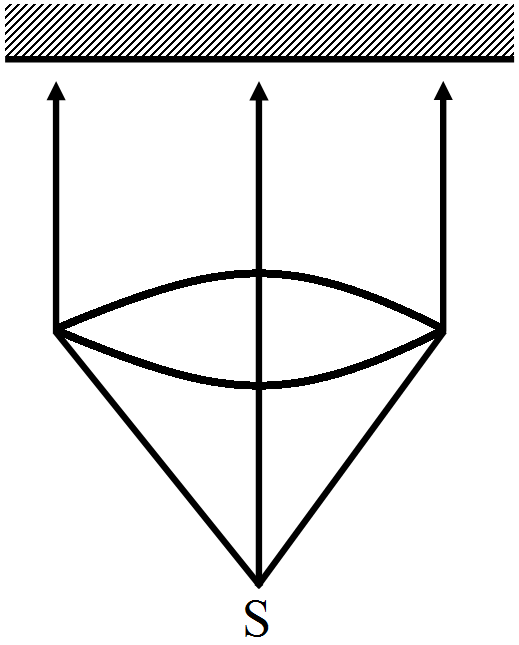
A totally reflecting, small plane mirror placed horizontally faces a parallel beam of light, as shown in the figure. The mass of the mirror is $20g$. Assume that there is no absorption in the lens and that $30\%$ of the light emitted by the source goes through the lens. Find the power of the source needed to support the weight of the mirror. Take $g = 10m/s^2.$​​​​​​​
In Joly's differential steam calorimeter, $3g$ of an ideal gas is contained in a rigid closed sphere at $20^\circ C.$ The sphere is heated by steam at $100^\circ C$ and it is found that an extra $0.095g$ of steam has condensed into water as the temperature of the gas becomes constant. Calculate the specific heat capacity of the gas in $Jg^{-1} K^{-1}.$ The latent heat of vaporisation of water $= 540\ cal-g^{-1}.$
Explain threshold frequency and stopping potential.###Define the following with respect to photoelectric effect :
(i) Work function (ii) Stopping potential
The magnifying power of a converging lens used as a simple microscope is $\Big(1+\frac{\text{D}}{\text{f}}\Big).$ A compound microscope is a combination of two such converging lenses. Why don't we have magnifying power $\Big(1+\frac{\text{D}}{\text{f}_\text{o}}\Big) \Big(1+\frac{\text{D}}{\text{f}_\text{o}}\Big)?$ In other words, why can the objective not be treated as a simple microscope but the eyepiece can?
A hydrogen atom in state n = 6 makes two successive transitions and reaches the ground state. In the first transition a photon of 1.13eV is emitted. (a) Find the energy of the photon emitted in the second transition (b) What is the value of n in the intermediate state?

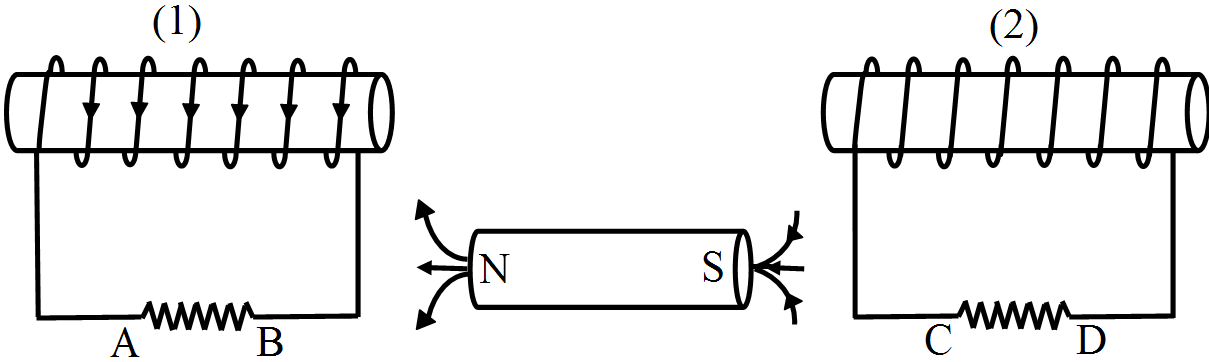
In the figure given below, a bar magnet moving towards the right or left induces an emf in the coils (1) and (2). Find, giving reason, the directions of the induced currents through the resistors AB and CD when the magnet is moving (a) towards the right, and (b) towards the left.
  1. A giant refracting telescope at an observatory has an objective lens of focal length $15 m$. If an eyepiece of focal length $1.0 \ cm$ is used, what is the angular magnification of the telescope?
  2. If this telescope is used to view the moon, what is the diameter of the image of the moon formed by the objective lens? The diameter of the moon is $3.48 \times 10^{6 }m,$ and the radius of lunar orbit is $3.8 \times 10^{8 }m$.
Consider a thin target $\left(10^{-2} m\right.$ square, $10^{-3} m$ thickness $)$ of sodium, which produces a photocurrent of $100 \mu A$ when a light of intensity $100 W / m ^2(\lambda=660 nm)$ falls on it. Find the probability that a photoelectron is produced when a photon strikes a sodium atom. $[$Take density of $Na =0.97 \ kg / m ^3 ].$
Derive the equation of the missing term in the Ampere circuital law $OR$ Derive the equation of displacement current and write its unit and definition.