Question
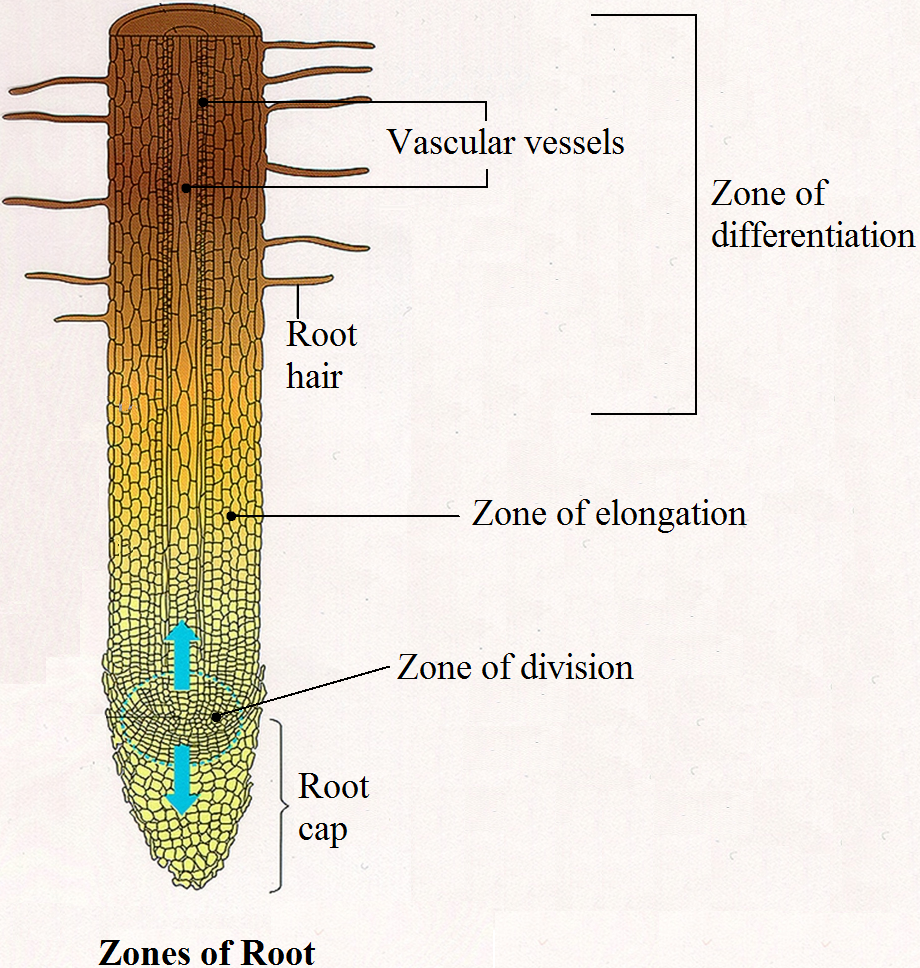
With the help of proper diagram describe various regions of root.

Answer

Regions of the Root:
  1. Root Cap: The root is covered at the apex by a thimble-like structure called the root cap. It protects the tender apex of the root as it makes its way through the soil.
  2. Region of Elongation: A few millimetres above the root cap is the region of meristematic activity. The cells of this region are very small, thin-walled and with dense protoplasm. They divide repeatedly. The cells proximal to this region undergo rapid elongation and enlargement and are responsible for the growth of the root in length. This region is called the region of elongation.
  1. Region of Maturation: The cells of the elongation zone gradually differentiate and mature. Hence, this zone, proximal to region of elongation, is called the region of maturation. From this region some of the epidermal cells form very fine and delicate, thread-like structures called root hairs. These root hairs absorb water and minerals from the soil.

Need a full question paper?

Generate a complete, print-ready paper with questions like this in minutes — across 16+ boards, with answer keys.
Start Generating Free

Similar questions

Give the location of hepatic caecae in a cockroach. What is their function?
Explain the difference between ultrafiltration and selective reabsorption.
What are Casparian strips? Write any two differences in the epidermis of monocotyledon and dicotyledon leaves.
Sunday morning Abhishek and his friends emptied all the overhead tanks belonging to flat owners who were not residing in their apartments for the last few months. On their return, the owners complained about their empty tanks. Some elderly people even spoke against Abhishek and his friends. Abhishek humbly apologised for the inconvenience caused. He explained that water in the tanks had become stagnant and become a breeding ground for mosquitoes which will give rise to malaria. The people appreciated the boys.
  1. What values are reflected by Abhishek in the above case?
  2. What is the causal agent of malaria and how does it reach human body?
  3. How many phases the causal organism undergoes in its life cycle?
  4. As an individual what can you do to avoid malaria in your neighbourhood?
What is bark? What are its different types?
Explain the three types of cell junctions.
In animals there are special glands secreting hormones, whereas there are no glands in plants. Where are plant hormones formed? How are the hormones translocated to the site of activity?
Compare the following: Central neural system (CNS) and Peripheral neural system (PNS)
What are nucleotides? Describe their structure.
Explain different layers of arteries.