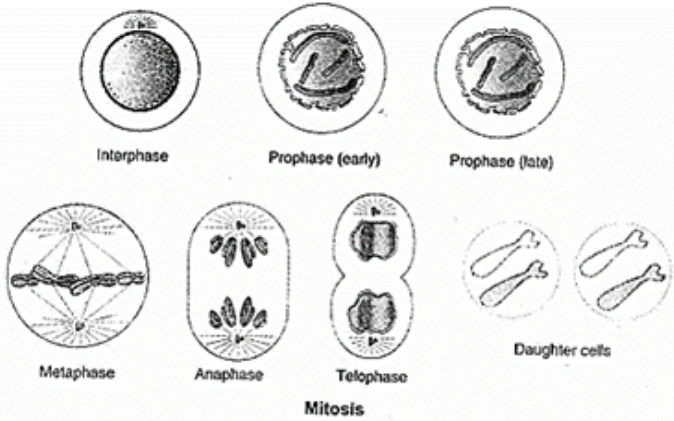
Mitosis is divided into the following four stages:
i.
Prophase• Condensation of chromosomal material starts. The chromosomal material becomes untangled during the process of chromatin condensation.
• The centriole, which had undergone duplication during S phase of interphase now begins to move towards opposite poles of the cell.
• At the end of prophase, Golgi complexes, endoplasmic reticulum, nucleolus and the nuclear envelope disappear.
ii.
MetaphaseMitosis
• The metaphase is characterized by all the chromosomes coming to lie at the equator.
• One chromatid of each chromosome connected by its kinetochore to spindle fibres from one pole and its sister chromatid connected by its kinetochore to spindle fibres from the opposite pole.
• The plane of alignment of the chromosomes at metaphase is referred to as the metaphase plate.
iii.
Anaphase• At the onset of anaphase, each chromosome arranged at the metaphase plate is split simultaneously and make the two daughter chromatids.
• They are now referred to as chromosomes of the future daughter nuclei and begin their migration towards the two opposite poles.
• As each chromosome moves away from the equatorial plate, the centromere of each chromosome is towards the pole and hence at the leading edge, with the arms of the chromosome trailing behind.
iv.
TelophaseThis is the stage which shows the following key events:
• Chromosomes cluster at opposite spindle poles and their identity is lost as discrete elements.
• Nuclear envelope assembles around the chromosome clusters.
• Nucleolus, Golgi complex and ER reform.
v.
CytokinesisKaryokinesis is followed by cell division to form two daughter cells. This process is called cytokinesis at the end of which cell division is complete.