Questions

5 Marks Questions

Take a timed test

6 questions · self-marked practice — reveal the answer and mark yourself.

Question 15 Marks
Singer and Nicolson proposed the model for membrane. Describe the composition of the membrane.
Answer
Nicholson and Singer in 1972 proposed this model. The name of this model was fluid mosaic model.
According to this model, each phospholipid layer is bimolecular and their hydrophilic ends are pointed towards top and bottom respectively. In this, protein are of two categories:
i. Peripheral (extrinsic) and
ii. integral (intrinsic)
The integral proteins are tightly held in place by strong hydrophilic or hydrophobic interactions or both and are difficult to remove from the membranes. The peripheral proteins are superficially arranged on either side and can be easily separated. These proteins have enzymatic properties and also make membranes selectively permeable. These proteins are referred to as permeases. This is a widely accepted model.
View full question & answer
Question 25 Marks
The cells of a unicellular organism are usually spherical whereas those of multicellular tend to be many-sided. Why?
Answer
It is true that the cells of unicellular organisms tend to be spherical. It is because of the following reasons:
i. Surface tension: Surface tension shapes the spherical way as in the case in air-borne soap bubbles.
ii. The free-floating cells with thin membranes tend to be spherical as it is the most economical shape that can confine a given mass of protoplasm. The shape and the size of the cell depend upon the place where they are present and the functions they have to perform. In multicellular animals, the cells tend to become faceted as they come in contact with each other in the same way as the spherical soap bubbles become flattened when they are jammed together in a small space.
View full question & answer
Question 35 Marks
Enumerate the assumptions that we have undertaken in making the respiratory balance sheet. Are these assumptions valid for a living system?
Answer
Respiratory Balance Sheet: Some assumptions in preparing respiratory balance sheet are:
i. None of the intermediates produced in this pathway is used to make any other compound.
ii.Only glucose is being respired no other alternative substrates enter in the pathway at any of intermediary stages in any case.
iii.There seems to be a sequential, orderly pathway that is functioning, with a single substrate forming next as well as with glycolysis. Kreb's cycle and ETS pathway following one after the other pathway.
iv. NADH synthesised in glycolysis transferred to mitochondria; it undergoes oxidative phosphorylation also.
This assumption is not really valid in a living system since all the pathways work simultaneously; moreover, the substrates enter pathways and also are withdrawn from the pathways as and when required; ATP used when needed and enzymes control the reactions also. It is only useful in the extraction and storing energy; there is a net gain of 36 ATP mols in aerobic respiration for
one mol of glucose.
View full question & answer
Question 45 Marks
Explain the formation of NADH and ATP during glucolysis in aerobic respiration.
Answer
NADH = Nicotinamide Adenine Dinucleotide Hydrogen: It is formed by the reduction of NAD. NAD plays an important role during glycolysis, where 3-phosphoglyceraldehyde is converted into 1, 3-diphosphoglycerate in the presence of inorganic phosphate and the enzyme glyceraldehyde phosphate dehydrogenase.
ATP = Adenosine 4riphosphate: It is a high energy compound present in the living cells. During the formation of ATP, energy is stored and during hydrolysis, energy is released. 2 molecules of ATP are formed from ADP when 1, 3-diphosphoglycerate is converted into 3- phosphoglycerate. Two molecules of ATP are formed from ADP when phosphoenolpyruvate is converted into pyruvic acid at the end of glycolysis. In this way, four molecules of ATP are formed and two molecules are used during the conversion of glucose into glucose-6-phosphate and later fructose-1,6-phosphate. So there is a net gain of two ATP molecules during glycolysis.
View full question & answer
Question 55 Marks
Briefly describe the significance of cell division.
Answer
Cell division is significant in the following ways
i. Cell multiplication: Cell division is a means of cell multiplication or the formation of new cells from pre-existing cells.
ii. Continuity: It maintains continuity of living matter generation after generation.
iii. Multicellular organisms: The body of a multicellular organism is formed of innumerable cells. They are formed by repeated divisions of a single cell or zygote. As the number of cells increases, many of them begin to differentiate, form tissues and organisms.
iv. Cell size: Cell division helps in the maintenance of a particular cell size which is essential for efficiency and control of cell activities.
v. Genetic similarity: The common type of cell division or mitosis maintains the genetic similarity of all the cells in an individual despite being different, i.e., structurally and functionally.
View full question & answer
Question 65 Marks
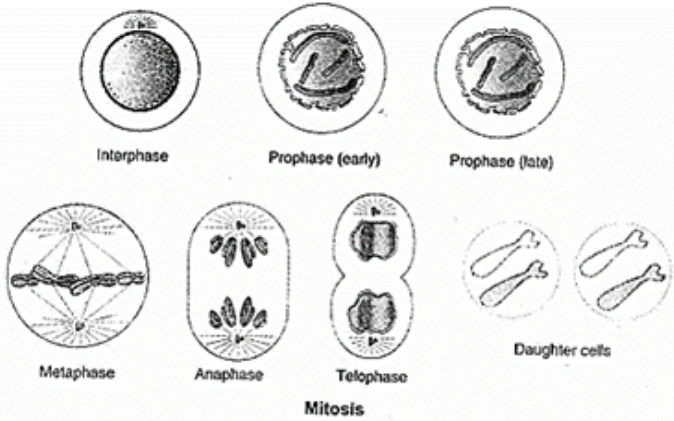
With the help of suitable diagrams describe mitosis.
Answer
Mitosis is divided into the following four stages:
i. Prophase
• Condensation of chromosomal material starts. The chromosomal material becomes untangled during the process of chromatin condensation.
• The centriole, which had undergone duplication during S phase of interphase now begins to move towards opposite poles of the cell.
• At the end of prophase, Golgi complexes, endoplasmic reticulum, nucleolus and the nuclear envelope disappear.

Image
ii. Metaphase
Mitosis
• The metaphase is characterized by all the chromosomes coming to lie at the equator.
• One chromatid of each chromosome connected by its kinetochore to spindle fibres from one pole and its sister chromatid connected by its kinetochore to spindle fibres from the opposite pole.
• The plane of alignment of the chromosomes at metaphase is referred to as the metaphase plate.
iii. Anaphase
• At the onset of anaphase, each chromosome arranged at the metaphase plate is split simultaneously and make the two daughter chromatids.
• They are now referred to as chromosomes of the future daughter nuclei and begin their migration towards the two opposite poles.
• As each chromosome moves away from the equatorial plate, the centromere of each chromosome is towards the pole and hence at the leading edge, with the arms of the chromosome trailing behind.
iv. Telophase
This is the stage which shows the following key events:
• Chromosomes cluster at opposite spindle poles and their identity is lost as discrete elements.
• Nuclear envelope assembles around the chromosome clusters.
• Nucleolus, Golgi complex and ER reform.
v. Cytokinesis
Karyokinesis is followed by cell division to form two daughter cells. This process is called cytokinesis at the end of which cell division is complete.
View full question & answer