Question
With well labelled diagrams explain meiosis.

Answer

Different stages involved in meiosis:
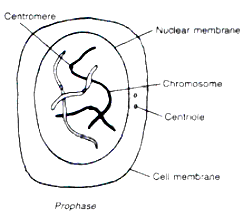
(a) The diploid number of chromosomes appear
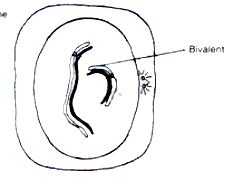
(b) Homologous chromosomes pair with each other , shorten and thicken
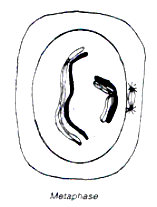
(c) Replication has occurred and the chromatics visible at equatorial plane
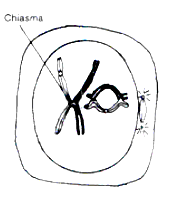
(d) Homologous chromosomes move apart except at the chissmata where the chromatids have exchanged portions
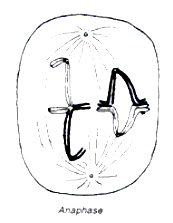
(e) A spindle forms and homologous chromosomes move to opposite ends taking the exchanged portions with them.
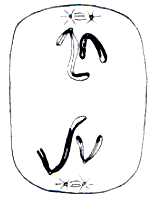
(f) Homologous chromosomes seperated but not enclosed in nuclear membranes
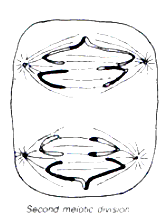
(g) Spindles form at right angles to the first one and the chromatids separate
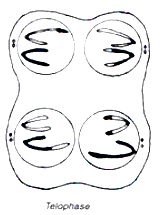
(h) Four nuclei appear , each enclosing the hapoid number of chromosomes
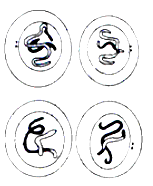
(i) Cytoplasm divides to form four gametes.
Need a full question paper?

Generate a complete, print-ready paper with questions like this in minutes — across 16+ boards, with answer keys.

Start Generating Free

Similar questions

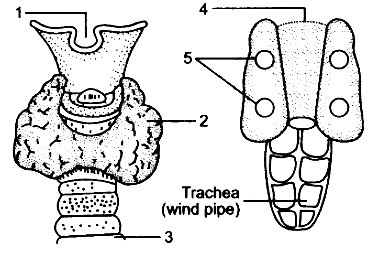
Given alongside are the diagrammatic sketches of some endocrine glands. Observe the figures and answer the following questions:
(i) Label the parts numbered 1 to 5.
(ii) Name the hormones secreted by (2) and (5).
(iii) Which chemicals in our body are greatly affected by hormones?
(iv) What is the chemical nature of hormones?
(v) Name the elements related to the functioning of hormones secreted by the structure (2) and (5).
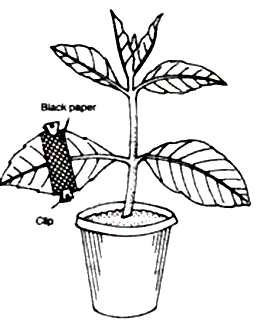
The diagram alongside represents an experiment conducted to prove the importance of a factor in photosynthesis.

Study the same and then answer the questions that follow:
(i) Name the factor being studied in his experiment.
(ii) Why was the plant kept in a dark room before conducting the experiment?
(iii}Why was the experimental leaf then kept in
1. boiling water 2. methylated spirit?
(iv) Name the solution used to test for the presence of starch in the leaf.
(v) What will we observe in the experimental leaf at the end of the starch test?
(vi) Give a balanced chemical equation to represent the process of photosynthesis.
What is the importance of photosynthesis in the life of the following:

Animals

Explain the terms ultrafiltration and selective absorption
Differentiate Between Genotype and Phenotype.
Complete the following by filling in the blanks numbered 1 to 10 with the appropriate word/term:
Photosynthesis involves light reaction and dark reaction. During light reaction, the chlorophyll present in the (1) ______ gets activated by absorbing light energy. This energy splits (2) ______ molecules to (3) ______ and oxygen and releases two electrons. This process is called (4) ______. The (5) ______ ions are picked up by NADP to form (6) ______. The ADP is converted to (7) ______. This process is called (8) ______. During the dark phase, the compound produced at the end of the light reaction reacts with carbon dioxide to form (9) ______. This product is converted to starch. The process is called (10) ______.
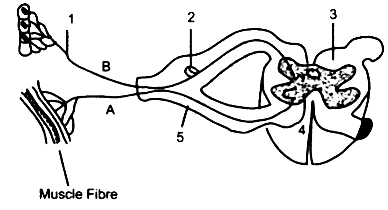
The diagram given below shows the internal structure of the spinal cord, depicting a simple reflex. Study the same and then answer the questions that follow:

(i) Name the parts numbered 1 to 5.
(ii) Using the letters of the alphabet shown in the figure indicate the direction in which an impulse enters and leaves the spinal cord.
(iii) What is the term given to the point of contact between two nerve cells?
(iv) What is meant by ‘simple reflex’ ? Give two examples of simple reflexes and name the stimuli too.
(v) How does the arrangement of nerve cells in the spinal cord differ from that in the brain?
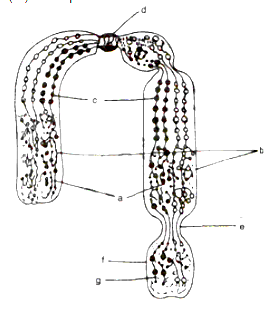
Label the lettered parts of the given figure and answer the following questions:
(i) What does this diagram represent?
(ii) What is the importance of'd'?
(iii) What are the 'staining' properties of 'b' and 'c'?
(iv) Who gave the term used for this structure today?
(v) What is a?
(vi) Is 'e' present in all chromosomes?
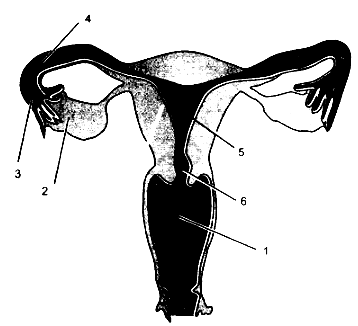
Given below is a diagram of the female reproductive system of a human being

(i) Name the parts numbered 1 to 6.
(ii) Normally after how many days does an ovary release an egg?
(iii) Where are the sperms released during coitus?
(iv) What do the sperms do after being released?
(v) What is the function of the organ numbered 5?
(vi) How many days does it normally take from the fertilization of the egg up to the birth of the baby?
Describe the mechanism of focusing the image of a distant object in your eye when you raise your head after reading a book.