MCQ
With what minimum velocity should block be projected from left end $A$ towards end $B$ such that it reaches the other end $B$ of conveyer belt moving with constant velocity $v$. Friction coefficient between block and belt is $\mu$ .
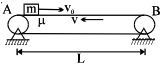
  • A
    $\sqrt {\mu gL} $
  • $\sqrt {2\mu gL} $
  • C
    $\sqrt {3\mu gL} $
  • D
    $2\sqrt {\mu gL} $

Answer

Correct option: B.
$\sqrt {2\mu gL} $
b
$a=\mu g$

$0^{2}=v_{0}^{2}-2 \mu g L$ or $v_{0}^{2}=2 \mu g L$

$\therefore V_{0}=\sqrt{2 \mu g L}$

Need a full question paper?

Generate a complete, print-ready paper with questions like this in minutes — across 16+ boards, with answer keys.

Start Generating Free

Similar questions

If the mass of sun were ten times smaller and gravitational constant G were ten times larger in magnitudes.
  1. Walking on ground would became more difficult.
  2. The acceleration due to gravity on earth will not change.
  3. Raindrops will fall much faster.
  4. Airplanes will have to travel much faster.
A particle executes $S.H.M$  between $x =\, -A$ to $x =\, +A$ . The time taken for it in going from $0$ to $A/2$ is $T_1$ and from $A/2$ to $A$ is $T_2$. Then
A ball thrown by one player reaches the other in $2\, sec$. The maximum height attained by the ball above the point of projection will be about .......... $m$
A string is stretched so that its length is increased by $\frac{1}{\eta }$ of its original length. The ratio of fundamental frequency of transverse vibration to that of fundamental frequency of longitudinal vibration will be
A cubical block of wood of specific gravity $0.5$ and a chunk of concrete of specific gravity $2.5$ are fastened together. The ratio of the mass of wood to the mass of concrete which makes the combination to float with its entire volume submerged under water is
Which of the following velocity-time graphs shows a realistic situation for a body in motion
The mean square speed of the molecules of a gas at absolute temperature T is proportional to:
Match List $I$ with List $II$.

LIST $-I$ LIST $-II$
$(A)$ Torque $(I)$ $kg\,m ^{-1}\,s ^{-2}$
$(B)$ Energy density $(II)$ $kg\,m\,s^{-1}$
$(C)$ Pressure gradient $(III)$ $kg\,m ^{-2}\,s ^{-2}$
$(D)$ Impulse $(IV)$ $kg\,m ^2\,s ^{-2}$

Choose the correct answer from the options given below

To a person, going eastward in a car with a velocity of $25\, km/hr$, a train appears to move towards north with a velocity of $25\sqrt 3 $ $km/hr$. The actual velocity of the train will be..........$km/hr$
A boat covers certain distance between two spots in a river taking $t_1$ hrs going downstream and $t_2$ hrs going upstream. What time will be taken by boat to cover same distance in still water?