Question
With what potential an electron should be accelerated so that its de Broglie wavelength becomes equal to the wavelength of first line of lymen series for $He^+$ ion ?

Answer

$\frac{\mathrm{h}}{\sqrt{2 \mathrm{meV}}}=\frac{1}{\mathrm{R}(2)^{2}\left(\frac{1}{1^{2}}-\frac{1}{2^{2}}\right)}$

$\Rightarrow \frac{\mathrm{h}}{\sqrt{2 \mathrm{meV}}}=\frac{1}{4 \mathrm{R}\left(\frac{3}{4}\right)}=\frac{1}{3 \mathrm{R}}$

$\frac{\mathrm{h}^{2}}{2 \mathrm{meV}}=\frac{1}{9 \mathrm{R}^{2}} \Rightarrow \mathrm{V}=\frac{9 \mathrm{R}^{2} \mathrm{h}^{2}}{2 \mathrm{me}}$

Need a full question paper?

Generate a complete, print-ready paper with questions like this in minutes — across 16+ boards, with answer keys.
Start Generating Free

Similar questions

A sodium atom is in one of the states labeled 'Lowest excited levels'. It remains in that state for an average time of $10^{-8}\ sec$, before it makes a transition back to a ground state. What is the uncertainty in energy of that excited state
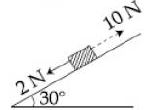
A block kept on a rough inclined plane, as shown in the figure, remains at rest upto a maximum force $2\,N$ down the inclined plane. The maximum external force up the inclined plane that does not move the block is $10\,N.$ The coefficient of static friction between the block and the plane is : [Take $g = 10\,m/s^2$ ]
If $I = 50\, kg-m^2$, then ......... $N-m$ torque will be applied to stop it in $10\, sec$. Its initial angular speed is $20\, rad/sec$.
There are two identical capacitors, the first one is uncharged and filled with a dielectric of constant $K$ while the other one is charged to potential $V$ having air between its plates. If two capacitors are joined end to end, the common potential will be
A body has speed $V, 2V$ and $3V$ in first $1/3$ of distance $S$, seconds $1/3$ of $S$ and third $1/3$ of $S$ respectively. Its average speed will be
The position of a particle related to time is given by $x =\left(5 t ^2-4 t +5\right) m$. The magnitude of velocity of the particle at $t=2\,s$ will be $...........ms^{-1}$
Ketones are prepared by
Given that $u_x=$ horizontal component of initial velocity of a projectile, $u_y=$ vertical component of initial velocity, $R=$ horizontal range, $T=$ time of flight and $H=$ maximum height of projectile. Now match the following two columns.
Column $I$ Column $II$
$(A)$ $u_x$ is doubled, $u_y$ is halved $(p)$ $H$ will remain unchanged
$(B)$ $u_y$ is doubled $u_x$ is halved $(q)$ $R$ will remain unchanged
$(C)$ $u_x$ and $u_y$ both are doubled $(r)$ $R$ will become four times
$(D)$ Only $u_y$ is doubled $(s)$ $H$ will become four times
In gamma ray emission from a nucleus
The material of permanent magnet has