Question
Without using trigonometric table, prove that
$\cos ^2 26^{\circ}+\cos 64^{\circ} \sin 26^{\circ}+\frac{\tan 36^{\circ}}{\cot 54^{\circ}}=2$

Answer

$\text { LHS }=\cos ^2 26^{\circ}+\cos 64^{\circ} \sin 26^{\circ}+\frac{\tan 36^{\circ}}{\cot 54^{\circ}}$
$=\cos ^2 26^{\circ}+\cos \left(90^{\circ}-26^{\circ}\right) \sin 26^{\circ}+\frac{\tan 36^{\circ}}{\cot \left(90^{\circ}-54^{\circ}\right)}$
$=\cos ^2 26^{\circ}+\sin 26^{\circ} \cdot \sin 26^{\circ}+\frac{\tan 36^{\circ}}{\tan 36^{\circ}}$
$=\cos ^2 26^{\circ}+\sin ^2 26+1 \ldots .\left(\cos ^2 \theta+\sin ^2 \theta=1\right)$
$=1+1=2$
$=\text { RHS }$
Hence proved.

Need a full question paper?

Generate a complete, print-ready paper with questions like this in minutes — across 16+ boards, with answer keys.
Start Generating Free

Similar questions

One fourth of herd of camel was seen in the forest. Twice the square root of the herd had gone to mountains and the remaining $15$ camels were seen on the bank of a river. Find the total number of camel.
Find the 20th term from the end of the AP $3, 8, 13,$ $\ldots\ldots$ $253.$
Prove the following identitie:
$sec^4A (1 - \sin^4A) - 2 \tan^2A = 1$
Two similar cylindrical tins have base radii of 6 cm and 8 cm respectively. Find the capacity of the smaller tin, if the capacity of the larger tin is $256 \mathrm{~cm}^3$.
If the$ n^{th}$​​​​​​​ term of the $A.P. 58, 60, 62,....$ is equal to the $n^{th}​​​​​​​$​​​​​​​ term of the $A.P. -2, 5, 12, ….,$ find the value of n.
Prove that $\left(\frac{\tan 20^{\circ}}{\operatorname{cosec} 70^{\circ}}\right)^2+\left(\frac{\cot 20^{\circ}}{\sec 70^{\circ}}\right)^2=1$
Solve the following equation and give your answer correct to $3$ significant figures: $5x^2 – 3x – 4 = 0$
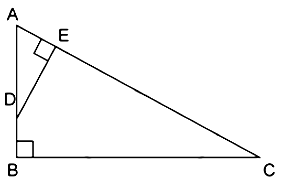
$ABC$ is a right angled triangle with $\angle ABC = 90^\circ. D$ is any point on $AB$ and $DE$ is perpendicular to $AC.$ Prove that
Find, area of $\triangle ADE :$ area of quadrilateral $BCED.$
The point P(3, 4) is reflected to P’ in the x-axis and O’ is the image of O (the Origin) in the line PP’ Find :
(i) The coordinates of P’ and O’.
(ii) The length of segment PP’ and OO’.
(iii) The perimeter of the quadrilateral POP’O’
(iv) What is the special name of the quadrilateral POP’O’.
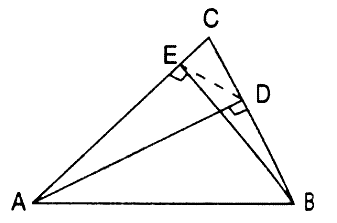
The following figure shows a triangle ABC in which AD and BE are perpendiculars to BC and AC respectively.

Show that;
(i) ΔADC ~ ΔBEC
(ii) CA × CE = CB × CD
(iii) ΔABC ~ ΔDEC
(iv) CD × AB = CA × DE