Question 13 Marks
A pole being broken by the wind the top struck the ground at an angle of $30^\circ$ and at a distance of $8\ m$ from the foot of the pole. Find the whole height of the pole.
Answer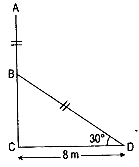
Let $ABC$ be the pole. When broken at $B$ by the wind, let it's top $A$ strike the ground such that
$\angle CAB = 30^\circ$
$AC = 8\ m$
In $\triangle ACB,$
$ \tan 30^{\circ}=\frac{ BC }{ AC }$
$\frac{1}{\sqrt{3}}=\frac{ BC }{8}$
$B C=\frac{8}{\sqrt{3}} $
Again In $\triangle A C B$,
$\cos 30^{\circ}=\frac{ AC }{ AB }$
$\frac{\sqrt{3}}{2}=\frac{8}{ AB }$
$AB =\frac{16}{\sqrt{3}}$
Height of the pole $= AC = AB + BC$
$=\frac{16}{\sqrt{3}}+\frac{8}{\sqrt{3}}$
$=8 \sqrt{3 } m \text { or } 13.86 m $ View full question & answer→Question 23 Marks
A vertical tower stands on a horizontal plane and is surmounted by a flagstaff of height 7 meters. At a point in a plane, the angle of elevation of the bottom and the top of the flagstaff are respectively 30° and 60°. Find the height of the tower.
Answer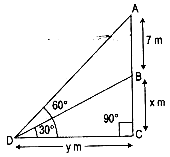
Let the height of the tower be x m and distance DC = y m.
∴ AB = height of flagstaff = 7 m
Now in right-angled Δ BCD,
$\frac{ BC }{ CD }=\tan 30^{\circ}$
$\therefore \frac{x}{y}=\frac{1}{\sqrt{3}}$
⇒ y = √3x ....(i)
Also, in right angled Δ ACD,
$\frac{ AC }{ CD }=\tan 60^{\circ}$
$\Rightarrow \frac{x+7}{y}=\sqrt{3}$
$\Rightarrow x +7=\sqrt{ } 3 y $
⇒ x + 7 = 3(√3 x) ...(from (i))
⇒ x + 7 = 3x
⇒ 2x = 7
$\Rightarrow x=\frac{7}{2}=3.5 m$ View full question & answer→Question 33 Marks
An aeroplane when $3,000$ meters high passes vertically above another aeroplane at an instance when their angles of elevation at the same observation point are $60°$ and $45°$ respectively. How many meters higher is the one than the other?
Answer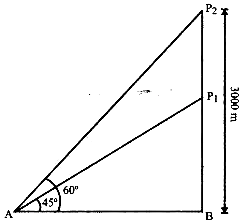
Let $P_1$ and $P_2$ denote the positions of the two planes. Then in right-angled $\triangle P_1AB$,
$\frac{P_1 B}{A B}=\tan 45^{\circ} \Rightarrow P_1 B=A B$
In right-angled $\triangle P_2AB$,
$\Rightarrow \frac{P_2 B}{A} B=\tan 60^{\circ}=\sqrt{3}$
$\Rightarrow AB =\frac{P_2 B}{\sqrt{3}}$
$\Rightarrow AB =\frac{3000}{\sqrt{3}}$
$⇒ AB = 1000\sqrt{3}$
∴ Vertical distance between the two planes is $P_1P_2 = P_2B - P_1B$
= 3000 - 1000√3
= 1000( 3 - √3) m View full question & answer→Question 43 Marks
From a window $A , 10\ m$ above the ground the angle of elevation of the top $C$ of a tower is $X^\circ$, Where tan $x^{\circ}=\frac{5}{2}$ and the angle of depression of the foot $D$ of the tower is $Y^\circ,$ Where tan $y^{\circ}=\frac{1}{4}$. calculate the height $CD$ of the tower in metres .
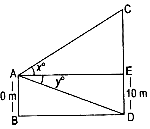
Answer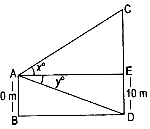
Here $,AB = DE = 10m$
In $\triangle ADE$
$\frac{D E}{A E}=\tan y^{\circ}=\frac{1}{4}$
$\Rightarrow AE = 4DE = 4 \times 10 = 40\ m$
In $\triangle AEC,$
$\frac{C E}{A E}=\tan x^{\circ}=\frac{5}{2}$
$\Rightarrow C E=40 \times \frac{5}{2}=110 m$
$C D=D E+E D=(10+100)=110 m $
Hence, the height of the tower $CD$ is $110\ m.$ View full question & answer→Question 53 Marks
In triangle ABC, AB = 12 cm, LB = 58°, the perpendicular from A to BC meets it at D. The bisector of angle ABC meets AD at E. Calculate:
(i) The length of BD;
(ii) The length of ED.
Give your answers correct to one decimal place.
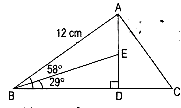
Answer(i) In right-angled Δ ABD,
$\frac{ BD }{ BA }=\cos 58^{\circ}$
BD = BA cos 58°
= 12 x (0.5299) cm
= 6.3588 cm
(ii) In right-angled Δ EBD,
$\frac{ ED }{ BD }=\tan 29^{\circ}$
ED = BD tan 29°
= (6.3588)(0.5543) cm
= 3.52 cm (approx).
View full question & answer→Question 63 Marks
From the top of a tower $60\ m$ high, the angles of depression of the top and bottom of pole are observed to be $45^\circ$ and $60^\circ$ respectively. Find the height of the pole.
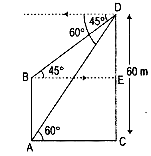
AnswerFrom the adjoining figure, in right-angled $\triangle BED,$
$\frac{ DE }{ BE }=\tan 45^{\circ}$
$DE = BE .....(1)$
In right-angled $\triangle ACD,$
$\frac{ CD }{ AC }=\tan 60^{\circ}$
$\frac{60}{ AC }=\sqrt{3}$
$AC =20 \sqrt{3}$
From (1), $D E=B E=A C=20 \sqrt{3}$
Now, $AB = CD - DE$
$=(60-20 \sqrt{3}) m$
$=20(30-\sqrt{3}) m $
View full question & answer→Question 73 Marks
In figures, find the length CF.
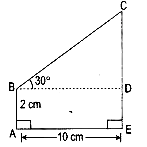
Answer$BD = AF$
$BD = 10 cm$
In $\triangle BCD,$ we have
$\tan 30^\circ = \frac{C D}{B D}$
$\frac{1}{\sqrt{3}}=\frac{C D}{10}$
$C D=\frac{10 \times \sqrt{3}}{3} cm$
$C F=C D+D F=\frac{10 \times \sqrt{3}}{3}+2 cm$
$=\frac{10 \times \sqrt{3}+6}{3} cm $
View full question & answer→Question 83 Marks
Prove that $\frac{\sec \theta-1}{\sec \theta+1}=\left(\frac{\sin \theta}{1+\cos \theta}\right)^2$
Answer$\text { LHS }=\frac{\sec \theta-1}{\sec \theta+1}$
$ =\frac{\frac{1}{\cos \theta}-1}{\frac{1}{\cos \theta}+1} $
$ =\frac{1-\cos \theta}{1+\cos \theta}$
$=\frac{1-\cos \theta \times(1+\cos \theta)}{1+\cos \theta \times(1+\cos \theta)} $
$=\frac{1-\cos ^2 \theta}{(1+\cos \theta)^2} $
$ =\frac{\sin ^2 \theta}{(1+\cos \theta)^2}$
$=\left(\frac{\sin \theta}{1+\cos \theta}\right)^2 $
$=\text { RHS }$
View full question & answer→Question 93 Marks
$\frac{\sin A}{1+\cos A}+\frac{1+\cos A}{\sin A}=2 \operatorname{cosec} A$
Answer$\text { LHS }=\left(\frac{\sin ^2 A+(1+\cos A)^2}{(1+\cos A) \sin A}\right)$
$=\frac{\sin ^2 A+1+\cos ^2 A+2 \cos A}{(1+\cos A) \sin A}$
$=\frac{1+1+2 \cos A}{(1+\cos A) \sin A}$
$=\frac{2(1+\cos A)}{(1+\cos A) \sin A}$
$= 2 co\sec A$
$= RHS$
Hence proved.
View full question & answer→Question 103 Marks
if $\frac{x}{a} \cos \theta+\frac{y}{b} \sin \theta=1$ and $\frac{x}{a} \sin \theta-\frac{y}{b} \cos \theta=1$ prove that $\frac{x^2}{a^2}+\frac{y^2}{h^2}=2$
Answer${\left[\frac{x}{a} \cos \theta+\frac{y}{b} \sin \theta\right]^2+\left[\frac{x}{a} \sin \theta-\frac{y}{b} \cos \theta\right]=(1)^2+(1)^2}$
$\frac{x^2}{a^2} \cos ^2 \theta+\frac{y^2}{b^2} \sin ^2 \theta \frac{2 x y}{a b} \cos \theta \sin \theta=\frac{x^2}{a^2} \sin ^2 \theta+\frac{y^2}{b^2} \cos ^2 \theta-\frac{2 x y}{a b} \sin \theta \cos \theta=1+1$
$\frac{x^2}{a^2} \cos ^2 \theta+\frac{y^2}{b^2} \cos ^2 \theta+\frac{y^2}{b^2} \sin ^2 \theta=2$
$\cos ^\theta\left[\frac{x^2}{a^2}+\frac{y^2}{b^2}\right]+\sin ^2 \theta\left(\frac{x^2}{a^2}+\frac{y^2}{a^2}\right)=2$
$\frac{x^2}{a^2}+\frac{y^2}{b^2}=\left(\therefore \cos ^2 \theta+\sin ^2 \theta=1\right)$
View full question & answer→Question 113 Marks
Prove that: $\sin ^6 \theta+\cos ^6 \theta=1-3 \sin ^2 \theta \cos ^2 \theta$.
Answer$\sin ^6 \theta+\cos ^6 \theta$
$=\left(\sin ^2 \theta\right)^3+\left(\cos ^2 \theta\right)^3$
$=\left(\sin ^2 \theta+\cos ^2 \theta\right)\left(\sin ^4 \theta+\cos ^2 \theta-\sin ^2 \theta \cos ^2 \theta\right)$
$=1 \times\left(\left(\sin ^2 \theta\right)^2+\left(\cos ^2 \theta\right)^2+2 \sin ^2 \theta \cdot \cos ^2 \theta-3 \sin ^2 \theta \cdot \cos ^2 \theta\right)$
$=\left(\sin ^2 \theta\right)^2+\left(\cos ^2 \theta\right)^2-3 \sin ^2 \theta \cdot \cos ^2 \theta$
$=1-3 \sin ^2 \theta \cos ^2 \theta$
$=\text { RHS }$
View full question & answer→Question 123 Marks
Prove that: $\frac{1}{\operatorname{cosec} A-\cot A}-\frac{1}{\sin A}=\frac{1}{\sin A}-\frac{1}{\operatorname{cosec} A+\cot A}$
Answer$\frac{1}{\operatorname{cosec} A-\cot A}-\frac{1}{\sin A}=\frac{1}{\sin A}-\frac{1}{\operatorname{cosec} A+\cot A}$
$\text { or } \frac{1}{\operatorname{cosec} A-\cot A}+\frac{1}{\operatorname{cosec} A+\cot A}=\frac{1}{\sin A}+\frac{1}{\sin A}=\frac{2}{\sin A}$
$\text { LHS }=\frac{(\operatorname{cosec} A+\cot A)+(\operatorname{cosec} A-\cot A)}{\operatorname{cosec} A-\cot A}(\operatorname{cosec} A+\cot A)$
$=\frac{2 \operatorname{cosec} A}{\operatorname{cosec} 2-\cot ^2 A}$
$=\frac{2 \operatorname{cosec} A}{1}$
$=\frac{2}{\sin A}$
$= RHS$
Hence proved.
View full question & answer→Question 133 Marks
Prove the following identity : $\sqrt{\frac{1-\cos A}{1+\cos A}}=\frac{\sin A}{1+\cos A}$
Answer$=\text { LHS }=\sqrt{\frac{1-\cos A}{1-\cos A}}$
$=\sqrt{\frac{1-\cos A}{1+\cos A} \cdot \frac{1+\cos A}{1+\cos A}}$
$=\sqrt{\frac{1-\cos ^2 A}{(1+\cos A)^2}}$
$=\sqrt{\frac{\sin ^2 A}{(1+\cos A)^2}}$
$=\frac{\sin A}{1+\cos A}$
View full question & answer→Question 143 Marks
Prove that $(\sin \theta + cosec \theta )^2 + (\cos \theta + sec \theta )^2 = 7 + \tan^2\theta + \cot^2\theta .$
Answer$L.H.S = (\sin \theta + cosec \theta )^2 + (\cos \theta + sec \theta )^2$
$= (\sin^2\theta + cosec^2\theta + 2 \sin \theta cosec \theta + \cos^2\theta + sec^2\theta + 2cos \theta sec \theta )$
$= (\sin^2\theta + \cos^2\theta ) + (cosec^2\theta + sec^2\theta ) + 2 \sin \theta \left(\frac{1}{\sin \theta}\right)+2 \cos \theta\left(\frac{1}{\cos \theta}\right)$
$= (1) + (1 + \cot^2\theta + 1 + \tan^2\theta ) + (2) + (2)$
$= 7 + \tan^2\theta + \cot^2\theta$
$= R.H.S$
$$
View full question & answer→Question 153 Marks
Prove that : $\frac{\sin A+\cos A}{\sin A-\cos A}+\frac{\sin A-\cos A}{\sin A+\cos A}=\frac{2}{\sin ^2 A-\cos ^2 A}$.
Answer$\text { LHS }=\frac{\sin A+\cos A}{\sin A-\cos A}+\frac{\sin A-\cos A}{\sin A+\cos A} $
$ =\frac{(\sin A+\cos A)^2+(\sin A-\cos A)^2}{(\sin A-\cos A)(\sin A+\cos A)}$
$=\frac{\sin ^2 A+\cos ^2 A+2 \sin A \cos A+\sin ^2 A+\cos ^2 A-2 \sin A \cdot \cos A}{\sin ^2 A-\cos ^2 A}$
$=2 \frac{\sin ^2 A+\cos ^2 A}{\sin ^A-\cos ^2 A} $
$=\frac{2}{\sin ^2 A-\cos ^2 A}$
$= RHS$
Hence proved.
View full question & answer→Question 163 Marks
Prove that: $\frac{\sin \theta-2 \sin ^3 \theta}{2 \cos ^3 \theta-\cos \theta}=\tan \theta$.
Answer$\text { LHS }=\frac{\sin \theta-2 \sin ^3 \theta}{2 \cos ^3 \theta-\cos \theta}$
$=\frac{\sin \theta\left(1-2 \sin ^2 \theta\right)}{\cos \theta\left(2 \cos ^2 \theta-1\right)} $
$ =\frac{\tan \theta\left(1-2\left(1-\cos ^2 \theta\right)\right)}{2 \cos ^2 \theta-1} $
$=\frac{\tan \theta\left(1-2+2 \cos ^2 \theta\right)}{2 \cos ^2 \theta-1}$
$=\frac{\tan \theta\left(2 \cos ^2 \theta-1\right)}{2 \cos ^2 \theta-1}$
$= tan \theta$
$= RHS$
Hence proved.
View full question & answer→Question 173 Marks
Prove that : $\frac{1}{\sec \theta-\tan \theta}=\sec \theta+\tan \theta^{\prime}$
Answer$\text { LHS }=\frac{1}{\sec \theta-\tan \theta} $
$ =\frac{1}{\left(\frac{1}{\cos \theta}\right)-\left(\frac{\sin \theta}{\cos \theta}\right)} $
$ =\frac{\cos \theta \times(1+\sin \theta)}{(1-\sin \theta) \times(1+\sin \theta)}$
$=\frac{\cos \theta(1+\sin \theta)}{1-\sin ^2 \theta} $
$=\frac{\cos \theta(1+\sin \theta)}{\cos ^2 \theta} $
$ =\frac{1}{\cos \theta}+\frac{\sin \theta}{\cos \theta}$
$= \sec \theta + \tan \theta$
$= RHS$
Hence proved.
View full question & answer→Question 183 Marks
Prove the following identity : $(\sec \theta-\tan \theta)^2=\frac{1-\sin \theta}{1+\sin \theta}$
Answer$(\sec \theta-\tan \theta)^2$
$ =\left(\frac{1}{\cos \theta}-\frac{\sin \theta}{\cos \theta}\right)^2$
$ =\left(\frac{1-\sin \theta}{\cos \theta}\right)^2=\frac{(1-\sin \theta)^2}{\cos ^2 \theta}$
$=\frac{(1-\sin \theta)^2}{1-\sin ^2 \theta}=\frac{(1-\sin \theta)^2}{(1-\sin \theta)(1+\sin \theta)}$ (∵ $1-\sin ^2 \theta=\cos ^2 \theta$)
$=\frac{1-\sin \theta}{1+\sin \theta}$
View full question & answer→Question 193 Marks
Prove that $\frac{\tan ^2 \theta}{(\sec \theta-1)^2}=\frac{1+\cos \theta}{1-\cos \theta}$
Answer$\text { L.H.S }=\frac{\tan ^2 \theta}{(\sec \theta-1)^2}$
$ =\frac{\sec ^2 \theta-1}{(\sec \theta-1)^2} $
$ =\frac{(\sec \theta-1)(\sec \theta+1)}{(\sec \theta-1)^2} $
$ =\frac{\sec \theta+1}{\sec \theta-1} $
$=\frac{\frac{1}{\cos \theta}+1}{\frac{1}{\cos \theta}-1} $
$ =\frac{\frac{1+\cos \theta}{\cos \theta}}{\frac{1-\cos \theta}{\cos \theta}}$
$=\frac{1+\cos \theta}{1-\cos \theta} \\ =\text { R.H.S }$
View full question & answer→Question 203 Marks
If $A + B = 90^\circ$, show that $\sec^2A + \sec^2B = \sec^2A. \sec^2B$.
Answer$LHS = \sec^2A + \sec^2B$
$=\frac{1}{\cos ^2 A}+\frac{1}{\cos ^2 B}$
$=\frac{1}{\cos ^2 A}+\frac{1}{\cos ^2\left(90^{\circ}-A\right)}$
$=\frac{1}{\cos ^2 A}+\frac{1}{\sin ^2 A}$
$=\frac{1}{\sin ^A \cdot \cos ^2 A}$
$= \sec^2 A \operatorname{cosec^2}A$
$= \sec^2A \operatorname{cosec^2}(90^\circ - B)$
$= \sec^2A. \sec^2B = RHS$
Hence proved.
View full question & answer→Question 213 Marks
If $x = h + a \cos \theta , y = k + b \sin \theta$.
Prove that $\left(\frac{x-h}{a}\right)^2+\left(\frac{y-k}{b}\right)^2=1$.
AnswerIf is given that
x = h + a cos θ
and y = k + b sin θ
x - h = a cos θ ....(i)
y - k = b sin θ ....(ii)
The given equation is
$\left(\frac{x-h}{a}\right)^2+\left(\frac{y-k}{b}\right)^2=1$
$LHS =\left(\frac{a \cos \theta}{a}\right)^2+\left(\frac{b \sin \theta}{b}\right)^2$ ....(Putting the values of (i) and (ii)]
$= \cos^2\theta + \sin^2\theta$
$= 1$
= RHS
Hence proved.
View full question & answer→Question 223 Marks
Prove that $\frac{\sin 70^{\circ}}{\cos 20^{\circ}}+\frac{\operatorname{cosec} 20^{\circ}}{\sec 70^{\circ}}-2 \cos 70^{\circ} \times \operatorname{cosec} 20^{\circ}=0$.
Answer$\text { LHS }=\frac{\sin 70^{\circ}}{\cos 20^{\circ}}+\frac{\operatorname{cosec} 20^{\circ}}{\sec 70^{\circ}}-2 \cos 70^{\circ} \times \operatorname{cosec} 20^{\circ} $
$ \frac{\sin \left(90^{\circ}-20^{\circ}\right)}{\cos 20^{\circ}}+\frac{\operatorname{cosec}\left(90^{\circ}-20^{\circ}\right)}{\sec 70^{\circ}}-2 \cos 70^{\circ} \times \operatorname{cosec} 20^{\circ} $
$=\frac{\cos 20^{\circ}}{\cos 20^{\circ}}+\frac{\sec 70^{\circ}}{\sec 70^{\circ}}-2 \cos 70^{\circ} \times \cos e c 20^{\circ}$
$= 1 + 1 - 2cos (90^{\circ} - 20^{\circ}) . cosec 20^{\circ}$
$=2-2 \sin 20^{\circ} \cdot \frac{1}{\sin 20}^{\circ}$
$= 2 - 2$
$= 0$
$= RHS$
Hence proved.
View full question & answer→Question 233 Marks
Prove that $\left(\frac{\tan 20^{\circ}}{\operatorname{cosec} 70^{\circ}}\right)^2+\left(\frac{\cot 20^{\circ}}{\sec 70^{\circ}}\right)^2=1$
Answer$LHS = \left(\frac{\tan 20^{\circ}}{\cos e c 70^{\circ}}\right)^2+\left(\frac{\cot 20^{\circ}}{\sec 70^{\circ}}\right)^2$
$=\left(\frac{\sin 20^{\circ} \cdot \sin 70^{\circ}}{\cos 20^{\circ}}\right)^2+\left(\frac{\cos 20^{\circ} \cdot \cos 20^{\circ}}{\sin 20^{\circ}}\right)^2 $
$ =\left[\frac{\sin 20^{\circ} \cdot \sin \left(90^{\circ}-20^{\circ}\right)}{\cos 20^{\circ}}\right]^2+\left[\frac{\cos 20^{\circ} \cdot \cos \left(90^{\circ}-20^{\circ}\right)}{\sin 20^{\circ}}\right]^2 $
$ =\left[\frac{\sin 20^{\circ} \cdot \cos 20^{\circ}}{\cos 20^{\circ}}\right]^2+\left[\frac{\cos 20^{\circ} \cdot \sin 20^{\circ}}{\sin 20^{\circ}}\right]^2$
$= \sin^2 20^\circ + cos^2 20^\circ$
$= 1$
$= RHS$
Hence proved.
View full question & answer→Question 243 Marks
Without using a trigonometric table, prove that
$\frac{\cos 70^{\circ}}{\sin 20^{\circ}}+\frac{\cos 59^{\circ}}{\sin 31^{\circ}}-8 \sin ^2 30^{\circ}=0$
AnswerWe have,
$\text { LHS }=\frac{\cos 70^{\circ}}{\sin 20^{\circ}}+\frac{\cos 59^{\circ}}{\sin 31^{\circ}}-8 \sin ^2 30^{\circ}=0 $
$=\frac{\cos \left(90^{\circ}-20^{\circ}\right)}{\sin 20^{\circ}}+\frac{\cos \left(90^{\circ}-31^{\circ}\right)}{\sin 31^{\circ}}-8 \times\left(\frac{1}{2}\right)^2$
$=\frac{\sin 20^{\circ}}{\sin 20^{\circ}}+\frac{\sin 31^{\circ}}{\sin 31^{\circ}}-8 \times \frac{1}{4}$
$= 1 + 1 - 2$
$= 2 -2$
$= 0$
$= \text{RHS}$
Hence proved.
View full question & answer→Question 253 Marks
Without using trigonometric table, prove that
$\cos ^2 26^{\circ}+\cos 64^{\circ} \sin 26^{\circ}+\frac{\tan 36^{\circ}}{\cot 54^{\circ}}=2$
Answer$\text { LHS }=\cos ^2 26^{\circ}+\cos 64^{\circ} \sin 26^{\circ}+\frac{\tan 36^{\circ}}{\cot 54^{\circ}}$
$=\cos ^2 26^{\circ}+\cos \left(90^{\circ}-26^{\circ}\right) \sin 26^{\circ}+\frac{\tan 36^{\circ}}{\cot \left(90^{\circ}-54^{\circ}\right)}$
$=\cos ^2 26^{\circ}+\sin 26^{\circ} \cdot \sin 26^{\circ}+\frac{\tan 36^{\circ}}{\tan 36^{\circ}}$
$=\cos ^2 26^{\circ}+\sin ^2 26+1 \ldots .\left(\cos ^2 \theta+\sin ^2 \theta=1\right)$
$=1+1=2$
$=\text { RHS }$
Hence proved.
View full question & answer→Question 263 Marks
Prove the identity $(sin θ + cos θ) (tan θ + cot θ ) = sec θ + cosec θ$.
AnswerL.H.S. = (sin θ + cos θ)(tan θ + cot θ)
$=(\sin \theta+\cos \theta)\left(\frac{\sin \theta}{\cos \theta}+\frac{\cos \theta}{\sin \theta}\right)$
$=(\sin \theta+\cos \theta)\left(\frac{\sin ^2 \theta+\cos ^2 \theta}{\cos \theta \sin \theta}\right)$
$=(\sin \theta+\cos \theta) \times \frac{1}{\sin \theta \cos \theta} [\because \sin^2\theta + \cos^2\theta = 1]$
$=\frac{\sin \theta+\cos \theta}{\cos \theta \sin \theta}$
$=\frac{\sin \theta}{\cos \theta \sin \theta}+\frac{\cos \theta}{\cos \theta \sin \theta}$
$=\frac{1}{\cos \theta}+\frac{1}{\sin \theta}$
$=\sec \theta+\operatorname{cosec} \theta$
= R.H.S
Hence proved.
View full question & answer→Question 273 Marks
Prove that $\sin^4\theta - \cos^4\theta = \sin^2\theta - \cos^2\theta$
$= 2sin^2\theta - 1$
$= 1 - 2 \cos^2\theta$
Answer$L.H.S. = \sin^4\theta - \cos^4\theta$
$L.H.S. = (\sin^2\theta )^2 - (\cos^2\theta )^2$
$L.H.S. = (\sin^2\theta - \cos^2\theta )(\sin^2\theta + \cos^2\theta )$
$L.H.S. = (\sin^2\theta - \cos^2\theta ) x 1$
$L.H.S. = \sin^2\theta - \cos^2\theta$
$L.H.S. = R.H.S.L.H.S.= \sin^2\theta - (1 - \sin^2\theta )$
$L.H.S. = \sin^2\theta - 1 + \sin^2\theta$
$L.H.S. = 2sin^2\theta - 1$
$L.H.S. = R.H.S$
$L.H.S. = 2(1 - \cos^2\theta ) - 1$
$L.H.S. = 2 - 2cos^2\theta - 1$
$L.H.S. = 1 - 2cos^2\theta$
$L.H.S. = R.H.S.$
View full question & answer→Question 283 Marks
Prove that $\frac{\tan A}{\left(1+\tan ^2 A\right)^2}+\frac{\cot A}{\left(1+\cot ^2 A\right)^2}=\sin A \cdot \cos A$
Answer$\text { LHS }=\frac{\tan A}{\left(1+\tan ^2 A\right)^2}+\frac{\cot A}{\left(1+\cot ^2 A\right)^2}$
$=\frac{\tan A}{\left(\sec ^2 A\right)^2}+\frac{\cot A}{(\operatorname{cosec} A)^2}$
$=\frac{\sin A}{\cos A} \times \cos ^2 A \times \cos ^2 A+\frac{\cos A}{\sin A} \times \sin ^2 A \times \sin ^2 A$
$= \sin A.\cos^3A + \sin^3A.\cos A$
$= \sin A \cos A (\cos^2A + \sin^2A)$
$= \sin A. \cos A x 1$
$= \sin A. \cos A$
$= RHS$
Hence proved.
View full question & answer→Question 293 Marks
Prove that $\left(\frac{1-\cos ^2 \theta}{\cos \theta}\right)\left(\frac{1-\sin ^2 \theta}{\sin \theta}\right)=\frac{1}{\tan \theta+\cot \theta}$
Answer$\text { LHS }=\left(\frac{1-\cos ^2 \theta}{\cos \theta}\right)\left(\frac{1-\sin ^2 \theta}{\sin \theta}\right)$
$\text { LHS }=\left(\frac{\sin ^2 \theta}{\cos \theta}\right) \cdot\left(\frac{\cos ^2 \theta}{\sin \theta}\right)$
$LHS = \sin \theta . \cos \theta $
$\text { RHS }=\frac{1}{\tan \theta+\cot \theta}$
$\text { RHS }=\frac{1}{\frac{\sin ^2 \theta+\cos ^2 \theta}{\sin \theta \cdot \cos \theta}}$
$\text { RHS }=\frac{\sin \theta \cdot \cos \theta}{\sin ^2 \theta+\cos ^2 \theta}$
$RHS =\sin \theta . \cos \theta $
$LHS = RHS$
Hence proved.
View full question & answer→Question 303 Marks
Prove that $\frac{\tan A+\sec A-1}{\tan A-\sec A+1}=\frac{1+\sin A}{\cos A}$.
Answer$\text { LHS }=\frac{\tan A+\sec A-1}{\tan A-\sec A+1} $
$ =\frac{(\tan A+\sec A)-\left(\sec ^2 A-\tan ^2 A\right)}{(\tan A-\sec A)+1} $
$ =\frac{(\tan A+\sec A)(1-\sec A+\tan A)}{\tan A-\sec A+1}$
$= \tan A + \sec A$
$=\frac{\sin A}{\cos A}+\frac{1}{\cos A}=\frac{1+\sin A}{\cos A}$
$= RHS$
Hence proved.
View full question & answer→Question 313 Marks
Prove that $\frac{\cot A+\operatorname{cosec} A-1}{\cot A-\operatorname{cosec} A+1}=\frac{1+\cos A}{\sin A}$
Answer$\text { LHS }=\frac{\cot A+\operatorname{cosec} A-1}{\cot A-\operatorname{cosec} A+1}$
$ =\frac{(\cot A+\operatorname{cosec} A)-\left(\operatorname{cosec}{ }^2 A-\cot ^2 A\right)}{\cot A-\operatorname{cosec} A+1}$
$ =\frac{(\cot A+\operatorname{cosec} A)(1-(\operatorname{cosec} A-\cot A))}{\cot A-\operatorname{cosec} A+1} $
$ =\cot A +\operatorname{cosec} A =\frac{\cos A}{\sin A}+\frac{1}{\sin A}$
$=\cos A+\frac{1}{\sin A} $
$ =\text { RHS }$
Hence proved.
View full question & answer→Question 323 Marks
Prove that$\frac{\tan ^2 \theta}{(\sec \theta-1)^2}=\frac{1+\cos \theta}{1-\cos \theta}$
Answer$\text { L.H.S }=\frac{\tan ^2 \theta}{(\sec \theta-1)^2}$
$ =\frac{\sec ^2 \theta-1}{(\sec \theta-1)^2}$
$=\frac{(\sec \theta-1)(\sec \theta+1)}{(\sec \theta-1)^2}$
$=\frac{\sec \theta+1}{\sec \theta-1}$
$=\frac{\frac{1}{\cos \theta}+1}{\frac{1}{\cos \theta}-1} $
$ =\frac{\frac{1+\cos \theta}{\cos \theta}}{\frac{1-\cos \theta}{\cos \theta}}$
$=\frac{1+\cos \theta}{1-\cos \theta} $
$=\text { R.H.S }$
View full question & answer→Question 333 Marks
Prove that $\frac{\sin \theta \tan \theta}{1-\cos \theta}=1+\sec \theta$.
Answer$\text { LHS }=\frac{\sin \theta \tan \theta}{1-\cos \theta} $
$ =\frac{\sin \theta \cdot \frac{\sin \theta}{\cos \theta}}{1-\cos \theta}$
$ =\frac{\sin ^2 \theta}{\cos \theta(1-\cos \theta)} $
$ =\frac{(1-\cos \theta)(1+\cos \theta)}{\cos \theta(1-\cos \theta)}$
$=\frac{1+\cos \theta}{\cos \theta}=\frac{1}{\cos \theta}+\frac{\cos \theta}{\cos \theta}$
$= \sec \theta + 1$
$= RHS$
Hence proved.
View full question & answer→Question 343 Marks
Prove that $(cosec A - \sin A)( \sec A - \cos A) \sec^2 A = tan A$.
AnswerLHS = $(cosec A - \sin A)(\sec A - \cos A). \sec^2A$
$=\left(\frac{1}{\sin A}-\sin A\right) \cdot\left(\frac{1}{\cos A}-\cos A\right) \cdot \frac{1}{\cos ^2 A}$
$=\frac{1-\sin ^2 A}{\sin A} \cdot \frac{1-\cos ^2 A}{\cos A} \times \frac{1}{\cos ^2 A}$
$=\frac{\cos ^2 A}{\sin A} \times \frac{\sin ^2 A}{\cos A} \times \frac{1}{\cos ^2 A} \ldots\left[\because\left(1-\sin ^2 A\right)=\cos ^2 A, 1-\cos ^2 A=\sin ^2 A\right]$
$ =\frac{\sin A}{\cos A}=\tan A$
$= RHS $
Hence proved.
View full question & answer→Question 353 Marks
If $\cos \theta + \sin \theta = \sqrt2 \cos \theta $, show that $\cos \theta - \sin \theta = \sqrt2 \sin \theta .$
AnswerWe have,
$\cos \theta+\sin \theta=\sqrt{ } 2 \cos \theta$
Squaring both side,
$(\cos \theta + \sin \theta )^2 = 2 \cos^2 \theta$
$\Rightarrow \cos^2\theta + \sin^2\theta + 2 \sin \theta . \cos \theta = 2 \cos^2 \theta$
$\Rightarrow 2 \sin \theta . \cos \theta = 2 \cos^2 \theta - \cos^2\theta - \sin^2\theta$
$\Rightarrow 2 \sin \theta . \cos \theta = \cos^2\theta - \sin^2\theta$
$\Rightarrow 2 \sin \theta . \cos \theta = ( \cos \theta + \sin \theta )( \cos \theta - \sin \theta )$
$\Rightarrow 2 \sin \theta . \cos \theta = ( \cos \theta - \sin \theta ) x \sqrt2 \cos \theta ....$(Given)
$\Rightarrow \cos \theta - \sin \theta = \sqrt2 \sin \theta$
Hence proved.
View full question & answer→Question 363 Marks
Prove that $\sqrt{\frac{1+\sin \theta}{1-\sin \theta}}=\sec \theta+\tan \theta$
Answer$\text { LHS }=\sqrt{\frac{1+\sin \theta}{1-\sin \theta} \times \frac{1+\sin \theta}{1+\sin \theta}} $
$ =\sqrt{\frac{(1+\sin \theta)^2}{1-\sin ^2 \theta}} $
$ =\sqrt{\frac{(1+\sin \theta)^2}{\cos ^2 \theta}}$
$=\frac{1+\sin \theta}{\cos \theta}=\frac{1}{\cos \theta}+\frac{\sin \theta}{\cos \theta}$
$= \sec \theta + \tan \theta$
$= RHS$
Hence proved.
View full question & answer→Question 373 Marks
Prove that: $\sqrt{\frac{1-\cos \theta}{1+\cos \theta}}=\operatorname{cosec} \theta-\cot \theta$
Answer$\text { LHS }=\sqrt{\frac{1-\cos \theta}{1+\cos \theta} \times \frac{1-\cos \theta}{1-\cos \theta}}$
$=\sqrt{\frac{(1-\cos \theta)^2}{1-\cos ^2 \theta}}$
$=\frac{1-\cos \theta}{\sqrt{1-\cos ^2 \theta}}$
$=\frac{1-\cos \theta}{\sqrt{\sin ^2 \theta}}$ $=\frac{1-\cos \theta}{\sin \theta}$
$=\frac{1}{\sin \theta}-\frac{\cos \theta}{\sin \theta}$
$= co\sec \theta - \cot \theta$
$= RHS$
Hence proved.
View full question & answer→Question 383 Marks
The length of a shadow of a tower standing on a level plane is found to be 2y meters longer when the seen's altitude is 30° than when it was 45° prove that the height of the tower is y ( √3 + 1 ) meter.
Answer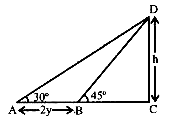
In the right-angled triangle BCD.
$\tan 45^\circ = \frac{h}{B C}$
$h = BC ....(1)$
In right-angled $\triangle ACD,$
$\tan 30^\circ = \frac{h}{2 y+B C}$
$\Rightarrow \frac{1}{\sqrt{3}}=\frac{h}{2 y+h}$
$\Rightarrow h(\sqrt{3}-1)=2 y$
$\Rightarrow h = y ( \sqrt{3} + 1 ) m$
Hence proved. View full question & answer→Question 393 Marks
If $2 \sin A-1=0$, show that: $\sin 3 A=3 \sin A-4 \sin ^3 A$
Answer$2 sinA − 1 = 0$
$\Rightarrow sinA = 1/2$
We know $\sin 30^{\circ}=1 / 2$
So, $A = 30^\circ$
$LHS = \sin 3A = sin90^\circ = 1$
$RHS = 3sinA - 4sin^3A$
$=3 sin30^\circ - 4sin^330^\circ$
$=3\left(\frac{1}{2}\right)-4\left(\frac{1}{2}\right)^3$
$=\frac{3}{2}-\frac{1}{2}=1$
LHS = RHS
View full question & answer→Question 403 Marks
Prove that $\tan^2\Phi + \cot^2\Phi + 2 = sec^2\Phi .cosec^2\Phi .$
Answer$L.H.S. = \tan^2\Phi + \cot^2\Phi + 2$
$= \tan^2\Phi + 1 + \cot^2\Phi + 1$
$= sec^2\Phi + cosec^2\Phi$
$=\frac{1}{\cos ^2 \Phi}+\frac{1}{\sin ^2 \Phi}$
$=\frac{\sin ^2 \Phi+\cos ^2 \Phi}{\sin ^2 \Phi \cdot \cos ^2 \Phi}$
$=\frac{1}{\sin ^2 \Phi \cdot \cos ^2 \Phi}$
$= cosec^2\Phi . sec^2\Phi$
$= R.H.S.$
Hence proved.
View full question & answer→Question 413 Marks
If A = 60°, B = 30° verify that tan( A - B) =$\frac{\tan A-\tan B}{1+\tan A \cdot \tan B}$.
AnswerIt is given that A = 60°, B = 30°
Putting A = 60° and B = 30° in the given equation,
we get
tan( A - B) = $\frac{\tan A-\tan B}{1+\tan A \cdot \tan B}$
$\Rightarrow \tan \left(60^{\circ}-30^{\circ}\right)=\frac{\tan 60^{\circ}-\tan 30^{\circ}}{1+\tan 60^{\circ} \cdot \tan 30^{\circ}}$
$\Rightarrow \tan 30^{\circ}=\frac{\sqrt{3}-\frac{1}{\sqrt{3}}}{1+\sqrt{3} \times \frac{1}{\sqrt{3}}}$
$\Rightarrow \frac{1}{\sqrt{3}}=\frac{\frac{2}{\sqrt{3}}}{2}$
$\Rightarrow \frac{1}{\sqrt{3}}=\frac{1}{\sqrt{3}}$
⇒ LHS = RHS
View full question & answer→Question 423 Marks
Prove that $\frac{1+\sin \theta}{1-\sin \theta}=1+2 \frac{\tan \theta}{\cos \theta}+2 \tan ^2 \theta$.
AnswerRHS = $1+2 \frac{\tan \theta}{\cos \theta}+2 \tan ^2 \theta$
$=1+2 \frac{\sin \theta}{\cos ^2 \theta}+2 \frac{\sin ^2 \theta}{\cos ^2 \theta} $
$ =\frac{\cos ^2 \theta+2 \sin \theta+2 \sin ^2 \theta}{\cos ^2 \theta} $
$=\frac{1-\sin ^2 \theta+2 \sin \theta+2 \sin ^2 \theta}{1-\sin ^2 \theta} $
$ =\frac{1+\sin ^2 \theta+2 \sin \theta}{1-\sin ^2 \theta} $
$=\frac{(1+\sin \theta)^2}{1+\sin \theta}(1-\sin \theta)$
$=\frac{1+\sin \theta}{1-\sin \theta}$
$= LHS$
Hence proved.
View full question & answer→Question 433 Marks
Prove that: $2(\sin^6\theta + \cos^6\theta ) - 3 ( \sin^4\theta + \cos^4\theta ) + 1 = 0.$
Answer$LHS = 2(\sin^6\theta + \cos^6\theta ) - 3 ( \sin^4\theta + \cos^4\theta ) + 1$
$= 2( \sin^2\theta + \cos^2\theta ) ( \sin^4\theta + \cos^4\theta - \sin^2\theta .\cos^2\theta ) - 3( ( \sin^2\theta + \cos^2\theta )^2- 2sin^2\theta . \cos^2\theta + 1$
$= 2 x 1 ( ( \sin^2\theta + \cos^2\theta )^2^- 2 \sin^2\theta .\cos^2\theta - \sin^2\theta .\cos^2\theta ) - 3( (1)^2 - 2sin^2\theta . \cos^2\theta ) + 1$
$= 2 ( (1)^2 - 3 \sin^2\theta .\cos^2\theta ) - 3 ( 1 - 2 \sin^2\theta . \cos^2\theta ) + 1$
$= 2 - 6 \sin^2\theta . \cos^2\theta - 3 + 6 \sin^2\theta . \cos^2\theta + 1$
$= - 1 + 1 = 0$
$= RHS$
Hence proved.
View full question & answer→Question 443 Marks
Prove the following trigonometric identities.
$\frac{1}{\sec A-1}+\frac{1}{\sec A+1}=2 \operatorname{cosec} A \cot A$
AnswerWe need to prove $\frac{1}{\sec A-1}+\frac{1}{\sec A+1}=2 \operatorname{cosec} A \cot A$
Solving the L.H.S, we get
$\frac{1}{\sec A-1}+\frac{1}{\sec A+1}=\frac{\sec A+1+\sec A-1}{(\sec A-1)(\sec A+1)}$
$=\frac{2 \sec A}{\sec ^2 A-1}$
Further using the property $1+\tan ^2 \theta=\sec ^2 \theta$ we get
So
$\frac{2 \sec A}{\sec ^2 A-1}=\frac{2 \sec A}{\tan ^2 A}$
$=\frac{2\left(\frac{1}{\cos A}\right)}{\frac{\sin ^2 A}{\cos ^2 A}}$
$=2 \frac{1}{\cos A} \times \frac{\cos ^2 A}{\sin ^2 A}$
$=2\left(\frac{\cos A}{\sin A}\right) \times \frac{1}{\sin A}$
$= 2co\sec A \cot A$
View full question & answer→Question 453 Marks
Prove that$\frac{\sin \theta \tan \theta}{1-\cos \theta}=1+\sec \theta$.
Answer$\text { LHS }=\frac{\sin \theta \tan \theta}{1-\cos \theta} $
$ =\frac{\sin \theta \cdot \frac{\sin \theta}{\cos \theta}}{1-\cos \theta} $
$ =\frac{\sin ^2 \theta}{\cos \theta(1-\cos \theta)} $
$ =\frac{(1-\cos \theta)(1+\cos \theta)}{\cos \theta(1-\cos \theta)}$
$=\frac{1+\cos \theta}{\cos \theta}=\frac{1}{\cos \theta}+\frac{\cos \theta}{\cos \theta} $
$=\sec \theta+1 $
$=\text { RHS }$
Hence proved.
View full question & answer→Question 463 Marks
If $x=r \sin \theta \cos \Phi, y=r \sin \theta \sin \Phi$ and $z=r \cos \theta$, prove that $x^2+y^2+z^2=r^2$.
AnswerWe have,
$x = r \sin \theta \cos \Phi ,$
$y = r \sin \theta \sin \Phi ,$
$z = r \cos \theta $ Squaring and adding,
$x^2 + y^2+ z^2$
$= r^2 \sin^2\theta \cos^2\Phi + r^2sin^2\theta \sin^2\Phi + r^2 \cos^2\theta $
$= r^2 \sin^2\theta (\cos^2\Phi + \sin^2\Phi ) + r^2 \cos^2\theta $
$= r^2 \sin^2\theta x (1) + r^2 \cos^2\theta $
$= r^2 (\sin^2\theta + \cos^2\theta )$
$= r^2 x 1 = r^2$^
Hence, $x^2 + y^2+ z^2 = r^2.$
Hence proved.
View full question & answer→Question 473 Marks
If $5 \tan \theta = 4,$ find the value of :$\frac{5 \sin \theta+3 \cos \theta}{5 \sin \theta+2 \cos \theta}$
Answer$5 \tan \theta = 4$
tan $\theta =\frac{4}{5}$
$\frac{\sin \theta}{\cos \theta}=\frac{4}{5}$
$\frac{5 \sin \theta+3 \cos \theta}{5 \sin \theta+2 \cos \theta}=\frac{\frac{5 \sin \theta}{\cos \theta}+3 \frac{\cos \theta}{\cos \theta}}{\frac{5 \sin \theta}{\cos \theta}+\frac{2 \cos \theta}{\cos \theta}}$ ....[Nr., and Dr. dividing by $\cos\ \theta$]
$=\frac{5 \times \frac{4}{5}+3}{5 \times \frac{4}{5}+2}$
$=\frac{4+3}{4+2}=\frac{7}{6}$
View full question & answer→Question 483 Marks
Solve : $\sin^2\theta - 3 \sin \theta + 2 = 0 .$
Answer$\sin^2\theta - 3 \sin \theta + 2 = 0$
$\Rightarrow \sin^2\theta - 2 \sin \theta - \sin \theta + 2 = 0$
$\Rightarrow \sin \theta (\sin \theta - 2) - 1(\sin \theta - 2) = 0$
$\Rightarrow (\sin \theta - 2)(\sin \theta - 1) = 0$
$\Rightarrow \sin \theta - 2 = 0$
$\Rightarrow \sin \theta = 2 \sin \theta = 2$ has no solution for angle $\theta$ , as there is no any angle whose $\sin \theta$ is equal to $2.$
$\Rightarrow \sin \theta - 1 = 0$
$\Rightarrow \sin \theta = 1$
$\Rightarrow \theta = 90^\circ$
View full question & answer→Question 493 Marks
Without using tables evaluate:
$\frac{2 \tan 53^{\circ}}{\cot 37^{\circ}}-\frac{\cot 80^{\circ}}{\tan 10^{\circ}}$.
Answer$\frac{2 \tan 53^{\circ}}{\cot 37^{\circ}}-\frac{\cot 80^{\circ}}{\tan 10^{\circ}}$
$ =\left(\frac{2 \tan 53^{\circ}}{\cot \left(90^{\circ}-53^{\circ}\right)}-\left(\frac{\cot 80^{\circ}}{\tan \left(90-80^{\circ}\right)}\right)\right. $
$ =\left(\frac{2 \tan 53^{\circ}}{\tan 53^{\circ}}\right)-\left(\frac{\cot 80^{\circ}}{\cot 80^{\circ}}\right)$
$= 2 - 1$
$= 1$
View full question & answer→Question 503 Marks
Without using trigonometric tables, evaluate
$\sin ^2 34^{\circ}+\sin ^2 56^{\circ}+2 \tan 18^{\circ} \tan 72^{\circ}-\cot ^2 30^{\circ}$
Answer$\sin ^2 34^{\circ}+\sin ^2 56^{\circ}+2 \tan 18^{\circ} \tan 72^{\circ}-\cot ^2 30^{\circ}:$
$=\sin ^2 34^2+\sin ^2\left(90^{\circ}-34^{\circ}\right)+2 \tan 18^{\circ} \tan \left(90^{\circ}-18^{\circ}\right)-\cot ^2 30^{\circ}$
$=\sin ^2 34^{\circ}+\cos ^2 34^{\circ}+2 \tan 18^{\circ} \cot 18^{\circ}-\cot ^2 30^{\circ}$
$=\left(\sin ^2 34^{\circ}+\cos ^2 34^{\circ}\right)+2 \tan 18^{\circ} \times \frac{1}{\tan 18^{\circ}}-\cot ^2 30^{\circ}$
$=1+2 \times 1-(\sqrt{3})^2 $
$ =1+2-3$
$=3-3 $
$ =0$
View full question & answer→