Question
Work done by a force is given by $\text{W}=\vec{\text{F}.}\vec{\text{S}}\text{ Where}\vec{\text{ F}}$ is the force and $\vec{\text{S}}$is the displacement. Show that:
  1. Work done is also equal to change in K.E.
  2. Work done is also equal to change in potential energy using this expression.

Answer

  1.  

m = mass of body at rest
$\vec{\text{ds}}$ = small displacement in the direction of force Small amount of work done by force
$\text{dW}=\vec{\text{F}}.\vec{\text{ds}}$
$=\text{FdS}\cos0^\circ=\text{FdS}$
If is acceleration Produced in the body, then
$\vec{\text{F}}=\text{m}\vec{\text{a}}=\text{m}\frac{\text{dv}}{\text{dt}}$
$\text{dW}=\bigg(\text{m}\frac{\text{dv}}{\text{dt}}\bigg).\text{dS}=\text{m}\bigg(\frac{\text{dS}}{\text{dt}}\bigg)\text{dv}$
$=\text{mv}\text{ dv}$
Total work done by the force
$\text{W}=\int_\limits{0}^{\text{v}}\text{vdv}=\text{m}\bigg[\frac{\text{v}^2}{2}\bigg]_0^\text{v}$
$\text{W}=\frac{1}{2}\text{mv}^2$
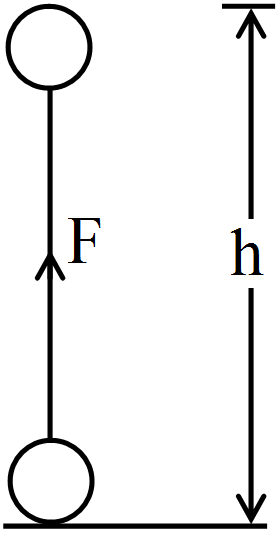
  1. F = mg

As the distance is moved in the direction of force applied
Work done = Force distance
W = F × h = mgh

Need a full question paper?

Generate a complete, print-ready paper with questions like this in minutes — across 16+ boards, with answer keys.

Start Generating Free

Similar questions

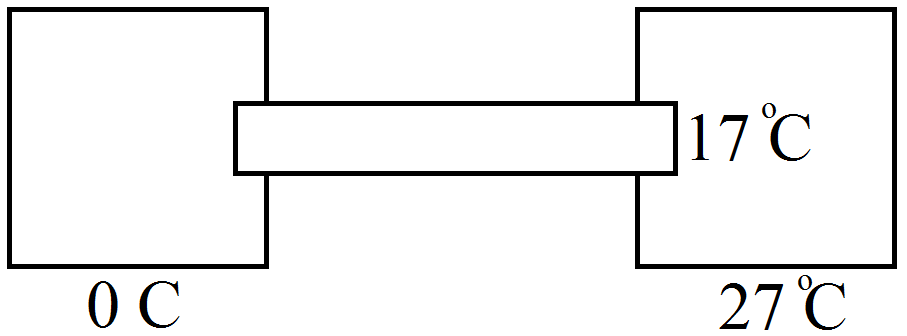
A cylindrical rod of length 50cm and cross sectional area $1cm^2$ is fitted between a large ice chamber at 0°C and an evacuated chamber maintained at 27°C as shown in figure. Only small portions of the rod are inside the chambers and the rest is thermally insulated from the surrounding. The cross section going into the evacuated chamber is blackened so that it completely absorbs any radiation falling on it. The temperature of the blackened end is 17°C when steady state is reached. Stefan constant $\sigma=6\times10^{-8}\text{W/m}^{-2}\text{K}^{-4}.$ Find the thermal conductivity of the material of the rod.
The radius of gyration of a uniform disc about a line perpendicular to the disc equals its radius. Find the distance of the line from the centre.
The density p of a piece of metal of a mass m and volume V is given by the formula = $\frac{\text{M}}{\text{V}}.,$ If $\text{m} = 375.32  \pm0.01\text{g},$ and $\text{V} = 136.41\pm  0.01\text{cm}^3$ Find % error in $\rho$
Figure shows a smooth track, a part of which is a circle of radius R. A block of mass m is pushed against a spring of spring constant k fixed at the left end and is then released. Find the initial compression of the spring so that the block presses the track with a force mg when it reaches the point P, where the radius of the track is horizontal.
A uniform rod of mass 300g and length 50cm rotates at a uniform angular speed of 2rad/s about an axis perpendicular to the rod through an end. Calculate:
  1. The angular momentum of the rod about the axis of rotation.
  2. The speed of the centre of the rod.
  3. Its kinetic energy.
The temperature of $3\ kg$ krypton gas is raised from $-29^\circ C$ to $89^\circ C$.
  1. If this is done at constant volume, compute the heat added, the work done, and the change in internal energy.
  2. Repeat if the heating process is at constant pressure.
For $K_r, \text{C}_\upsilon=0.0357\ \text{cal/gm}^\circ\text{C}$ and $\text{C}_\text{P}=0.0595\ \text{cal/gm}^\circ\text{C.}$
The displacement of a particle executing periodic motion is given by:$\text{y}=4\cos^2\Big(\frac{\text{t}}{2}\Big)\sin(1000\text{t}).$ Find independent constituent simple harmonic motion.
A Carnot engine whose heat sink is at $27°C$ has an efficiency of $40\%$. By how many degrees should the temperature of source be changed to increase the efficiency by $10\%$ of the original efficiency?
Two heavy spheres each of mass $100kg$ and radius $0.10m$ are placed $1.0m$ apart on a horizontal table. What is the gravitational force and potential at the mid point of the line joining the centres of the spheres? Is an object placed at that point in equilibrium? If so, is the equilibrium stable or unstable?
The specific heat capacities of hydrogen at constant volume and at constant pressure are $2.4 \mathrm{cal}^{-} \mathrm{g}^{-1}{ }^{\circ} \mathrm{C}^{-1}$ and $3.4 \mathrm{cal}-$ $\mathrm{g}^{-1}{ }^{\circ} \mathrm{C}^{-1}$ respectively. The molecular weight of hydrogen is $2 \mathrm{~g}-\mathrm{mol}^{-1}$ and the gas constant, $\mathrm{R}=8.3 \times 10^7 \mathrm{erg}^{\circ} \mathrm{C}^{-1} \mathrm{~mol}^{-}$ ${ }^1$. Calculate the value of $J$.