Question
Work done by a frictional force is

Answer

(d)Work done by friction can be positive, negative and zero depending upon the situation.

Need a full question paper?

Generate a complete, print-ready paper with questions like this in minutes — across 16+ boards, with answer keys.
Start Generating Free

Similar questions

Assertion : Photoelectric saturation current increases with the increase in frequency of incident light.
Reason : Energy of incident photons increases with increase in frequency and as a result photoelectric current increases.
What are the speeds of two objects if, when they move uniformly towards each other, they get $4\,m$ closer in each second and when they move uniformly in the same direction with the original speeds, they get $4.0\,m$ closer each $10\,s$ ?
The type of waves that can be propagated through solid is
A force $\overrightarrow{ F }=(\hat{ i }+2 \hat{ j }+3 \hat{ k }) N$ acts at a point $(4 \hat{ i }+3 \hat{ j }-\hat{ k }) m \cdot$ Then the magnitude of torque about the point $(\hat{i}+2 \hat{j}+\hat{k}) m$ will be $\sqrt{ x } N - m .$ The value of $x$ is$........$
The breaking stress of wire going over a smooth pully is $2 \times 10^9\, N/m^2$. What would be the minimum radius of wire used if it is not to break?
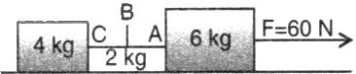
Two blocks of masses 6 kg and 4 kg connected by a rope of mass 2 kg are resting on a frictionless floor as shown in the following figure.
Image
If a constant force of 60 N is applied to 6 kg block, tension in the rope at points $A , B$ and C are respectively given by:
To find the spring constant $(k)$ of a spring experimentally, a student commits $2 \%$ positive error in the measurement of time and $1 \%$ negative error in measurement of mass. The percentage error in determining value of $\mathrm{k}$ is :
In Young's double slit experiment, if monochromatic light is replaced by white light
A beam of light of $\lambda = 600 \,\,nm$ from a distant source falls on a single slit $1\,\, mm$ wide and the resulting diffraction pattern is observed on a screen $2\,\, m$ away. The distance between first dark fringes on either side of the central bright fringe is 
The potential energy of a body of mass $m$ is given by $U = ax + by$, where $x$ and $y$ are the position coordinates of the particle. The acceleration of the particle is