MCQ
Work done by a sample of an ideal gas in a process $A$ is double the work done in another process $B.$ The temperature rises through the same amount in the two processes. If $C_A$ and $C_B$ be the molar heat capacities for the two processes:
  • A
    $C_A = C_B$
  • B
    $C_A < C_B$
  • $C_A > C_B$
  • D
    $C_A$ and $C_B$ cannot be defined.

Answer

Correct option: C.
$C_A > C_B$
According to the first law of thermodynamics, $\triangle\text{Q}=\triangle\text{U}+\triangle\text{W},$
where $\triangle\text{Q}$ is the heat supplied to the system when $\triangle\text{W}$ work is done on the system and $\triangle\text{U}$ is the change in internal energy produced.
Since the temperature rises by the same amount in both processes, change in internal energies are same,
i.e. $\triangle\text{U}_\text{A}=​​​​\triangle\text{U}_\text{B}.$
But as, $\triangle\text{W}_\text{A}=​​​​\triangle\text{W}_\text{B}$ this gives $\triangle\text{Q}_\text{A}=2\triangle\text{Q}_\text{B}.$
Now, molar heat capacity of a gas, $\text{C}=\frac{\triangle\text{Q}}{\text{n}\triangle\text{T}},$
where $\triangle\frac{\text{Q}}{\text{n}}$ is the heat supplied to a mole of gas and $\triangle\text{T}$ is the change in temperature produced.
As $\triangle\text{Q}_\text{A}=2\triangle\text{Q}_\text{B},\text{C}_\text{A}>\text{C}_\text{B}.$

Need a full question paper?

Generate a complete, print-ready paper with questions like this in minutes — across 16+ boards, with answer keys.

Start Generating Free

Similar questions

A narrow beam of white light goes through a slab having parallel faces.
  1. The light never splits in different colours.
  2. The emergent beam is white.
  3. The light inside the slab is split into different colours.
  4. The light inside the slab is white.
If a body is thrown up with the velocity of $15 \,m/s$ then maximum height attained by the body is..........$m$ ($g = 10\,m/{s^2}$)
Two liquids of densities $d_1$ and $d_2$ are flowing in identical capillary tubes uder the same pressure difference. Ift $t_1$ and $t_2$ are time taken for the flow of equal quantities (mass) of liquids, then the ratio of coefficient of viscosity of liquids must be
A sample of an ideal gas undergoes an isothermal expansion. If $d Q, d U$ and $d W$ represent the amount of heat supplied, the change in internal energy and the work done respectively, then
The diameters of two planets are in ratio $4:1$ . Their mean densities have ratio $1:2$ . The ratio of gravitational acceleration on the surface of planets will be
Which of the following can not determine the state of a thermodynamic system
Who among the following gave first the experimental value of $G$
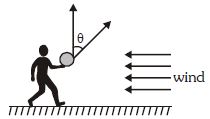
A body throws a ball upwards with velocity $v_0 = 20\, m/s$ . The wind imparts a horizontal acceleration of $4\, m/s^2$ to the ball. The angle $\theta $ from vertical at which the ball must be thrown so that the ball returns to the boy's hand is $(g = 10\, m/s^2)$
The moment of inertia of a solid cylinder about its axis is $I$. It is allowed to roll down an incline without slipping. If its angular velocity at the bottom be $\omega $, then $K.E.$ of the cylinder will be
Two cars $A$ and $B$ are travelling in the same direction with velocities ${v_1}$ and ${v_2}$$({v_1} > {v_2})$. When the car $A$ is at a distance $d$ ahead of the car $B$, the driver of the car $A$ applied the brake producing a uniform retardation $a$ There will be no collision when