Question
Would you expect the second electron gain enthalpy of O as positive, more negative or less negative than the first? Justify your answer.

Answer

For oxygen atom:
$\text{O}(\text{e}) + \text{e}^{-} \rightarrow \text{O}^{-}(\text{g}) (\Delta\text{eg} \text{H} = -141 \ \text{kj}\ \text{mol}^{-})$
$\text{O} (\text{g}) + \text{e}^{-} \rightarrow \text{O} ^{2-} (\text{g}) (\Delta\text{eg}\text{H} = + 780\ \text{KJ}\ \text{mol}^{-1})$
The first electron gain enthalpy of oxygen is negative because energy is released when a gaseous atom accepts an electron to form monovalent anion. The second electron gain enthalpy is positive because energy is needed to overcome the force of repulsion between monovalent anion and second incoming electron.

Need a full question paper?

Generate a complete, print-ready paper with questions like this in minutes — across 16+ boards, with answer keys.

Start Generating Free

Similar questions

Calculate the equilibrium constant for the following reaction at 298K and 1atm pressure $\text{NO(g)}+\frac{1}{2}\text{O}_2(\text{g})\rightleftharpoons\text{NO}_2(\text{g})$
Given $\Delta \mathrm{H}_{\mathrm{f}}^{\circ}$ at $298 \mathrm{~K}^{-20} \mathrm{NO}(\mathrm{g})=90.4 \mathrm{~kJ} \mathrm{~mol}^{-1}$ and $\mathrm{NO}_2(\mathrm{~g})=33.8 \mathrm{~kJ} \mathrm{~mol}^{-1}, \Delta \mathrm{~S}^{\circ}$ at $298 \mathrm{~K}^{-}$for the reaction $=-70.0 \mathrm{JK}^{-}$ ${ }^1 \mathrm{~mol}^{-1}, \mathrm{R}=8.31 \mathrm{JK}^{-1} \mathrm{~mol}^{-1}$.
What is the hybrid state of:
i. B in $\mathrm{BF}_3$.
ii. Al in $\mathrm{AlCl}_3$,
iii. Be in $\mathrm{BeCl}_2$,
iv. C in $\mathrm{CO}_2$ and $\mathrm{C}_2 \mathrm{H}_4$,
v. S in $\mathrm{SO}_2$ and $\mathrm{SO}_3$ ?
Assuming the water vapor to be a perfect gas, calculate the internal energy change when 1 mol of water at $100^{\circ} C$ and 1 bar pressure is converted to the ice at $0^{\circ} C$. Given the enthalpy of fusion of ice is 6.00 kJ mol1 heat capacity of water is $4.2 J / g ^{\circ} C$.
If 0.561g of KOH is dissolved in water to give 200mL of solution at 298K. Calculate the concentrations of potassium, hydrogen and hydroxyl ions. What is its pH?
Write reactions to justify amphoteric nature of aluminium.
  1. In the following redox reactions, identify the oxidation and reducing agents:
  1. $\text{H}_3\text{PO}\text{(aq)}+2\text{HgCl}_2+2\text{H}_2\text{O}\text{(aq)}\\ \xrightarrow{ \ \ \ \ }\text{H}_3\text{PO}_4\text{(aq)}+2\text{Hg(l)}+4\text{HCl(aq)}$
  2. $\text{O}_2\text{(g)}+\text{PtF}_6\text{g}\xrightarrow{ \ \ \ \ }\text{O}_2^+[\text{PtF}_6]^\ominus\text{(s)}$
  1. Why does $H_2S$ acts as reducing agent only whereas $SO_2$​​​​​​​ acts as bot oxidant as wells as rductant?
Which of the following Lewis structure of $\text{CO}_2$ molecule is least significant resonating form?
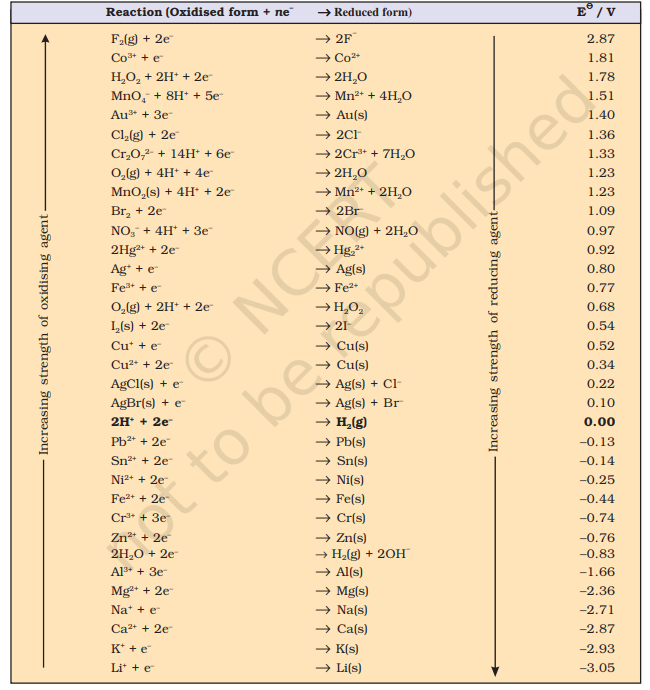
Using the standard electrode potentials given in the Table, predict if the reaction between the following is feasible:

$\mathrm{Ag}(\mathrm{s})$ and $\mathrm{Fe}^{3+}(\mathrm{aq})$.
5.975g of the higher oxide of metal gave 5.575g of lower oxide on heating. The quantity of the lower oxide gave 5.175g of metal on reduction. Prove that these results are in accordance with the law of multiple proportions.
Write the Lewis structure of hydrogen peroxide.