Question
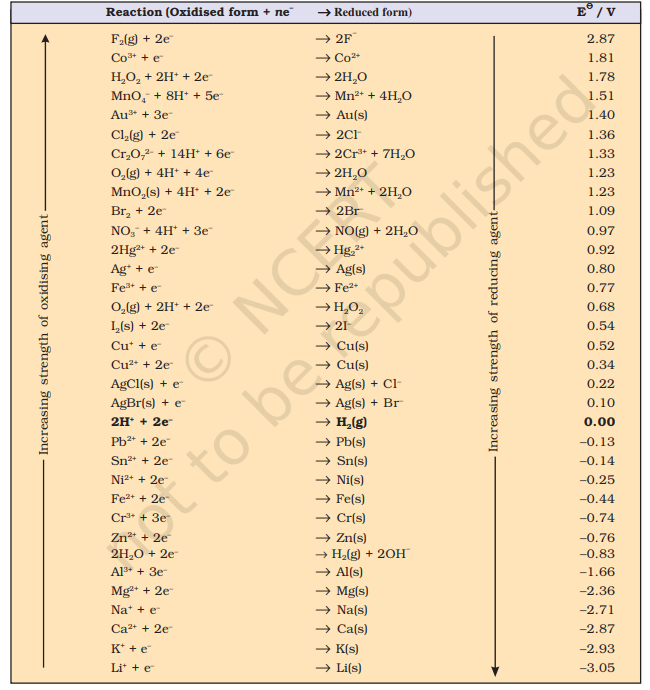
Using the standard electrode potentials given in the Table, predict if the reaction between the following is feasible:
$\mathrm{Ag}(\mathrm{s})$ and $\mathrm{Fe}^{3+}(\mathrm{aq})$.

Answer

The possible reaction between $\mathrm{Ag}(\mathrm{s})$ and $\mathrm{Fe}^{3+}(\mathrm{aq})$. is given by, $\text{Ag}_{(\text{s})}+2\text{Fe}^{3+}_{(\text{aq})}\rightarrow\text{Ag}^{+}_{(\text{aq})}+\text{Fe}^{2+}_{(\text{aq})}$ $\text{Oxidation half equation:}\ \ \ \ \ \ \ \text{Ag}_{(\text{s})}\xrightarrow{\ \ \ \ \ \ }\text{Ag}^{+}_{(\text{aq})}+\text{e}^-;\ \ \text{E}^\circ=-0.80\text{V}\\\text{Reduction half equation:}\ \ \text{Fe}^{3+}_{(\text{aq})}+\text{e}^-\xrightarrow{\ \ \ \ \ }\text{Fe}^{2+}_{(\text{aq})};\ \ \ \ \ \ \ \ \text{E}^\circ=+0.77\text{V}\\\overline{\ \ \ \ \ \ \ \ \ \ \ \ \ \ \ \ \ \ \ \ \ \ \ \ \ \ \ \ \ \ \ \ \ \ \ \ \ \ \ \ \ \ \ \ \ \ \ \ \ \ \ \ \ \ \ \ \ \ \ \ \ \ \ \ \ \ \ \ \ \ \ \ \ \ \ \ \ \ \ \ \ \ \ \ \ \ \ \ \ \ \ \ \ \ \ \ \ \ \ \ \ \ \ \ \ \ \ \ \ \ \ \ \ \ \ \ \ \ }\\\ \ \ \ \ \ \ \ \ \ \ \ \ \ \ \ \ \ \ \ \ \ \ \ \ \ \ \ \ \ \ \ \ \text{Ag}^{}_{(\text{s})}+\text{Fe}^{3+}_{(\text{aq})}\xrightarrow{\ \ \ \ \ }\text{Ag}^{+}_{(\text{aq})}+\text{Fe}^{2+}_{(\text{aq})};\ \ \ \text{E}^\circ=-0.03\text{V}$Here, E° for the overall reaction is negative. Hence, the reaction between $\mathrm{Ag}(\mathrm{s})$ and $\mathrm{Fe}^{3+}(\mathrm{aq})$. is not feasible.
Need a full question paper?

Generate a complete, print-ready paper with questions like this in minutes — across 16+ boards, with answer keys.

Start Generating Free

Similar questions

What happens when:
  1. Aluminium is treated with dilute NaOH.
  2. Boric acid is added to water.
  3. Diborane is reacted with $\text{H}_2\text{O}$.
  1. Write IUPAC name of the following:
  1. $\text{CH}_2\text{CH}_2\text{CHO}\text{ and }\text{CH}_3\text{C}-\text{CH}_3\\ \ \ \ \ \ \ \ \ \ \ \ \ \ \ \ \ \ \ \ \ \ \ \ \ \ \ \ \ \ \ \ \ \ \ \ \ \ \ \ \ \ ||\\ \ \ \ \ \ \ \ \ \ \ \ \ \ \ \ \ \ \ \ \ \ \ \ \ \ \ \ \ \ \ \ \ \ \ \ \ \ \ \ \ \ \text{O}$
  2. Draw the structure of 3-oxopentanal.
Draw the structure of
(i) $\mathrm{BeCl}_2$​​​​​​​ (vapour)
(ii) $\mathrm{BeCl}_2$ (solid).
The quantum numbers of six electrons are given below. Arrange them in order of increasing energies. If any of these combination(s) has/ have the same energy lists:
  1. $\text{n}=4,\text{l}=2,\text{m}_\text{l}=-2,\text{m}_{\text{s}}=-\frac{1}{2}$
  2. $\text{n}=3,\text{l}=2,\text{m}_\text{l}=1,\text{m}_{\text{s}}=+\frac{1}{2}$
  3. $\text{n}=4,\text{l}=1,\text{m}_\text{l}=0,\text{m}_{\text{s}}=+\frac{1}{2}$
  4. $\text{n}=3,\text{l}=2,\text{m}_\text{l}=-2,\text{m}_{\text{s}}=-\frac{1}{2}$
  5. $\text{n}=3,\text{l}=1,\text{m}_\text{l}=-1,\text{m}_{\text{s}}=+\frac{1}{2}$
  6. $\text{n}=4,\text{l}=1,\text{m}_\text{l}=0,\text{m}_{\text{s}}=+\frac{1}{2}$
For real gases the relation between p, V and T is given by van der Waals equation:
$\Big(\text{P}+\frac{\text{an}^2}{\text{V}^2}\Big)(\text{V}-\text{nb})=\text{nRT}$
Where ‘a’ and ‘b’ are van der Waals constants, ‘nb’ is approximately equal to the total volume of the molecules of a gas.
‘a’ is the measure of magnitude of intermolecular attraction.
  1. Arrange the following gases in the increasing order of ‘b’. Give reason. $O_2, CO_2, H_2, He.$
  2. Arrange the following gases in the decreasing order of magnitude of ‘a’. Give reason.$CH_4, O_2, H_2.$
Arrange the elements N, P, O and S in the order of:
  1. Increasing first ionisation enthalpy.
  2. Increasing non metallic character. Give reason for the arrangement assigned.
Describe what you need to do in the laboratory to test
i. the law of conservation of mass,
ii. the law of definite proportion
iii. the law of multiple proportions.
Correct the following electronic configuration of the elements in the ground state.
  1. $1\text{s}^2\ 2\text{s}^1,2\text{p}^2_\text{x},2\text{p}^2_\text{y},2\text{p}^2_\text{z},3\text{s}62,2\text{p}^1_\text{x}$
  2. $1\text{s}^2\ 2\text{s}^1,2\text{p}^1_\text{x},2\text{p}^1_\text{y},2\text{p}^1_\text{z}$
  3. $1\text{s}^2\ 2\text{s}^1,2\text{p}^6,3\text{s}^2,3\text{p}^6,3\text{d}^5$
  4. $1\text{s}^2\ 2\text{s}^2,2\text{p}^6,3\text{p}^6,3\text{d}^4,4\text{s}^2$
  1. Draw cis and trans-structures for Hex-2-ene. Which isomer will have higher boiling point and why?
  2.  
What are the advantages in using hydrogen as a fuel?