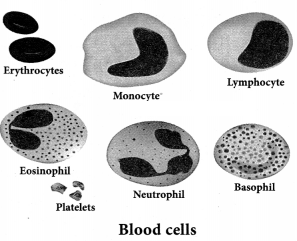
Blood is a fluid connective tissue.
Blood contains corpuscles which are red blood cells (erythrocytes), white blood cells (leucocytes) and platelets. In this fluid connective tissue, the blood cells move in a fluid matrix called. The plasma contains inorganic salts and organic substances. It is a main circulating fluid that helps in the transport of nutrient substances.Red blood corpuscles (Erythrocytes):
- The red blood corpuscles are oval shaped, circular, biconcave disc-like and lack nucleus when mature (mammalian RBC).
- They contain a respiratory pigment called haemoglobin which is involved in the transport of oxygen to tissues.
White blood corpuscles (Leucocytes): They are larger in size, contain distinct nucleus and are colourless. They are capable of amoeboid movement and play an important ‘ role in body’s defense mechanism. WBC’s are of two types :
(i) Granulocytes.
(ii) Agranulocytes.(i) Granulocytes have irregular shaped nuclei and cytoplasmic granules. They include the neutrophils, basophils and eosinophils. Agranulocytes lack cytoplasmic granules and include the lymphocytes and monocytes.Blood platelets : They are minute, anucleated, fragile fragments of giant bone marrow called mega karyocytes They play an important role in blood clotting mechanism.