Question
Write a note on Mechanism of $ \text{(DNA)}$ replication
Answer

$\rightarrow$ In living cells, such as $E.$coli, the process of replication requires a set of catalysts $($enzymes$).$
$\rightarrow$ The main enzyme is referred to as $ \text{(DNA)}-$ dependent $ \text{(DNA)}$ polymerase, since it uses a $ \text{(DNA)}$ template to catalyse the polymerisation of deoxynucleotides.
$\rightarrow$ These enzymes are highly efficient as they have to catalyse polymerisation of a large number of nucleotides in a very short time.
$\rightarrow$ $E.$ coli that has only $4.6 \times 10^6 \ bp \ ($compare it $6$ with human whose diploid content is $6.6 \times 10^9 \ bp),$ completes the process of replication within $18$ minutes; that means the average rate of polymerisation has to be approximately $2000 \ bp$ per second.
Not only do these polymerases have to be fast, but they also have to catalyse the reaction with high degree of accuracy.
Any mistake during replication would result into mutations. Furthermore, energetically replication is a very expensive process.
$\rightarrow$ Deoxyribonucleoside triphosphates serve dual purposes.
$(i)$ act as a substrates.
$(ii)$ provide energy for polymerisation reaction $($the two terminal phosphates in a deoxynucleoside triphosphates are high$-$ energy phosphates, same as in case of $ \text{ATP).}$
$\rightarrow$ $ \text{(DNA)}$-dependent $ \text{(DNA)}$ polymerases:
$\rightarrow$ In addition to $ \text{(DNA)}$$-$dependent $ \text{(DNA)}$ polymerases, many additional enzymes are required to complete the process of replication with high degree of accuracy.
$\rightarrow$ Replication fork:
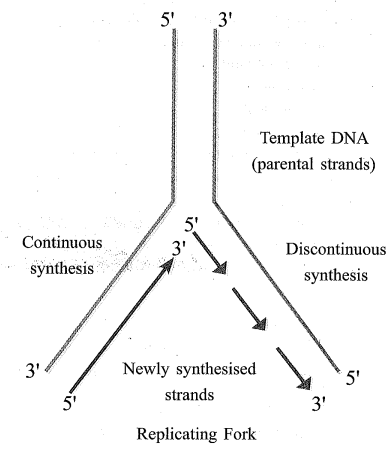
$\rightarrow$ For long $ \text{(DNA)}$ molecules, since the two strands of $ \text{(DNA)}$ cannot be separated in its entire length (due to very high energy requirement), the replication occurs within a small opening of the $ \text{(DNA)}$ helix, referred to as replication fork.
$\rightarrow$ Continuous, discontinuous. Strands:
$\rightarrow$ The $ \text{(DNA)}-$dependent $ \text{(DNA)}$ polymerases catalyse polymerisation only in one direction, that is $5\ '$ $\rightarrow$ $3\ '.$
$\rightarrow$ This creates some additional complications at the replicating fork.
$\rightarrow$ Consequently, on one strand (the template with polarity $3\ '$ $\rightarrow$ $5\ '),$ the replication is continuous, while on the other (the template with polarity $5\ '$ $\rightarrow$ $3\ '),$ it is discontinuous.
$\rightarrow$ The discontinuously synthesised fragments are later joined by the enzyme $ \text{(DNA)}$ ligase.
$\rightarrow$ Origin of replication:
$\rightarrow$ The $ \text{(DNA)}$ polymerases on their own cannot initiate the process of replication.
$\rightarrow$ Also the replication does not initiate randomly at any place in $ \text{(DNA)}$.
$\rightarrow$ There is a definite region in $E.$ coli $ \text{(DNA)}$ where the replication originates. Such regions are termed as origin of replication.
$\rightarrow$ It is because of the requirement of the origin of replication that a piece of $ \text{(DNA)}$ if needed to be propagated during recombinant $ \text{(DNA)}$ procedures, requires a vector.
$\rightarrow$ The vectors provide the origin of replication.
$\rightarrow$ Cell division $ \text{(DNA)}$ replication:
$\rightarrow$ In eukaryotes, the replication of $ \text{(DNA)}$ takes place at $S-$phase of the cell$-$cycle.
$\rightarrow$ The replication of $ \text{(DNA)}$ and cell division cycle should be highly coordinated.
$\rightarrow$ A failure in cell division after $ \text{(DNA)}$ replication results into polyploidy $($a chromosomal anomaly$).$
Image

Need a full question paper?

Generate a complete, print-ready paper with questions like this in minutes — across 16+ boards, with answer keys.
Start Generating Free

Similar questions

Read the following text carefully and answer the questions that follow:
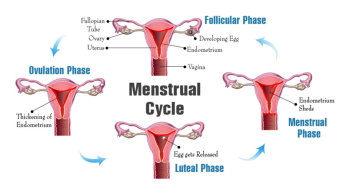
The image below shows the menstrual cycle of a human female. On the basis of this cycle:
Image
i. Explain the menstrual phase in a human female. State the level of ovarian and pituitary hormones during this phase. (1)
ii. Why is follicular phase in the menstrual cycle also referred as proliferative phase? Explain. (1)
iii. Explain the events that occur in a Graafian follicle at the time of ovulation and thereafter. (2)
OR
Draw a Graafian follicle and label antrum and secondary oocyte. (2)
Read the following text carefully and answer the questions that follow:
The pathogen of a disease depends on RBCs of human for growth and reproduction. The person with this
pathogen suffers with chill and high fever.
Image
i. Identify the disease. (1)
ii. Name the pathogen. (1)
iii. What is the cause of fever? (2)
OR
Represent the life cycle of the pathogen diagrammatically. (2)
Nematode specific genes were introduced into the tobacco host plant using a vector:
Read the following and answer any four questions front (i) to (v) given below:
Gene regulation is the mechanism of switching off and switching on of the genes depending upon the requirement of cells and the state of development. Gene regulation is of two types : negative and positive. In negative generegulation the genes continue expressing their effect till their activity is suppressed. Positive gene regulation is the one in which the genes remain non-expressed unless and until they are induced to do it. Operon model is a co-ordinated group of genes such as structural gene, operator gene, promoter gene, regulator gene which function together and regulate a metabolic pathway as a unit, e.g., lac operon, trp operon, ara operon, etc.
  1. Regulation of gene expression occurs at the level of.
  1. Transcription
  2. Processing/splicing
  3. Translation
  4. All of these.
  1. Inducible operon system usually occurs in A pathways. Nutrient molecules serve as B to stimulate production of the enzymes necessary for their breakdown. Genes for inducible operon are usually switched C and the repressor is synthesised in an D form.
S.no
A
B
C
D
(a)
anabolic
corepressor
on
inactive
(b)
anabolic
inducer
off
active
(c)
catabolic
inducer
off
active
(d)
catabolic
corepressor
on
inactive
  1. An mRNA molecule transcribed from the lac operon contains nucleotide sequences complementary to.
  1. Structural genes coding for the enzymes.
  2. the operator region
  3. the promotor region
  4. the repressor gene.
  1. Which statement correctly describes the control of transcription of the genes involved in the breakdown of lactose in Estherichia coli?
  1. A repressor protein binds to the operator and the genes are switched on.
  2. A repressor protein binds to the operator and the genes are switched off.
  3. A transcription factor binds to the promoter and the genes are switched on.
  4. A transcription factor binds to the promoter and the genes are switched off.
  1. Function of catabolic activator protein in lac operon is.
  1. To form mRNA
  2. Help to bind RNA polymerase
  3. Code for repressor
  4. To activates lac gene when glucose is absent.
Assuming that within a population of beetles where Hardy Weinberg conditions are met, the colour black $(B)$ is dominant over the colour red $(b). 40\%$ of all beetles are red $(bb).$
Given this information, answer the questions below:
$A.$ What is the frequency of red beetles?
$B.$ Calculate is the percentage of beetles in the population that are heterozygous.
$C.$ What is the frequency of homozygous dominant individuals?
$OR$
$D.$ Assuming that Hardy Wienberg conditions are met in the beetle population consisting of $1500$ beetles. How many beetles would you expect to be black and red in colour respectively?
Read the following and answer any four questions from (i) to (v) given below:
Non-native or alien species are often introduced in advertently for their economic and other uses. They often become invasive and drive away the local species. Exotic species have proved harmful to both aquatic and terrestrial ecosystems. For example, water hyacinth (Eichhornia crassipes) was introduced in Indian waters to reduce pollution. It was clogged water bodies including wetlands at many places resulting in death of several aquatic plants and animals.
  1. Island water ecosystem are the most vulnerable due to:
  1. Small size.
  2. Small number of species.
  3. Increases reproductive capacity.
  4. Both (a) and (b).
  1. Which of the following is not an alien species?
  1. Lantana camara.
  2. Periplaneta americana.
  3. Nile Perch.
  4. Yucca moth.
  1. Second major cause of species extinction is:
  1. Habitat loss and fragmentation.
  2. Over exploitation.
  3. Alien species invasion.
  4. Co-extinction.
  1. Assertion: Eichhomia crassipes drains off oxygen from water and can be seen growing in standing water.
Reason: Eichhornia crassipes is an indigenous species of India.
  1. Both assertion and reason are true and reason is the correct explanation of assertion.
  2. Both assertion and reason are true but reason is not the correct explanation of assertion.
  3. Assertion is true but reason is false.
  4. Both assertion and reason are false.
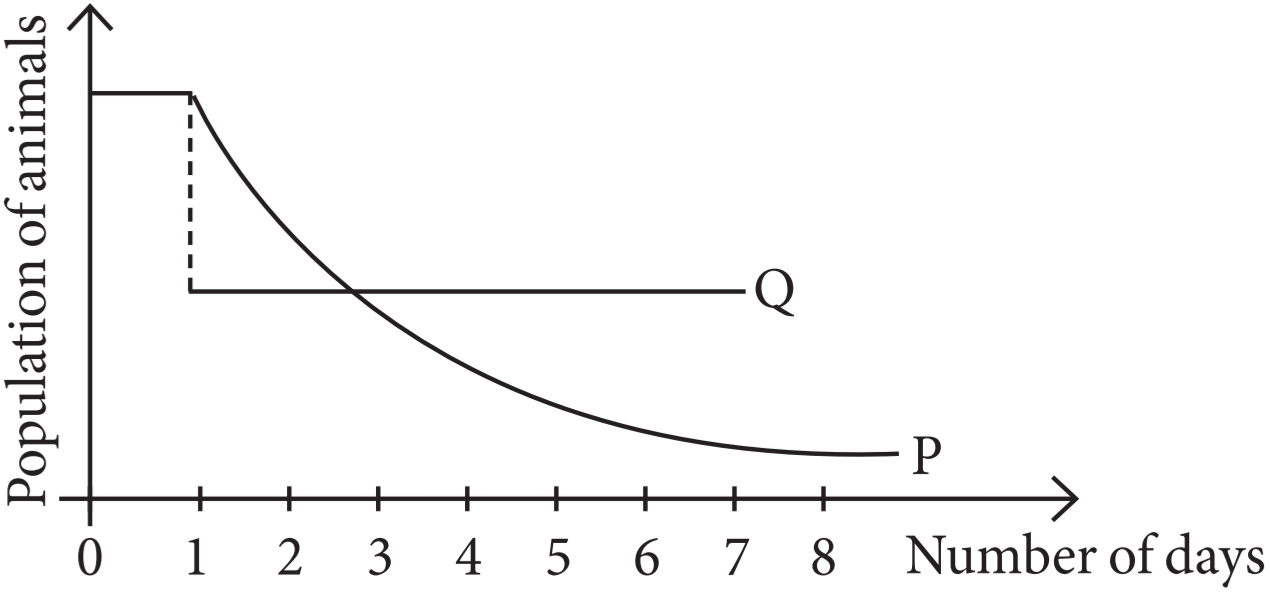
  1. The population of species Pin a certain conununity was constant until a population species Q from a distant land was subsequently introduced into that community. The interaction between the two populations is reflected in the graph below.


What could be the possible reason for the decrease in the population of species P over a number of days?
  1. Species Q is a predator of species P.
  2. Species Q is a prey species which wiped out the population of species P.
  3. Species P and Q compete for space but feeds on different food.
  4. None of these.
Read the following text carefully and answer the questions that follow:
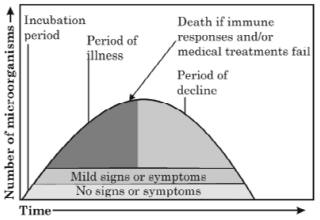
When a microorganism invades a host, a definite sequence of events usually occur leading to infection and disease, causing suffering to the host. This process is called pathogenesis. Once a microorganism overcomes the defense system of the host, development of the disease follows a certain sequence of events as shown in the graph. Study the graph given below for the sequence of events leading to appearance of a disease and answer the questions that follow:
Image
i. In which period, according to the graph there are maximum chances of a person transmitting a disease/infection and why? (1)
ii. Study the graph and write what is an incubation period. Name a sexually transmitted disease that can be easily transmitted during this period. Name the specific type of lymphocytes that are attacked by the pathogen of this disease. (1)
iii. Draw a schematic labelled diagram of an antibody. (2)
OR
In which period, the number of immune cells forming antibodies will be the highest in a person suffering from pneumonia?
Name the immune cells that produce antibodies. (2)
Explain the methods for making host cell competent to insert the r DNA.
Microbes are useful in household products. Explain this with suitable examples
Microbes can be used to decrease the use of chemical fertilizers and pesticides. Explain how this can be accomplished.###How biofertilizers increase fertility of soil?