Question
Microbes are useful in household products. Explain this with suitable examples

Answer

We use microbes. Our products are derived from them everyday.
(1) Curd: LABs are lactic acid bacteria.
→ They grow in milk and convert it to curd.
→ During growth, the LAB produce acids that coagulate and partially digest the milk proteins.
→ A small amount of a curd added to the fresh milk as inoculum or starter contain millions of LAB, which at suitable temperatures multiply, thus converting milk to curd.
→ LAB improves milk quality by increasing vitamin B12.
→ In our stomach too, the LAB play very beneficial role in checking diseases causing microbes.
2. Cheese:
→ Cheese is an edible substance. Microbes are used at different stages of cheese. making.
→ Different varieties of cheese are known by their characteristic texture, flavour and taste which is given by specific microbes used in the cheese production.
→ The large holes in "swiss cheese" are due to production of a large amount of carbon dioxide by a bacterium named Propionibacterium sharmanii.
→ The "Roquefort cheese" are ripened by growing a specific fungi on them, which gives them a particular flavour.
3. Batter:
→ The batter of dosa and idli is fermented by using bacteria. This batter looks puffed because of the production of carbon dioxide.
→ The dough, which is used for making bread, is fermented using saccharomyses cerevisiae- baker's yeast.
4. Toddy:
→ Some traditional drink and food is also produced by the help of microbes through fermentation.
→ In South India, traditional drink toddy is made by fermenting sap from palms.
5. Other food items:
→ To produce different food items fish, soyabean, bamboo etc. are passed through fermentation.
Need a full question paper?

Generate a complete, print-ready paper with questions like this in minutes — across 16+ boards, with answer keys.

Start Generating Free

Similar questions

Loss of habitat and fragmentation leads to loss in biodiversity. Explain with example.
Write a short note on endosperm development.
Write a short note on pollination by wind.
Write a short note on transcription unit.### Explain : Transcription unit
What is chromosomal disorder? Explain any two aneuploidy with characters in humans.###Mention any two autosomal genetic disorders with their symptoms.
Read the following and answer any four questions from (i) to (v) given below:
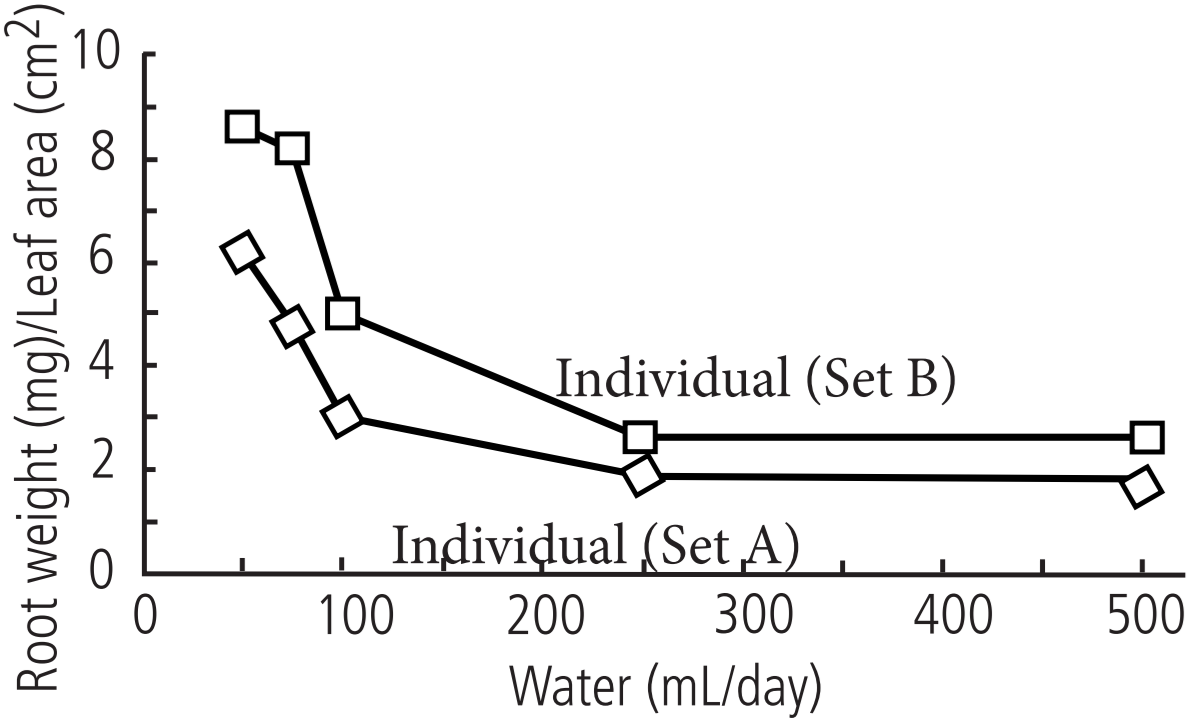
Ananya is a biologist, her research guide assigned project, i.e., to determine the effect ofin tra-specific competition on the growth of sapling of Eucalyptus. For this, she designed an experiment in which two sets of pots were used. ln the first set (set A) only I sapling was planted per pot and in the other set (set B) 16 saplings were planted per pot. To check for the effect of intra-specific competition on allocation of resources, a decreasing amount of water was added to each set. The results have been graphically indicated. Which of the following conclusions can indicated as follows:
  1. Which of the following statements can be concluded from the given study?
  1. More resources are allocated to the root during low water conditions.
  2. Competition for water among individuals of a population causes more root growth as compared to individuals who are growing alone.
  3. Lesser leaves are formed under low water conditions.
  4. Root growth is higher in individual grown singly as compared to individuals in populations.
  1. Which of the following associations is an example of competitions?
  1. Cuscuta and hedge plant.
  2. Balanus and Cathamalus.
  3. Cactus and moth.
  4. Orchid and mango.
  1. If '+' sign is assigned to beneficial interaction, '-' sign to detrimental and O sign to neutral interaction, then the population interaction of competition refers to:
  1. +, +
  2. -, -
  3. +, -
  4. +, 0
  1. lntraspecific competition is more severe due to:
  1. similar needs.
  2. similar adaptations.
  3. common resources.
  4. all of these.
  1. Assertion: Two members of a competing species may co-exist.
Reason: Different individuals of a species have different resource requirements.
  1. Both assertion and reason are true and reason is the correct explanation of assertion.
  2. Both assertion and reason are true but reason is not the correct explanation of assertion.
  3. Assertion is true but reason is false.
  4. Both assertion and reason are false.
Read the following and answer any four questions from (i) to (v) given below:
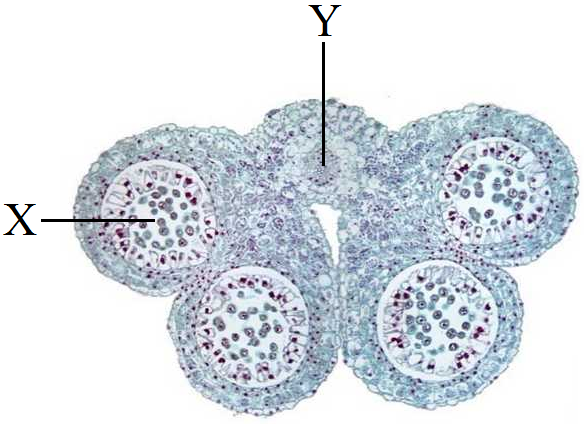
Many adaptations are found in flowers to achieve certain kind of pollination. The pollination achieved by insects is known as entomophily. The given diagram shows the cross-section of an anther of an insect pollinated flower.
  1. Which of the following is/ are the function(s) of structure Y?
  1. To carry waste products away from the anther.
  2. To supply oxygen to the cells of the anther.
  3. To transport food and mineral salts to the anther.
  4. To supply water to the anther.
  1. Conly.
  2. C and D only.
  3. A, B and D only.
  4. A, B, C and D.
  1. Which of the following most accurately describes the structures found in compartment X?
  1. They contain two haploid nuclei resulting from meiosis.
  2. They contain two haploid nuclei resulting from mitosis.
  3. They contain two haploid male gametes, resulting from mitosis.
  4. They contain a vegetative nucleus and pollen tube nucleus.
  1. Which of the following is a distinctive characteristic of insect-pollinated flower?
  1. All of them have nectar guides on their flowers.
  2. They produce sugary fruit.
  3. Their pollen grains tend to have rough surfaces.
  4. They produce abundant quantities of pollen to make up for pollen grains that might be removed by the wind.
  1. Which of the following are likely characteristics of the structures found in X and stamens of this plant?
S. No
Structure of X
Stamens
(a)
Abundant and light
Pendulous
(b)
Rough surfaces
Non-pendulous
(c)
Light and sticky
Pendulous
(d)
Coarse and sticky
Protrude outside the flower
  1. Spiny or sticky pollen grains and large, attractively coloured flowers are associated with:
  1. Hydrophily.
  2. Entomophily.
  3. Ornithophily.
  4. Anemophily.
Describe: Genetic engineered insulin
Bacteria cannot be seen with the naked eyes, but these can be seen with the help of a microscope. If you have to carry a sample from your home to your biology laboratory to demonstrate the presence of microbes with the help of a microscope, which sample would you carry and why?
Explain the amplification of gene of interest using PCR (Diagram is must)