Question
Write a note on Mechanism of DNA replication

Answer

→ In living cells, such as E.coli, the process of replication requires a set of catalysts (enzymes).
→ The main enzyme is referred to as DNA- dependent DNA polymerase, since it uses a DNA template to catalyse the polymerisation of deoxynucleotides.
→ These enzymes are highly efficient as they have to catalyse polymerisation of a large number of nucleotides in a very short time.
→ E.coli that has only 4.6 x 10⁶ bp (compare it 6 with human whose diploid content is 6.6 x 10⁹ bp), completes the process of replication within 18 minutes; that means the average rate of polymerisation has to be approximately 2000 bp per second.
Not only do these polymerases have to be fast, but they also have to catalyse the reaction with high degree of accuracy.
Any mistake during replication would result into mutations. Furthermore, energetically replication is a very expensive process.
→ Deoxyribonucleoside triphosphates serve dual purposes.
(i) act as a substrates.
(ii) provide energy for polymerisation reaction (the two terminal phosphates in a deoxynucleoside triphosphates are high- energy phosphates, same as in case of ATP).
→ DNA-dependent DNA polymerases:
→ In addition to DNA-dependent DNA polymerases, many additional enzymes are required to complete the process of replication with high degree of accuracy.
→ Replication fork:
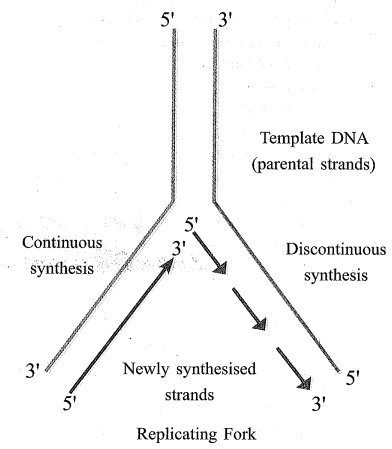
→ For long DNA molecules, since the two strands of DNA cannot be separated in its entire length (due to very high energy requirement), the replication occurs within a small opening of the DNA helix, referred to as replication fork.
→ Continuous, discontinuous. Strands:
→ The DNA-dependent DNA polymerases catalyse polymerisation only in one direction, that is 5' → 3'.
→ This creates some additional complications at the replicating fork.
→ Consequently, on one strand (the template with polarity 3' → 5'), the replication is continuous, while on the other (the template with polarity 5' → 3'), it is discontinuous.
→ The discontinuously synthesised fragments are later joined by the enzyme DNA ligase.
→ Origin of replication:
→ The DNA polymerases on their own cannot initiate the process of replication.
→ Also the replication does not initiate randomly at any place in DNA.
→ There is a definite region in E. coli DNA where the replication originates. Such regions are termed as origin of replication.
→ It is because of the requirement of the origin of replication that a piece of DNA if needed to be propagated during recombinant DNA procedures, requires a vector.
→ The vectors provide the origin of replication.
→ Cell division & DNA replication:
→ In eukaryotes, the replication of DNA takes place at S-phase of the cell-cycle.
→ The replication of DNA and cell division cycle should be highly coordinated.
→ A failure in cell division after DNA replication results into polyploidy (a chromosomal anomaly).
Image

Need a full question paper?

Generate a complete, print-ready paper with questions like this in minutes — across 16+ boards, with answer keys.

Start Generating Free

Similar questions

What is transgenic animals? How it is useful for man kind?
Read the following and answer any four questions from (i) to (v) given below:

Within a region, species richness increases with increasing explored area, but only upto a limit. TI1e given graph explains this relationship.

  1. What does the given figure show?
  1. Rivet-popper hypothesis.
  2. Species-area relationship.
  3. Proportionate number of species of major taxa.
  4. $\alpha-\text{ecological diversity }$
  1. Equation for relationship (A) between species richness and area is:
  1. $\log\text{ S}=\log\text{ C}+\text{Z }\log\text{ A}$

  2. $\log\text{ C}=\log\text{ S}+\text{Z }\log\text{ A}$

  3. $\text{Z }\log\text{ A}=\log\text{ S}+\log\text{ C}$

  4. $\log\text{ S}=\log\text{ C}+\log\text{ A}$

  1. What is the value of slope of line or regression coefficient Z for frugivorous birds?
  1. 0.1 - 0.2
  2. 1.15
  3. 0.01 - 0.1
  4. 0.6 - 1.2
  1. The shape of curve for relationship between species richness and areas for wide variety of taxa is:
  1. Straight line.
  2. Parabola.
  3. Rectangular hyperbola.
  4. Bell shaped.
  1. Who gave this concept of increase in species richness with increasing offered area?
  1. Humboldt.
  2. Odum.
  3. Edward Wilson.
  4. Paul Ehrlich.
The bacterium Bacillus thuringiensis is widely used in contemporary biology as:
  1. Agent for production of dairy products.
  2. Source of industrial enzyme.
  3. Indicator of water pollution.
  4. Insecticide.
Define decomposition and describe the processes and products of decomposition.###Describe factor affecting decomposition.
Read the following and answer any four questions from (i) to (v) given below:
The pollen grains or microspores are the male reproductive bodies of a flower and are contained in the pollen sac or microsporangia. Each pollen grain consists of a single microscopic cell, possessing two coats: the exine and the in tine. The exine of a pollen grain is made of chemically stable material. Because of this, pollen grains are often very well preserved for thousands of years in soil and sediments.
  1. One of the most resistant biological material present in the exine of pollen grain is:
  1. Pectocellulose.
  2. Sporopollenin.
  3. Suberin.
  4. Cellulose.
  1. The exine possesses one or more thin places known as:
  1. Raphe.
  2. Germ pores.
  3. Hilum.
  4. Endothecium.
  1. What is the function of germ pore?
  1. Emergence of radicle.
  2. Absorption of water for seed germination.
  3. Initiation of pollen tube.
  4. All of these.
  1. What is the key advantage to the plant for having such strong pollen grain walls?
  1. It protects the vital genetic material in the pollen grain.
  2. It allows pollen to serve as a valuable fossil record for the study of ancient plants.
  3. It prevents the pollen tube from growing out before the pollen grain reaches the stigma of a compatible species.
  4. It gives weight to the pollen grain, allowing it to cling better to the body surfaces of insect pollinators.
  1. The number of germ pores in dicots and monocots respectively are:
  1. One and three.
  2. Three and two.
  3. Two and three.
  4. Three and one.
Write a short note on endosperm development.
Explain Linkage & Recombination.
Discuss the important measures that are useful in preventing and controlling the use of alcohol and drugs in youth.
Polymerase chain reaction:
  1. Is a method of synthesising human protein from human DNA
  2. Uses restriction enzymes
  3. Can produce billions of copies of a DNA fragment
  4. Takes place naturally in bacteria
Give information about primary and secondary lymphoid organ ### Explain lymphatic organs of human lymphatic system. (Diagram is not required)