Question
Write a short note on endosperm development.

Answer

→ Endosperm development precedes embryo development.
→ The primary endosperm cell divides repeatedly and forms a triploid endosperm tissue.
→ The cells of this tissue are filled with reserve food materials and are used for the nutrition of the developing embryo.
→ In the most common type of endosperm development, the PEN undergoes successive nuclear divisions to give rise to free nuclei. This stage of endosperm development is called free-nuclear endosperm.
→ Subsequently cell wall formation occurs and the endosperm becomes cellular.
→ The number of free nuclei formed before cellularisation varies greatly.
→ The coconut water from tender coconut that you are familiar with, is nothing but free- nuclear endosperm (made up of thousands of nuclei) and the surrounding white kernel is the cellular endosperm.
→ Endosperm may either be completely consumed by the developing embryo (e.g., pea, groundnut, beans) before seed maturation or it may persist in the mature seed (e.g. castor and coconut) and be used up during seed germination.
Need a full question paper?

Generate a complete, print-ready paper with questions like this in minutes — across 16+ boards, with answer keys.

Start Generating Free

Similar questions

Read the following and answer any four questions from (i) to (v) given below:
Non-native or alien species are often introduced in advertently for their economic and other uses. They often become invasive and drive away the local species. Exotic species have proved harmful to both aquatic and terrestrial ecosystems. For example, water hyacinth (Eichhornia crassipes) was introduced in Indian waters to reduce pollution. It was clogged water bodies including wetlands at many places resulting in death of several aquatic plants and animals.
  1. Island water ecosystem are the most vulnerable due to:
  1. Small size.
  2. Small number of species.
  3. Increases reproductive capacity.
  4. Both (a) and (b).
  1. Which of the following is not an alien species?
  1. Lantana camara.
  2. Periplaneta americana.
  3. Nile Perch.
  4. Yucca moth.
  1. Second major cause of species extinction is:
  1. Habitat loss and fragmentation.
  2. Over exploitation.
  3. Alien species invasion.
  4. Co-extinction.
  1. Assertion: Eichhomia crassipes drains off oxygen from water and can be seen growing in standing water.
Reason: Eichhornia crassipes is an indigenous species of India.
  1. Both assertion and reason are true and reason is the correct explanation of assertion.
  2. Both assertion and reason are true but reason is not the correct explanation of assertion.
  3. Assertion is true but reason is false.
  4. Both assertion and reason are false.
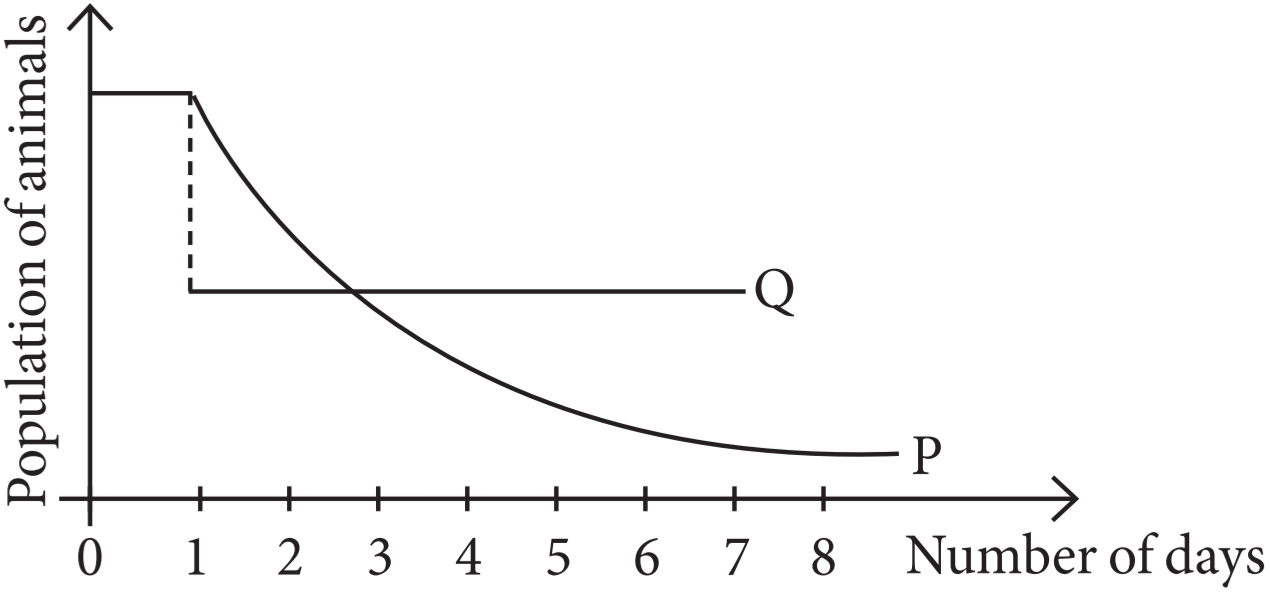
  1. The population of species Pin a certain conununity was constant until a population species Q from a distant land was subsequently introduced into that community. The interaction between the two populations is reflected in the graph below.


What could be the possible reason for the decrease in the population of species P over a number of days?
  1. Species Q is a predator of species P.
  2. Species Q is a prey species which wiped out the population of species P.
  3. Species P and Q compete for space but feeds on different food.
  4. None of these.
Read the following and answer any four questions from (i) to (v) given below:
Medical termination of pregnancy is termination of pregnancy before the fetus become viable. To reduce the incidence of illegal abortion and consequent maternal mortality, MTP Amendment Act, 2017 was enacted by the government of India. About 40-50 million MTPs are done in a year all over the world.
  1. Abortion can be safely done for about ______ weeks of pregnancy.
  1. 4
  2. 12
  3. 8-10
  4. 15-18
  1. How is MTP helpful in decreasing human population?
  1. By aborting normal female fetus.
  2. By aborting normal female fetus.
  3. By getting rid of unwanted pregnancies.
  4. None of these.
  1. Select an incorrect statement for MTP.
  1. Second trimester abortions are more risky than first trimester.
  2. It is being misused to abort normal female fetus.
  3. It helps to get rid of unwanted pregnancies.
  4. Child detected with congenital heart disease cannot be aborted.
  1. MTP was legalised by Government of India in:
  1. 1971
  2. 1982
  3. 1973
  4. 1991
  1. Assertion: MTPs are safe during first trimester of pregnancy.
Reason: After first trimester, fetus become intimately associated with the maternal tissues.
  1. Both assertion and reason are true, and reason is the correct explanation of assertion.
  2. Both assertion and reason are true, but reason is not the correct explanation of assertion.
  3. Assertion is true, but reason is false.
  4. Both assertion and reason are false.
Write a short note on transcription unit.### Explain : Transcription unit
Define decomposition and describe the processes and products of decomposition.###Describe factor affecting decomposition.
Explain the methods for making host cell competent to insert the r DNA.
Explain any two X-linked recessive disorder?
Differentiate between Monohybrid & Dihybrid Cross.
Explain- Restriction enzymes.
Read the following and answer any four questions from (i) to (v) given below:
Translation is the process of polymerisation of amino acids to form a polypeptide. The order and sequence of amino acids are defined by the sequence bases in the mRNA. The amino acids are joined by a bond called peptide bond. Ribosome is the site of protein synthesis.
  1. Which ion is essential for association of both units of ribosome at the time of protein formation?
  1. $\mathrm{Mg}^{2+}$
  2. $\mathrm{Mn}^{2+}$
  3. $\mathrm{Cl}^{-}$
  4. $\mathrm{Ca}^{2+}$
  1. During translation, how many initiation factors are required in eukaryotes for initiation reactions?
  1. 3
  2. 6
  3. 7
  4. 9
  1. Which part of mRNA contains untranslated regions (UTR)?
  1. 3' end
  2. 5' end
  3. Either 3' or 5' end
  4. Both 5' end and 3' end
  1. Name the enzyme that helps in combining amino acid to its particular tRNA?
  1. Activating enzyme
  2. Amino-acyl tRNA-synthetas
  3. PeptidyI transferase
  4. Both (a) and (b)
  1. From the given list, select the translation machinery.
  1. mRNA
  2. Ribosomes
  3. Amino acids
  4. tRNAs
  5. Peptidyl transferase
  6. Amino acyl tRNA synthetase
  7. Pyrophosphatase
  1. (1), (2), (3), (4) and (6)
  2. (1), (2), (3), (4) and (5)
  3. (1), (2), (3), (4), (5) and (6)
  4. (1), (2), (3), (4), (5), (6) and (7)
A regulatory body working under $\text{MoEF}$ for the release of transgenic crop is $............:$