Question
Write a short note on mobility of charge carriers.

Answer

Conductivity of conductor arises from mobile charge carriers.
In metals, electrons are mobile charge carriers. In an electrolyte they are positive and negative ions while in an ionised gas, they are electrons and positive charged ions. In semi conductors, free electrons and holes are mobile charge carriers.
"The magnitude of the drift velocity per unit electric field is called the mobility ( $\mu$ )."
$\mu=\frac{\left|\overrightarrow{v_d}\right|}{ E }$
The SI unit of mobility is $m ^2 / V s$ and practical unit is $cm ^2 / Vs$
Dimensional formula of mobility is $M ^{-1} L^0 T^2 A^1$
Using drift velocity $\left|\vec{v}_d\right|=\frac{E e}{m} \cdot \tau$ in equation (1).
we get,
$\begin{aligned}
\mu & =\frac{\frac{e E}{m} \tau}{ E } \\
\therefore \mu & =\frac{e \tau}{m}
\end{aligned}$
where $\tau$ is the average collision time for electrons.

Need a full question paper?

Generate a complete, print-ready paper with questions like this in minutes — across 16+ boards, with answer keys.
Start Generating Free

Similar questions

  1. Can two equipotential surfaces intersect each other? Give reasons.
  2. Two charges – q and +q are located at points A (0, 0, –a) and B (0, 0, +a) respectively. How much work is done in moving a test charge from point P (7, 0, 0) to Q (-3, 0, 0)?
Two electric dipoles whose dipole moments are $P$ and 64 P are placed on a line at a distance of 25 cm in opposite directions. If the electric field at any point between them is zero, then what will be the distance of this point from the electric potential $P$ ?
An electric current of 2.0A passes through a wire of resistance $25\Omega$. How much heat will be developed in 1minute?
What is wave-front ?
A ball is thrown vertically upward with a speed of 20m/s. Draw a graph showing the velocity of the ball as a function of time as it goes up and then comes back.
Ultraviolet light is incident on two photosensitive materials having work functions $W_1$ and $W_2 \ (W_1 > W_2).$ In which case will the kinetic energy of the emitted electrons be greater? Why?
Mention the disadvantages of phasor method of analysing AC circuits.
A convex lens (n = 1.5) of focal length fa is immersed.
  1. In water n = 1.33 and.
  2. In carbon disulphide n = 1.6, how does the lens behave in the two cases?
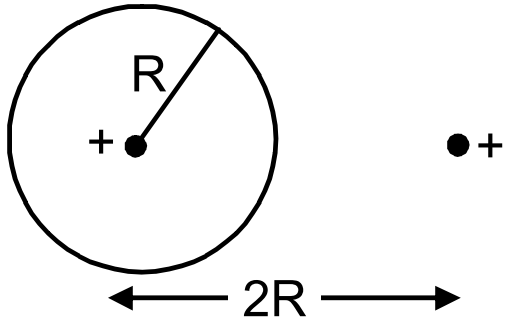
Find the flux of the electric field through a spherical surface of radius $R$ due to a charge of $10^{-7}C$ at the centre and another equal charge at a point $2R$ away from the centre.
Find the maximum kinetic energy of the photoelectrons ejected when light of wavelength 350nm is incident on a cesium surface. Work function of cesium = 1.9eV