Question
Write a short note on $n$-type semi-conductors.

Answer

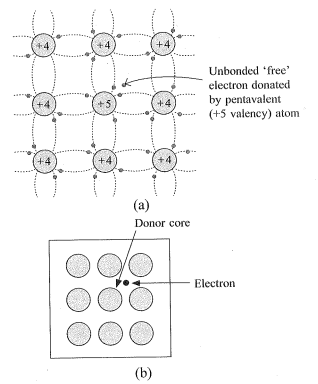
As shown in the Fig., to make this type of semi-conductor pure $S i$ or $G e$ is doped with a pentavalent element. (In the outer most orbit, there are 5 electrons in such atoms, So they are called pentavalent.)
Image
Example : Arsenic (As), Antimony (S $b$ ), Phosphorous (P) etc.
When an atom of +5 Valency element occupies the position of an atom in the crystal lattice of $S i$, four of its electrons bond with the four silicon neighbours while the fifth remains very weakly bound to its parent atom.
As a result the ionisation energy required to set this electron free is very small and even at room temperature the electron gains energy sufficient to be free and to move in the lattice of the semiconductor.
→For example :
the energy required to free this fifth electron is $\sim 0.01 eV$ for germanium and 0.05 eV for silicon, to separate the electron from its atom.
Thus the pentavalent dopant is donating one extra electron for conduction and hence it is known as donor impurity.
The number of electrons made available for conduction by dopant atoms depends strongly upon the doping level and it's is independent of any increase in ambient temperature.
In a doped semiconductor the total number of conduction electrons $n_e$ is due to the electrons contributed by donors and those generated intrinsically, while the total number of holes $n_h$ is only due to the holes from the intrinsic source.
Thus, with proper level of doping the number of conduction electrons can be made much larger than the number of holes.
Hence in an extrinsic semiconductor doped with pentavalent impurity, electrons become the majority carriers and the holes the minority carriers.
Charge of electron is negative. Hence from the first letter of the word 'negative', ' $n$ ', such semiconductors are known as $n$-type semiconductors.
For $n$-type semiconductors.
$n_e \gg n_h$

Need a full question paper?

Generate a complete, print-ready paper with questions like this in minutes — across 16+ boards, with answer keys.

Start Generating Free

Similar questions

The equation of a travelling sound wave is $\text{y}=6.0\sin(600\text{t}-1.8\text{x})$ where y is measured in $10^{-5}m$, t in second and x in metre.
  1. Find the ratio of the displacement amplitude of the particles to the wavelength of the wave.
  2. Find the ratio of the velocity amplitude of the particles to the wave speed.
Consider the situation of the previous question from a frame moving with a speed v0 parallel to the initial velocity of the block.
  1. What are the initial and final kinetic energies?
  2. What is the work done by the kinetic friction?
A particle goes in a circle of radius 2.0cm. A concave mirror of focal length 20cm is placed with its principal axis passing through the centre of the circle and perpendicular to its plane. The distance between the pole of the mirror and the centre of the circle is 30cm. Calculate the radius of the circle formed by the image.
The kinetic energy of a charged particle decreases by 10J as it moves from a point at potential 100V to a point at potential 200V. Find the charge on the particle.
  1. Show, giving a suitable diagram, how unpolarized light can be polarised by reflection.
  2. Two polaroids $P_1$ and $P_2$ are placed with their pass axes perpendicular to each other. Unpolarised light of intensity $I_0$ is incident on $P_1 A$ third polaroid $P_3$ is kept in between $P_1$ and $P_2$ such that its pass axis makes an angle of $60^{\circ}$ with that of $P_1$. Determine the intensity of light transmitted through $P_1, P_2$ and $P_3$.
An electromagnetic wave of wavelength $\lambda$ is incident on a photosensitive surface of negligible work function. If the photoelectrons emitted from the surface have the same de Broglie wavelength $\lambda\text{B,}$ prove that $\lambda=\Big(\frac{2\text{mc}}{\text{h}}\Big)\lambda^2_\text{B}.$
Figure shows a 11.7ft wide ditch with the approach roads at an angle of 15° with the horizontal. With what minimum speed should a motorbike be moving on the road so that it safely crosses the ditch?
Assume that the length of the bike is 5ft, and it leaves the road when the front part runs out of the approach road.
A coil of resistance $100\Omega$ is connected across a battery of emf 6.0V. Assume that the heat developed in the coil is used to raise its temperature. If the heat capacity of the coil is 4.0J/K, how long will it take to raise the temperature of the coil by 15^^\circC?
Three particles, each of mass 200g, are kept at the corners of an equilateral triangle of side 10cm. Find the moment of inertia of the system about an axis:
  1. Joining two of the particles.
  2. Passing through one of the particles and perpendicular to the plane of the particles.
Two wires A and B of the same material and having same length, have their cross sectional areas in the ratio 1 : 6. What would be the ratio of heat produced in these wires when same voltage is applied across each?