Question
Write a short note on sex determination in man.
Answer

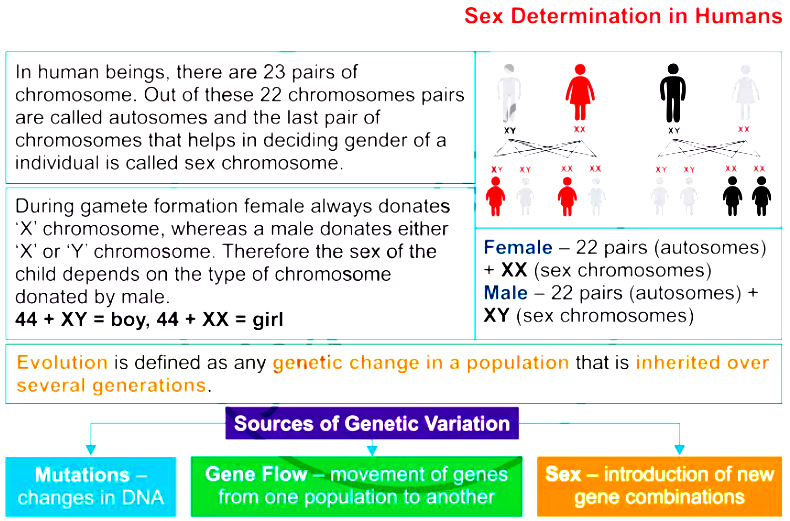
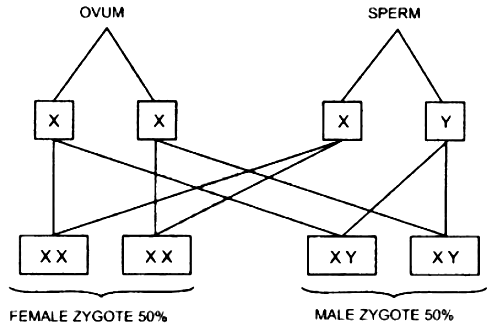
The difference between two individuals of the same species with respect to heredity is known as sex. So, an individual can either be a male or female in normal circumstances. Scientists have discovered that sex is transmitted by definite sex determination, also called heterosomes. The human body cells have two sex- chromosomes. A woman has two X- chromosomes while a man has one X- chromosome and one Y-chromosome.

Therefore, an egg cell has one X- chromosome and a sperm cell have either an X- or a Y-chromosome. This means that the sex of a baby is determined by the type of sperm cell fertilizing the egg. If an egg, fused with a sperm having Y-chromosome, then the male zygote will develop and when fused with a sperm having an X-chromosome then a female zygote will develop.

Need a full question paper?

Generate a complete, print-ready paper with questions like this in minutes — across 16+ boards, with answer keys.
Start Generating Free

Similar questions

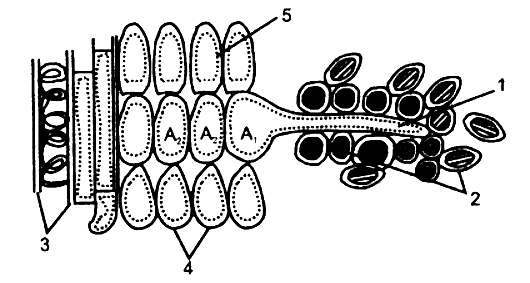
The figure given below is a diagrammatic representation of a part of the cross-section of the root in the root hair zone. Study the same and then answer the questions that follow :

(i) Name the parts indicated by guidelines ‘1’ to ‘5’
(ii) Is the root hair cell unicellular or multi-cellular?
(iii) Draw a labeled diagram of the root hair cell as it would appear if some fertilizer is added to the soil close to it.
(iv) Name the process responsible for the entry of water molecules from the soil into A1 and then A2.
(v) What pressure is responsible for the movement of water in the direction indicated by arrows?
(vi) How is this pressure set up?
How can the knowledge of processes of reproduction help people in limiting the size of their families? Give two concrete examples
Differentiate between :
Turgidity and Flaccidity
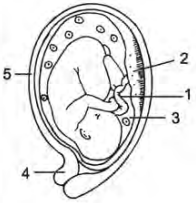
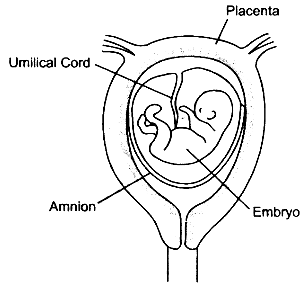
The below diagram is of a developing embryo is a mother’s womb:

(i) Write the functions of the placenta, amnion, and umbilical cord.
(ii) How are the waste products of a fetus removed?
(iii) What is the gestation period?
Implantation and Gestation (Definition).
The diagram represents a developing human foetus in the womb. Study the same and then answer the questions that follow:
(i) Name the parts '1' to '5' indicated by guidelines.
(ii) What term is given to the period of development of the foetus in the womb?
(iii) Mention two functions of the part labelled as '2' other than its endocrine function.

Image
Which one or more of the expressions in column II are appropriate for the items listed in column I? write the correct matching pairs-
Column IColumn II
(i) The blind spot(a) colour of the eye
(ii) the yellow spot(b) shape of the lens
(iii) Ciliary muscle(c) protective covering of the brain
(iv) Iris(d) basic unit of brain
(v) Meninges(e) free of rod cells
(f) vitreous humour
(g) centre of the retina
(h) no sensory cells
A lot of fish are dying near a sea shore. Describe any two possible causes.
Two potato cubes each 1 cm3 in size, were placed separately in two containers (A and B), the container A having water and the other (B) containing concentrated sugar solution. After 24 hours when the cubes were examined, those placed in water were found to be firm and had increased slightly in size and those placed in concentrated sugar solution were found to be soft and somewhat decreased in size. Use the above information to answer the questions that follow: Account for the softness and decrease in size of the potato cubes which were placed in sugar solution.
Give a labeled diagram of thymus gland.