Question
Write an equation of a line passing through the point representing solution of the pair of linear equations $x + y = 2$ and $2x - y = 1$. How many such lines can we find?

Answer

Given pair of linear equation is
$x + y - 2 = 0 ......(i)$
and $2x - y - 1 = 0 ......(ii)$
On Comparing with ax + by + c = 0 we get
$a_1 = 1, b_1 = 1$ and $c_1 = -2 $[from eq. (i)]
$a_2 = 2, b_2 = -1$ and $c_2 = -1$ [from eq. (ii)]
Here, $\frac{\text{a}_1}{\text{a}_2}=\frac{1}{2},\frac{\text{b}_1}{\text{b}_2}=\frac{1}{-1}$
and $\frac{\text{c}_1}{\text{c}_2}=\frac{-2}{-1}=\frac{2}{1}$
$\Rightarrow\frac{\text{a}_1}{\text{a}_2}\neq\frac{\text{b}_1}{\text{b}_2}$
So, both lines intersect at a point. Therefore, the pair of equations has a unique solution.
Hence, these equations are consistent.
Now$, x + y = 2 $
$\Rightarrow y = 2 - x$
if x = 0, then y = 2 and if x = 2, then y = 0
x
0
2
y
2
0
Points
A
B
and $2x - y - 1 = 0 $
$​​​​​​​\Rightarrow y = 2x - 1$
If x = 0, then $y = -1,$
If $\text{x}=\frac{1}{2},$ then y = 0
and if $x = 1$, then$ y = 1$​​​​​​​
x
0
$\frac{1}{2}$
1
y
-1
0
1
Points
C
D
E
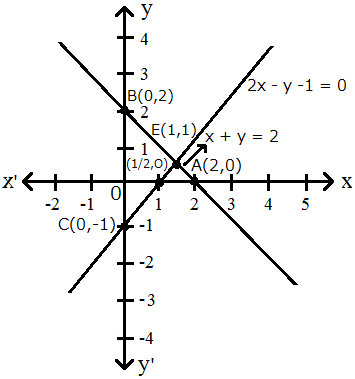
Plotting the points A(2, 0) and B(0, 2), we get the straight line AB. Plotting the points C(0, -1) and $\text{D}\Big(\frac{1}{2},0\Big)$ we get the straight line CD. The lines AB and CD intersect at E(1, 1).
Hence, infinite lines can pass through the intersection point of linear equations.
$x + y = 2 $and $2x - y = 1 $i.e.,$ E(1, 1)$ like as $y = x, 2x + y = 3, x + 2y = 3$, so no.

Need a full question paper?

Generate a complete, print-ready paper with questions like this in minutes — across 16+ boards, with answer keys.
Start Generating Free