CURRENT ELECTRICITY — Physics STD 12 Science — Question
Rajasthan BoardEnglish MediumSTD 12 SciencePhysicsCURRENT ELECTRICITY2 Marks
Question
Write and explain Kirchhoff's junction rule.
✓
Answer
$\rightarrow$ Kirchhoff's junction rule : "At any junction, the sum of the currents entering the junction is equal to the sum of currents leaving the junction."
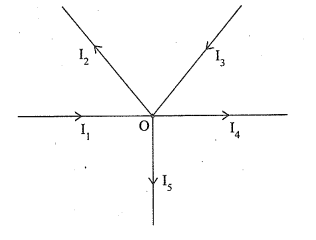
$\rightarrow$ Consider junction $O$ of a network as shown in the figure.
$\rightarrow$ The currents meeting at the junction point $O$ are $I _1, I _2, I _3, I _4$ and $I _5$ respectively.
Their directions are represented by arrows in the figure.
$\rightarrow$ Let $Q_1, Q_2, Q_3, Q_4$, and $Q_5$ be charges flowing through the cross$-$sectional area of conductors at time $t$ respectively.
$\rightarrow$ Thus,
$I _1=\frac{ Q _1}{t} \therefore Q _1= I _1 t$
$I _2=\frac{ Q _2}{t} \therefore Q _2= I _2 t$
$I _3=\frac{ Q _3}{t} \therefore Q _3= I _3 t$
$I _4=\frac{ Q _4}{t} \therefore Q _4= I _4 t$
$I _5=\frac{ Q _5}{t} \therefore Q _5= I _5 t$
$\rightarrow$ From the figure, the total electric charge entering the junction is $Q_1+Q_3$ while $Q_2+Q_4+Q_5$ amount of electric charge is leaving the junction in time $t$.
$\rightarrow$ According to the law of conservation of charge,
$Q _1+ Q _3= Q _2+ Q _4+ Q _5$
$\therefore I _1 t+ I _3 t= I _2 t+ I _4 t+ I _5 t$
$\therefore I _1+ I _3= I _2+ I _4+ I _5$
$\rightarrow$ Thus at the junction the sum of the currents entering the junction is equal to the sum of currents leaving the junction.
Need a full question paper?
Generate a complete, print-ready paper with questions like this in minutes — across 16+ boards, with answer keys.