Question
Write any four economic importance of Pteridophyta.

Answer

Economic Importance of Pteridophyta: 
1. Ornamental Value:
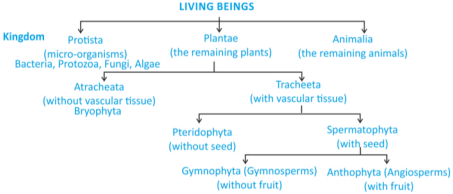
Many ferns are grown in gardens because they look large and beautiful. Example: Species of Lycopodium, Selaginella, Lygodium, Cyathea etc.
2. Food: Sporocarp of Marsilea has high amount of starch. These are used as nutritious food by the tribals.
3. Soil Conservation: Selaginella is useful in soil conservation.
4. Medicines: Anthelmintic drug is obtained from rhizomes and petioles of Dryopteris fern. Lycopodium clovetum is used in skin diseases. Equisetum arvense has diuretic properties.

Need a full question paper?

Generate a complete, print-ready paper with questions like this in minutes — across 16+ boards, with answer keys.

Start Generating Free

Similar questions

Lipids form a heterogeneous group but all are made up of carbon hydrogen and oxygen. These are insoluble in water and soluble in organic solvents like acetone, ether, alcohol etc. The number of oxygen atoms is very small compared to carbon atoms. They need a large amount of oxygen for their oxidation to release energy. They could be simple lipids, compound lipids, and derived lipids. Simple lipids are esters of fatty acid and alcohol. Compound lipids are formed when simple lipids combine with another compounds for example glycolipids, phospholipids and lipoproteins. Derived lipids are of various types and important example being steroids.

(1) Lipids mainly consist of
(a) Carbon only
(b) carbon hydrogen and nitrogen
(c) carbon hydrogen and oxygen
(d) Hydrogen only

(2) Among the given options non-polymeric molecule is
(a) Nucleic acids (b) proteins (c) Lipids (d) polysaccharides

(3) An example of unsaturated fatty acid is
(a) oleic acid (b) stearic acid (c) Linoleic acid (d) both a and c

(4) The number of carbon atoms as compared to oxygen atoms in lipids is
(a) same (b) much less (c) much more (d) none of these.

(5) Steroids are an example of
(a) derived lipids (b) conjugated lipids (c) simple lipids (d) lipo proteins
In addition to proteins, viruses also contain genetic material, that could be either RNA or DNA. No virus contains both RNA and DNA. A virus is a nucleoprotein and the genetic material is infectious. In general, viruses that infect plants have single stranded RNA and viruses that infect animals have either single or double stranded RNA or double stranded DNA. Bacterial viruses or bacteriophages (viruses that infect the bacteria) are usually double stranded DNA viruses. The protein coat called capsid made of small subunits called capsomeres, protects the nucleic acid. These capsomeres are arranged in helical or polyhedral geometric forms. Viruses cause diseases like mumps, small pox, herpes and influenza. AIDS in humans is also caused by a virus. In plants, the symptoms can be mosaic formation, leaf rolling and curling, yellowing and vein clearing, dwarfing and stunted growth.

(1) Viruses are made up of:
(a) Proteins & DNA
(b) Proteins only
(c) Proteins & RNA
(d) Proteins & DNA / RNA

(2) Bacteriophages are usually :
(a) Single stranded DNA viruses
(b) Double stranded RNA viruses
(c) Double stranded DNA viruses
(d) Single stranded RNA viruses

(3) Which is not a viral disease of humans:
(a) Pneumonia (b) Herpes (c) Mumps (d) Smallpox

(4) Select the incorrect statement regarding Capsomeres:
(a) Capsomeres are sub-units of Capsid
(b) Capsomeres are made of peptidoglycans
(c) Capsomeres may be arranged in helix or polyhedron
(d) Capsomeres are made of proteins

(5) Which of these is not a symptom of viral infection in crops:
(a) Leaf rolling (b) Curling of leaf (c) Decay of roots (d) Vein clearing
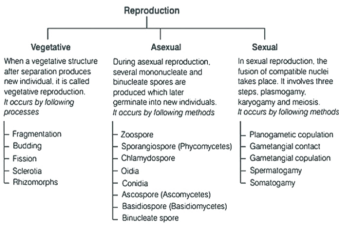
The fungi constitute a unique kingdom of heterotrophic organisms. They show a great diversity in morphology
and habitat. Fungi are cosmopolitan and occur in air, water, soil, and on animals and plants. They prefer to grow in warm and humid places. Most fungi are heterotrophic and absorb soluble organic matter from dead substrates and hence are called saprophytes. When a fungus reproduces sexually, two haploid hyphae of compatible mating types come together and fuse. In some fungi, the fusion of two haploid cells immediately results in diploid cells (2n). The fungiform fruiting bodies in which reduction division occurs, leading to the formation of haploid spores. Symbionts - in association with algae as lichens and with roots of higher plants as mycorrhiza. Three types of reproduction occur in fungi

Image

i. Observe the given flow chart of reproduction and mention which steps involves in the sexual cycle of fungi.
(1)
ii. What is Rhizopus? Also, mention Rhizopus - wheat rush a correct match? (1)
iii. What is Mycorrhiza? And mention its function. (2)

OR

In which form Fungi Stores Food Material? Do fungi have food vacuoles? (2)
Write a note on bulliform cells. Write any three differences between exarch and endarch.
Mention the ploidy of the following: protonemal cell of a moss; primary endosperm nucleus in dicot, leaf cell of a moss; prothallus cell of a ferm; gemma cell in Marchantia; meristem cell of monocot, ovum of a liverwort, and zygote of a fern.
(i) The pelvic girdle forms part of our body. Write down four functions of the pelvic girdle.
(ii) Draw a labelled diagram of the right pelvic bone and the bones of the hind limb.
Write the functions of human kidney.