Question
Write any two properties of electric field lines.

Answer

(i) The tangent drawn at any point to the line of electric force expresses the direction of the resultant electric field at that point.
(ii) Electric lines of force run from positive charge and end at netative charge.
Note: Students can also write other properties of electric field lines.

Need a full question paper?

Generate a complete, print-ready paper with questions like this in minutes — across 16+ boards, with answer keys.

Start Generating Free

Similar questions

Is heat a conserved quantity?
If all the particles of a system lie in X-Y plane, is it necessary that the centre of mass be in X-Y plane?
The motion of copper plate is damped when it is allowed to oscillate between the two poles of a magnet. What is the cause of this damping?
Answer the following questions, which help you understand the difference between Thomson’s model and Rutherford’s model better.
Is the probability of backward scattering (i.e., scattering of α-particles at angles greater than 90°) predicted by Thomson’s model much less, about the same, or much greater than that predicted by Rutherford’s model?
Answer the following question:
A magnetic field that varies in magnitude from point to point but has a constant direction (east to west) is set up in a chamber. A charged particle enters the chamber and travels undeflected along a straight path with constant speed. What can you say about the initial velocity of the particle?
Can X-rays be polarized?
Answer the following questions:
The earth’s magnetic field varies from point to point in space. Does it also change with time? If so, on what time scale does it change appreciably?
Answer the following questions:
Is Ohm’s law universally applicable for all conducting elements? If not, give examples of elements which do not obey Ohm’s law.
Does a conductor become charged when a current is passed through it?
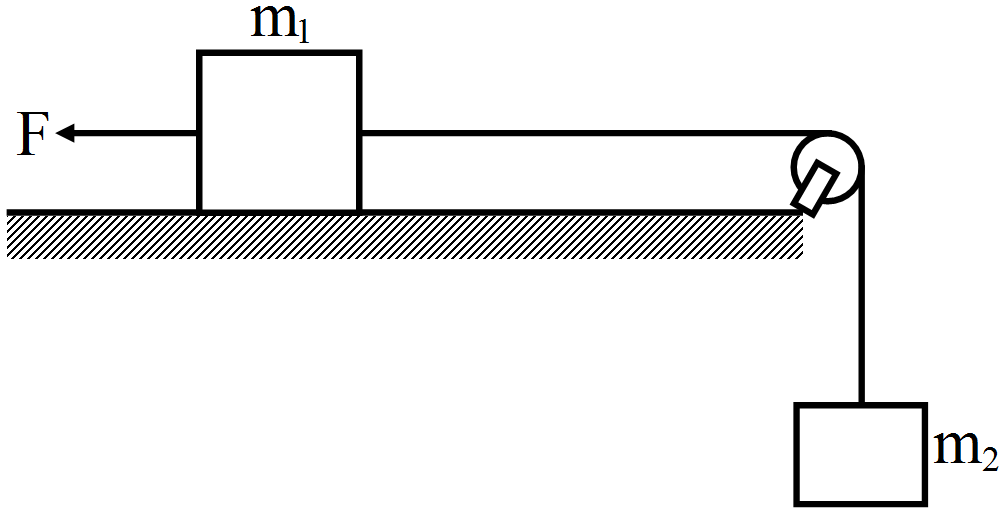
Consider the situation shown in The force F is equal to the $\frac{\text{m}_2\text{g}}{2}$ If the area of cross-section of the string is A and its Young's modulus Y, find the strain developed in it. The string is light and there is no friction anywhere.