Question
Write conclusion of Oersted's experiment.

Answer

A current carrying conductor produces magnetic field around it whose magnitude and direction depends on the magnitude and direction of current flowing in the conductor.

Need a full question paper?

Generate a complete, print-ready paper with questions like this in minutes — across 16+ boards, with answer keys.

Start Generating Free

Similar questions

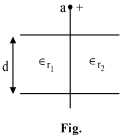
The capacitance of a parallel plate air capacitor is $10 \mu F$. This capacitor is divided into two equal parts as shown in the figure and filled with a medium having dielectric constant $\epsilon_{r_1}=2$ and $\epsilon_{r_2}=4$. Find the value of capacitance of this system.
Image
What is rms value $($root mean square$)$?
Derive the equation of rms values of voltage and current?
Two identical metal spheres of exactly equal mass have been taken. One is charged with negative charge say q and the other with the same amount of positive charge. Will there be any difference in the mass of the two spheres? If yes then why?
In a double slit interference experiment, the separation between the slits is 1.0mm, the wavelength of light used is $5.0 × 10^{-7}m$ and the distance of the screen from the slits is 1.0m.
  1. Find the distance of the centre of the first minimum from the centre of the central maximum.
  2. How many bright fringes are formed in one centimeter width on the screen?
While gas from a cooking gas cylinder is used, the pressure does not fall appreciably till the last few minutes. Why?
A copper wire of diameter 1.6 mm carries 20A. Find the maximum magnitude of the magnetic field $\overrightarrow{\text{B}}$ due to this current.
A pivoted aluminium bar falls much more slowly through a small region containing a magnetic field than a similar bar of an insulating material. Explain.
When does a charge be source of origin of electromagnetic waves? How are the magnetic field and electric field mutually and with the transmission of wave related? Which physical quantity is same for waves of all parts of electromagnetic classification?
Spring fitted doors close by themselves when released. You want to keep the door open for a long time, say for an hour. If you put a half kg stone in front of the open door, it does not help. The stone slides with the door and the door gets closed. However, if you sandwitch a 20g piece of wood in the small gap between the door and the floor, the door stays open. Explain why a much lighter piece of wood is able to keep the door open while the heavy stone fails.
What is electrostatic shielding? How is this property used in actual practice? Is the potential in the cavity of a charged conductor zero?