Radii of two circular current carrying coils are $r_1$ and $r_2$ respectively and number of turns in them are $n_1$ and $n_2$ respectively. They are joined in series. Prove that the ratio of produced magnetic fields at their centers is $n_1 r_2: n_2 r_1$. If coils are joined in parallel, then the ratio of magnetic fields produced at the centers is equivalent to $\left(r_2 / r_1\right)^2$.
Answer
Since the coils are joined in series, same current I will flow through them. Therefore, magnetic fields at the centers are $B _1=\frac{\mu_0 n_1 I }{2 r_1}$ and $B _2=\frac{\mu_0 n_2 I }{2 r_2}$ $\therefore \frac{ B _1}{B_2}=\frac{\frac{\mu_0 n_1 I }{2 r_1}}{\frac{\mu_0 n_2 I }{2 r_2}}$ $\Rightarrow \quad \frac{ B _1}{B_2}=\frac{n_1}{r_1} \times \frac{r_2}{n_2}=\frac{n_1 r_2}{r_1 n_2}$ $\Rightarrow \quad B _1: B _2=n_1 r_2: n_2 r_1$ Ans. When the coils are joined in parallel, then the ratio of currents in them is equal to reciprocal of ratio of their resistances $R _1$ and $R _2$, i.e., $\frac{ I _1}{ I _2}=\frac{ R _2}{ R _1}=\frac{n_2\left(2 \pi r_2\right) \rho}{n_1\left(2 \pi r_1\right) \rho}=\frac{n_2 r_2}{n_1 r_1}$ $\therefore \quad \frac{ B _1}{B_2}=\frac{\mu_0 n_1 I _1}{2 r_1} \times \frac{2 r_2}{\mu_0 n_2 I _2}$ $=\frac{n_1 r_2}{n_2 r_1} \times \frac{n_2 r_2}{n_1 r_1}=\frac{r_2^2}{r_1^2}$
Resistance of a galvanometer is $30 \Omega$. A current of 2 mA gives full scale deflection in it. Calculate the necessary resistance required to make it an ammeter of range $(0-0.3 A)$.
Answer
Sol. Given: $\quad G =30 \Omega$ $I _g=2 mA=2 \times 10^{-3} A$ and $I=0.3 A $ Shunt resistance to be joined in parallel with it to make it an ammeter in the range $(0-0.3 A)$ $S =\frac{ I _g}{\left( I - I _g\right)} \cdot G$ $=\frac{\left(2 \times 10^{-3}\right) \times 30}{\left(0.3-2 \times 10^{-3}\right)}$ $=\frac{60 \times 10^{-3} \times 10^3}{(300-2)}=\frac{60}{298}$ $=0.20 \Omega$ Ans.
In a solenoid, there are 500 turns/meter and current flowing in it is 5 A . Length of the solenoid is 0.5 m and its radius is 1 cm . Calculate the intensity of magnetic field inside the solenoid.
Answer
Here the number of turns of solenoid per unit length, $n=500$ per meter Current in the solenoid, $I =5 A$ $\therefore$ Intensity of magnetic field inside the solenoid $ B =\mu_0 n I $ or $B =\left(\frac{\mu_0}{4 \pi}\right), 4 \pi n I$ $=\frac{4 \pi \times 10^{-7} \times 4 \times 3.14 \times 500 \times 5}{4 \pi}$ $=3.14 \times 10^{-3}$ Weber $/$ meter $^2$ Ans. Note: In the above formula for B, there is no need of length and radius of the solenoid.
A coil of N turns is wound tightly in the form of a spiral whose internal and external radii $r_1$ are $r_2$ and respectively. Current $I$ is flowing through the coil, then calculate the magnetic field at the center.
Answer
Suppose there is a loop of very small thickness $\delta r$ of the arbitrary radius $r$ of the spiral coil, then due to this loop the magnetic field at the center is $\delta B =\frac{\mu_0(\delta N) I }{2 r}$ $\delta N =\frac{ N }{\left(r_2-r_1\right)} \times \delta r$ $\therefore \quad \delta B =\frac{\mu_0 NI }{2\left(r_2-r_1\right)} \times \frac{\delta r }{r}$ On integration, $B =\frac{\mu_0 NI }{2\left(r_2-r_1\right)} \int_{r_1}^{r_2} \frac{d r}{r}$ $=\frac{\mu_0 NI }{2\left(r_2-r_1\right)} \times[\ln r]_{r_1}^{r_2}$ $=\frac{\mu_0 NI }{2\left(r_2-r_1\right)}\left[\ln r_2-\ln r_1\right]$ or $B =\frac{\mu_0 NI }{2\left(r_2-r_1\right)} \ln \frac{r_2}{r_1}$ Ans.
Two identical coils, radius of each is 8 cm and number of turns is 100 are coaxial and their centers are 12 cm apart. If current of 1 A flows in each coil in the same direction, then calculate the magnetic field at the midpoint on the axial line.
Answer
Given, $a=8 cm=0.08 m, n=100, x=6 cm=0.06 m$ Produced magnetic field at a distance of 0.06 m from center of one coil $ B_1=\frac{\mu_0 n l a^2}{2\left(a^2+x^2\right)^{3 / 2}} $ On putting the values, $B _1=\frac{4 \pi \times 10^{-7} \times 100 \times 1 \times(0.08)^2}{2\left[(0.08)^2+(0.06)^2\right]^{3 / 2}}$ $=\frac{12.56 \times 10^{-7} \times 10^2 \times 64 \times 10^{-4}}{2\left[64 \times 10^{-4}+36 \times 10^{-4}\right]^{3 / 2}}$ $=\frac{12.56 \times 64 \times 10^{-9}}{2\left[100 \times 10^{-4}\right]^{3 / 2}}=\frac{12.56 \times 32 \times 10^{-9}}{1000 \times 10^{-6}}$ $=\frac{401.92 \times 10^{-9}}{10^{-3}}=4.02 \times 10^{-4} Tesla$ Since current is flowing in the same direction in both the coils, so magnitude of magnetic field on the axial line at the midpoint is $ \begin{aligned} B & =2 B_1=2 \times 4.02 \times 10^{-4} \\ & =8.04 \times 10^{-4} Tesla \end{aligned} $
In a long straight wire, a current of 5 A is flowing. How much magnetic field will be produced at a distance of 10 cm from it? Which rule will give the direction of the field?
Answer
Given : $I =5 A, r=10 cm=0.10 m$ Produced magnetic field $\vec{B}$ on the observation point due to this $ B=\frac{\mu_0}{4 \pi}\left(\frac{2 I}{r}\right) $ On putting the values, $=10^{-7}\left(\frac{2 I }{r}\right)$ $B =10^{-7}\left(\frac{2 \times 5}{0.10}\right)$ $=10^{-5} N / A - m$ Ans Direction of the field $\vec{B}$ can be determined by rule number 1 of right-hand palm rule, or Maxwell cork screw rule or right-hand thumb rule.
Current of 0.5 A is flowing through a circular loop of radius 5 cm . Calculate the magnetic field at the center of the loop.
Answer
Given : $\quad r=5 cm=5 \times 10^{-2} m$ $ I=0.5 A $ Magnetic field at the center of the loop $ B=\frac{\mu_0}{4 \pi}\left(\frac{2 \pi I}{r}\right) $ On putting the values, $B=\frac{4 \pi \times 10^{-7}}{4 \pi}\left(\frac{2 \pi \times 0.5}{5 \times 10^{-2}}\right)$ $=10^{-7} \times 2 \times 3.14 \times 10$ $=6.28 \times 10^{-6}$ Tesla Ans.
Ammeter and milli-ammeter both are made from galvanometer. Which of them has greater resistance?
Answer
We know that : $S =\frac{ I _{ g } G }{ I - I _{ g }}$ It is clear from the above expression that to convert galvanometer into milli-ammeter, a shunt S of greater resistance is required than shunt resistance of ammeter. $\because$ Resistance of ammeter, $R=\frac{G . S}{G+S}$ Hence, resistance of milli-ammeter will be more.
You are given a low resistance $R_1$, a high resistance $R_2$ and a galvanometer. How will you make such instruments from them which can measure (i) current, (ii) potential difference?
Answer
(i) To measure current, low resistance $R_1$ should be joined in parallel with the galvanometer. (ii) To measure potential difference, high resistance $R _2$ should be joined in series with the galvanometer.
What is being done to change the range of voltmeter?
Answer
$R _{ H }=\left(\frac{ V }{i_g}\right)- G$. On joining this high resistance to the given galvanometer in series, it will become voltmeter of range V . When high resistance $R _{ H }$ is joined with galvanometer in series, the effective resistance $R _{ V }=\left( R _{ H }+ G \right)$ of galvanometer becomes very high (camparison to G). So, when such a voltmeter is connected in parallel in a circuit to measure potential difference, then due to its high resistance, it allows very small fraction of total current to pass through it and hence gives reading of potential difference corresponding to total current flowing through the circuit.
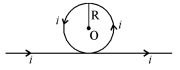
A long wire is bent as shown in the figure. Find the magnitude and direction of magnetic field at center $O$ of the circular part when a current $i$ ampere flows through it.
Answer
Magnetic field at center O due to straight part of the wire $B _1=\frac{\mu_0}{2 \pi} \times \frac{i}{ R }$ (perpendicular to the plane of the paper outward) Magnetic field at center O due to circular loop $B _2=\frac{\mu_0 i}{2 R }$ (perpendicular to the plane of paper outwards) $\therefore$ Resultant magnetic field at the center $B = B _1+ B _2$ $=\frac{\mu_0 \dot{j}}{2 \pi R }+\frac{\mu_0{ }^j}{2 R }$ $B=\frac{\mu_0 i}{2 R}\left(\frac{1}{\pi}+1\right)$
Definition of ampere : Magnetic force acting between two long, straight and parallel current carrying conductors per unit length, If $i_1=i_2=1 A$ and $d=1 m$, then $\frac{\delta F }{\delta l}=\frac{\mu_{ o } i_1 i_2}{2 \pi d}$ $\frac{\delta F }{\delta l}=\frac{\mu_0(1 A)(1 A)}{2 \pi(1 m)}=\frac{4 \pi \times 10^{-7}}{2 \pi}$ $\frac{\delta F }{\delta l}=2 \times 10^{-7} N / m$ 1 ampere electric current is that electric current which produces a force of $2 \times 10^{-7} N / m$ on two straight, parallel, current carrying wires when it flows through them and the wires are kept at a distance of 1 m in air or vacuum on the length 1 m of the wire.
State conditions when resultant magnetic field at a point due to two long straight perpendicular current carrying wires can be zero.
Answer
If coordinates of a point P located in $x-y$ plane is $(x, y)$, then magnetic fields due to mutually perpendicular lines is $B _1=\frac{\mu_{ o } i_1}{2 \pi x}$ and $B _2=\frac{\mu_{ o } i_2}{2 \pi y}$ and their directions will be along $z$-axis If there fields are equal and opposite, then their resultant field zero. $B_1-B_2=0$ $\Rightarrow \quad B _1= B _2$ $\frac{\mu_0 i_1}{2 \pi x}=\frac{\mu_0 i_2}{2 \pi y}$ $\Rightarrow \quad \frac{i_1}{x}=\frac{i_2}{y}$ $\Rightarrow \quad \frac{i_1}{i_2}=\frac{x}{y}$ whereas these currents point outward from the origin.
What is the importance of radial magnetic field in a moving coil galvanometer?
Answer
Torque, $\tau= NIAB \sin \theta$ When a coil is suspended in a radial magnetic field, then in each position of coil, its plane is along any force line. Hence, $\theta=90^{\circ}$ Therefore,$\sin \theta=1$ $\tau= NIAB$ or $\tau \propto I$ Hence, torque on a coil is proportional to the current flowing through it. So, in this way we can make scale of galvanometer linear.
A beam of electrons enters crossed region of electric field of intensity $E$ and magnetic field of intensity B. For what speed of electrons, the electron beam will remain unaffected?
Answer
Electron beam will remain unaffected when the electric and magnetic force acting on them is equal in magnitude but opposite in direction. $F _e= F _m$ or E. $e=e v B$ or $E =v B$ $\therefore v=\frac{E}{B}$
A beam of alpha particles and protons enters a uniform magnetic field with same speed. Calculate the ratio between their radii of circular path in magnetic field.
Answer
Radius of circular path of any charged particle in a magnetic field $r=\frac{m v}{q B }$ For $\alpha$-particle, $\quad r_\alpha=\frac{m_\alpha v}{2 e . B }$ For proton, $\quad r_{ p }=\frac{m_p v}{e \cdot B}$ $\therefore \quad \frac{r_\alpha}{r_p}=\frac{m_\alpha}{2 m_{ p }}=\frac{4 m_p}{2 m_p}$ $\because m \alpha=4 m_p$ or $\frac{r_\alpha}{r_p}=2 $ $\therefore \quad r_\alpha: r_p=2: 1$ Ans.
There is no change in the energy of a moving charged particle in a plane magnetic field. Explain, why?
Answer
Force exerted on a moving charged particle in magnetic field is perpendicular to the velocity of the particle. Hence, no work is done by the magnetic field on the particle. Hence the velocity of the particle will remain constant and so its kinetic energy will be unchanged.
Write an expression $F$ in vector form for a charge $q$ moving with a velocity $\vec{v}$ in a magnetic field $\vec{B}$. Obtain conditions with the help of this expression when this force is (i) maximum and (ii) minimum.
Answer
Force exerted on a charge $q$ moving with a velocity $\vec{v}$ in a magnetic field $\vec{B}$ $\overrightarrow{ F }=q(\vec{v} \times \overrightarrow{ B })$ (i) $\quad|\vec{v} \times \overrightarrow{ B }|=v B \sin \theta$ when $\theta=90^{\circ}, \vec{v} \times \overrightarrow{ B }$ then $\sin \theta=1$ which is the maximum value of $\sin \theta$, i.e, when $\vec{v} \times \overrightarrow{ B }$ then $|\vec{v} \times \overrightarrow{ B }|$ will be maximum. Hence magnitude of $\vec{F}$ will be maximum (ii) When $\theta=0^{\circ}$. i.e. $\vec{v} \| \overrightarrow{ B }$ then $\sin \theta=0$ hence $\quad|\vec{v} \times \overrightarrow{ B }|=0$ or $\quad \vec{F}=0$. i.e. when $\vec{v} \| \vec{d}$ then magnitude of $\overrightarrow{ F }$ will be minimum.
If current flowing in a circular coil is doubled and radius is halved, then what would be the change in the produced magnetic field at the center of the coil?
Answer
Magnetic field produced at the center of the circular coil $ B=\frac{\mu_0 NI}{2 R} $ Now if, $I ^{\prime}=2 I$ and radius $r^{\prime}=r / 2$ then magnetic field $ \begin{array}{ll} & B^{\prime}=\frac{\mu_0 NI^{\prime}}{2 R^{\prime}}=\frac{\mu_0 N(2 I)}{2(R / 2)} \\ \therefore & B^{\prime}=4 B \end{array} $ Magnetic field will become four times.
An electron is not deflected while passing through any field. Is it possible that there is no magnetic field present at that place? Explain.
Answer
Exerting force in magnetic field on a moving electron with velocity $\vec{v}$ $\overrightarrow{ F }=-e(\vec{v} \times \overrightarrow{ B })$ or $\overrightarrow{ F }=-e v B \sin \theta$ If $\theta=0^{\circ}$ or $180^{\circ}$, the magnitude of force F will be zero. Hence, an electron will not be deflected if it moves parallel or opposite to the direction. So, we cannot say that magnetic field is absent.
Under what condition, force on moving charged particle in a magnetic field will be (i) maximum (ii) minimum?
Answer
From, $F =q \nu$ B $\sin \theta$ (i) when $\theta=90^{\circ}$, then $F =q v B$ which is the maximum value. (ii) when $\theta=0^{\circ}$ or $\theta=180^{\circ}$ then $F =0$, which is the minimum value. When a charged particle moves perpendicular to the direction of magnetic field then maximum force is exerted on it and when it moves in the direction of magnetic field or opposite to the direction of magnetic field, then the force everted on it is minimum.
On changing a current carrying coil of N turns and R radius into a straight wire, how many times the magnetic field at distance R will be than at the magnitude at the center of the coil?
Answer
Magnetic field at the center of coil $ B_0=\frac{\mu_0 NI}{2 R} $ and magnetic field due to long straight wire $ B=\frac{\mu_0 I}{2 \pi R} $ Dividing equation (1) by (2) $ \frac{B_0}{B}=\frac{\frac{\mu_0 N I}{2 R}}{\frac{\mu_0 I}{2 \pi R}}=N \pi $
Unit of magnetic flux is weber. State its equivalent electric unit
Answer
$\because \quad \phi=$ B.A $=\frac{\text { Newton }}{\text { Coulomb } \times \frac{\text { metre }}{\text { second }}} \times$ metre $^2$ $=\frac{\text { Newton } \times \text { metre }}{\text { Coulomb }} \times$ second $=\frac{\text { Joule }}{\text { Coulomb }} \times$ second $=$ Volt $\times$ second
A current carrying conductor produces magnetic field around it whose magnitude and direction depends on the magnitude and direction of current flowing in the conductor.