Question
Write down Huygen's principle and explain how a new plane wavefront is formed at the end of a very small time interval.

Answer

• Huygen's principle :
"Every point or particle of a wavefront behaves as an independent secondary source, emits by itself secondary spherical waves. After a very small time interval the surface tangential to all such secondary spherical wavelets gives the position and shape of the new wavefront."
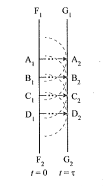
Image
A plane wavefront $F _1 F_2$ is shown in the fig. at time $t=0$.
To determine the shape of the wavefront at time $t=\tau$, we draw spheres of radius $v \tau$, from each point (points $A _1, B_1, C _1 \ldots$ etc.) on the wavefront. (Where $v$ is the speed of waves in the medium.)
A tangent common to all such points is drawn, which gives the position and shape of the new wavefront at time $t=\tau$.

Need a full question paper?

Generate a complete, print-ready paper with questions like this in minutes — across 16+ boards, with answer keys.
Start Generating Free

Similar questions

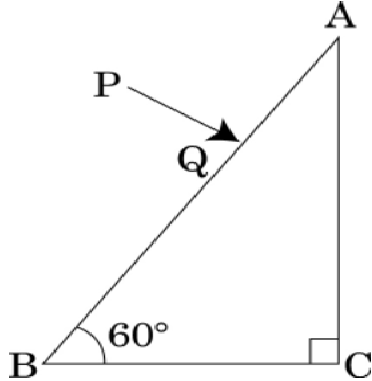
A ray PQ incident normally on the refracting face BA is refracting in the prism BAC made of material of refractive index 1.5. Complete the path of ray through the prism. From which face will the ray emerge? Justify your answer.

The electric force experienced by a charge of 1.0 × 10-6C is 1.5 × 10-3N. Find the magnitude of the electric field at the position of the charge.
A uranium-238 nucleus, initially at rest, emits an alpha particle with a speed of 1.4 x 10⁷m/s. Calculate the recoil speed of the residual nucleus thorium-234. Assume that the mass of a nucleus is proportional to the mass number.
When we can consider a charged particle as point electric charge ?
An $\alpha-\text{particle}$ and a proton of the same kinetic energy are in turn allowed to pass through a magnetic field $\overrightarrow{\text{B}},$acting normal to the direction of motion of the particles. Calculate the ratio of radii of the circular paths described by them.
Briefly explain about light.
A particle moves on a given straight line with a constant speed v. At a certain time it is at a point P on its straight line path. O is a fixed point. Show that $\overrightarrow{\text{OP}}\times\overrightarrow{\text{v}}$ is independent of the position P.
  1. Find the first excitation potential of He+ ion.
  2. Find the ionization potential of Li++ ion.
The torque of the weight of any body about any vertical axis is zero. Is it always correct?