Question
Write down the basic properties of electric charge.

Answer

►The basic properties of electric charge are given below:
(i)charges are additive in nature
(ii)A charge is a conserved quantity
(iii)Quantization of charge

Need a full question paper?

Generate a complete, print-ready paper with questions like this in minutes — across 16+ boards, with answer keys.
Start Generating Free

Similar questions

The magnetic field inside a tightly wound, long solenoid is $\text{B}=\mu_0\text{ni}.$ It suggests that the field does not depend on the total length of the solenoid, and hence if we add more loops at the ends of a solenoid the field should not increase. Explain qualitatively why the extra-added loops do not have a considerable effect on the field inside the solenoid.
Draw the ray diagram of an astronomical telescope showing image formation in the normal adjustment position. Write the expression for its magnifying power.
The apparent weight of an object increases in an elevator while accelerating upward. A moongphaliwala sells his moongphali using a beam balance in an elevator. Will he gain more if the elevator is accelerating up?
A tightly-wound, long solenoid has n turns per unit length, a radius r and carries a current i. A particle having charge q and mass m is projected from a point on the axis in a direction perpendicular to the axis. What can be the maximum speed for which the particle does not strike the solenoid ?
A Galilean telescope is $27\ cm$ long when focused to form an image at infinity. If the objective has a focal length of $30\ cm,$ what is the focal length of the eyepiece?
The gravitational field in a region is given by $\overrightarrow{\text{E}}=(5\text{N/kg})\overrightarrow{\text{i}}+(12\text{N/kg})\overrightarrow{\text{j}}.$
  1. Find the magnitude of the gravitational force acting on a particle of mass 2kg placed at the origin.
  2. Find the potential at the points (12m, 0) and (0, 5m) if the potential at the origin is taken to be zero.
  3. Find the change in gravitational potential energy if a particle of mass 2kg is taken from the origin to the point (12m, 5m).
  4. Find the change in potential energy if the particle is taken from (12m, 0) to (0, 5m).
The selling rate of a radioactive isotope is decided by its activity. What will be the second$-$hand rate of a one month old $\text{ }^{32}\text{P}\big(\text{t}_{\frac{1}{2}}=14.3\text{days}\big)$ source if it was originally purchased for $800$ rupees?
The force acting on a particle moving along $X-$axis is $F = -k(x - u_0t)$ where $k$ is a positive constant. An observer moving at a constant velocity $v_0,$ along the $X-$axis looks at the particle. What kind of motion does he find for the particle?
A parallel beam of monochromatic light is used in a Young's double slit experiment. The slits are separated by a distance $d$ and the screen is placed parallel to the plane of the slits. Show that if the incident beam makes an angle $\theta=\sin^{-1}\Big(\frac{\lambda}{2\text{D}}\Big)$ with the normal to the plane of the slits, there will be a dark fringe at the centre $P_0$ of the pattern.
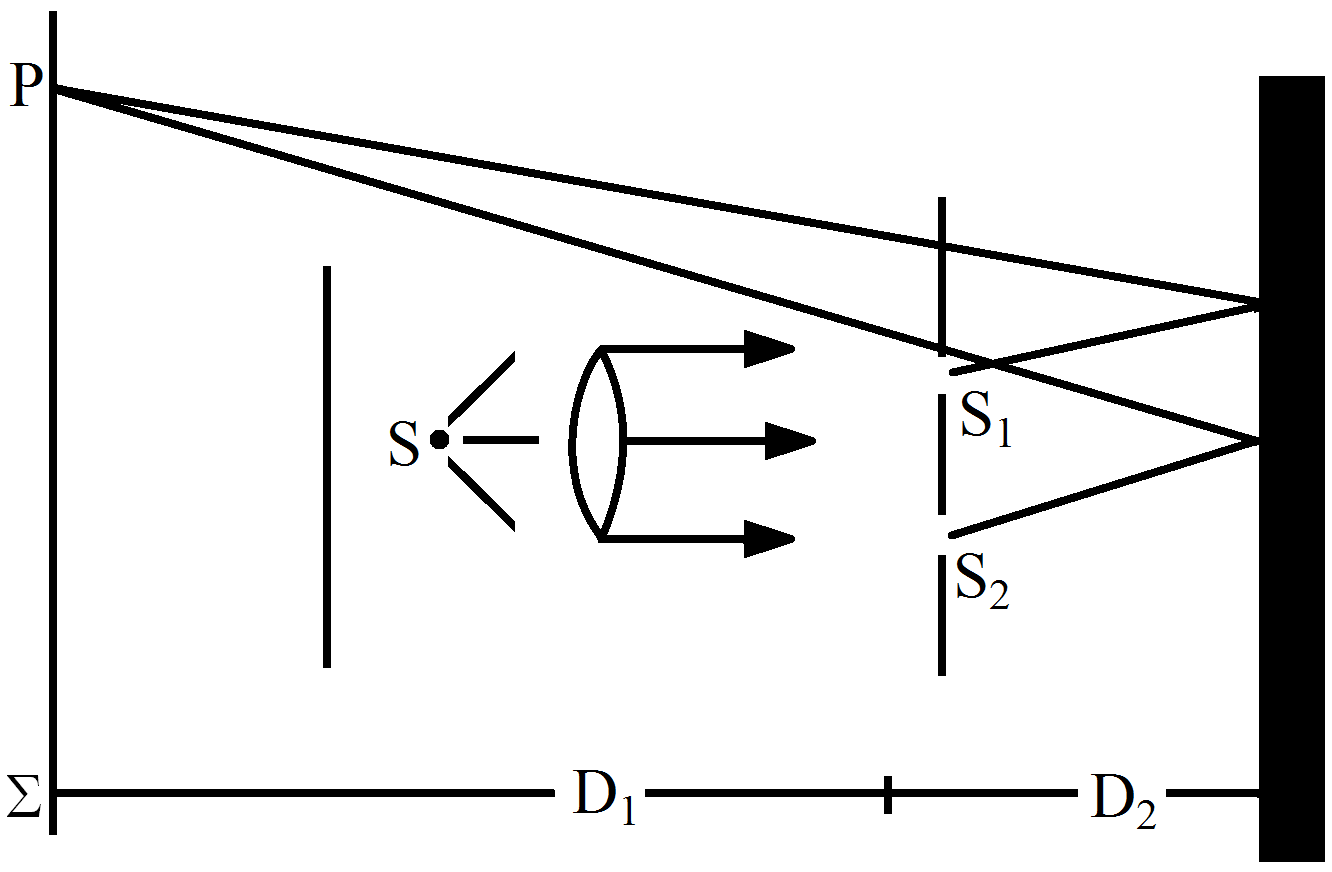
A double slit $S_1 - S_2$ is illuminated by a coherent light of wavelength $\lambda$. The slits are separated by a distance $d$. A plane mirror is placed in front of the double slit at a distance $D_1$ from it and a screen $\sum$ is placed behind the double slit at a distance $D_2$ from it $($figure $17-E_2)$. The screen $E$ receives only the light reflected by the mirror. Find the fringe$-$width of the interference pattern on the screen.