Question
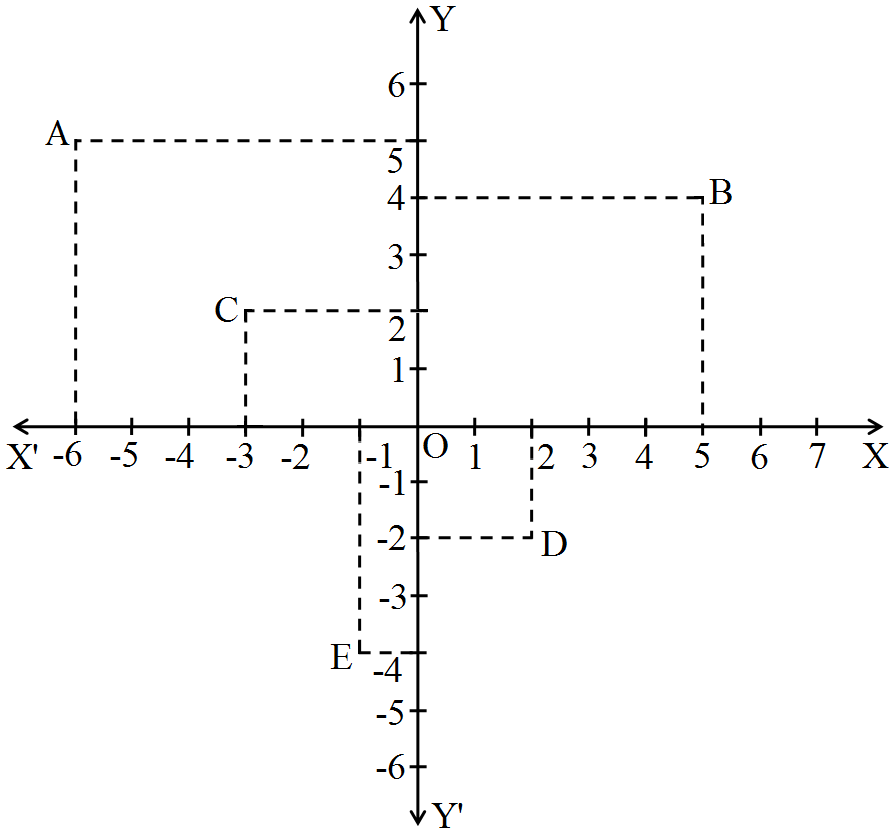
Write down the coordinates of each of the following points $\text{A, B, C, D,}$ and $E$.
Answer

Draw the perpendiculars from the $\text{AF, BG, CH, DI}$ and $EJ$ on the $x$-axis.
$1.$ The distance of $A$ from the $y-$axis $= OF = -6$ units
The distance of $A$ from the $x-$axis $= AF = 5$ units
Hence, the coordinate of $A$ are $(-6, 5)$
$2.$ The distance of $B$ from the $y$-axis $= OG = 5$ units
The distance of $B$ from the $x-$axis $= BG = 4$ units
Hence, the coordinate of $B$ are $(5, 4)$
$3.$ The distance of $C$ from the $y-$axis $= OH = -3$ units
The distance of $C$ from the $x-$axis $= HC = 2$ units
Hence, the coordinate of $C$ are $(-3, 2)$
$4.$ The distance of $D$ from the $y-$axis $= OI = 2$ units
The distance of $D$ from the $x-$axis $= ID= -2$ units
Hence, the coordinate of $D$ are $(2, -2)$
$5.$ The distance of $E$ from the $y-$axis $= OJ = -1$ unit
The distance of $E$ from the $x-$axis $= JE = -4$ units
Hence, the coordinate of $E$ are $(-1, -4)$
Thus, the coordinates of $A, B, C, D$ and $E$ are respectively, $A(-6, 5), B(5, 4), C(-3, 2), D(2, -2)$ and $E(-1, -4)$

Need a full question paper?

Generate a complete, print-ready paper with questions like this in minutes — across 16+ boards, with answer keys.
Start Generating Free

Similar questions

Study the bar graph representing the number of persons in various age groups in a town shown in figure Observe the bar graph and answer the following questions:
$i.$ What is the percentage of the youngest age$-$group persons over those in the oldest age group $?$
$ii.$ What is the total population of the town $?$
$iii.$ What is the number of persons in the age-group $60–65?$
$iv.$ How many persons are more in the age-group $10–15$ than in the age group $30–35?$
$v.$ What is the age$-$group of exactly $1200$ persons living in the town $?$
$vi.$ What is the total number of persons living in the town in the age$-$group $50–55?$
$vii.$ What is the total number of persons living in the town in the age$-$groups $10 – 15$ and $60 – 65?$

$viii.$ Whether the population in general increases, decreases or remains constant with the increase in the age$-$group.
A hand fan is made by sticking $10$ equal size triangular strips of two different types of paper as shown in the figure. The dimensions of equal strips are $25\ cm, 25\ cm$ and $14\ cm$ . Find the area of each type of paper needed to make the
Twenty cylindrical pillars of the Parliament House are to be cleaned. If the diameter of each pillar is $0.50\ m$ and height is $4m$.What will be the cost of cleaning them at the rate of $₹ 2.50$ per square meter?
Represent $\sqrt{4.7}$ geometrically on the number line.
The inner diameter of a cylindrical wooden pipe is $24\ cm$ and its outer diameter is $28\ cm$.
The length of the pipe is $35\ cm$. Find the mass of the pipe, if $1cm^3$ of wood has a mass of $0.6g.$
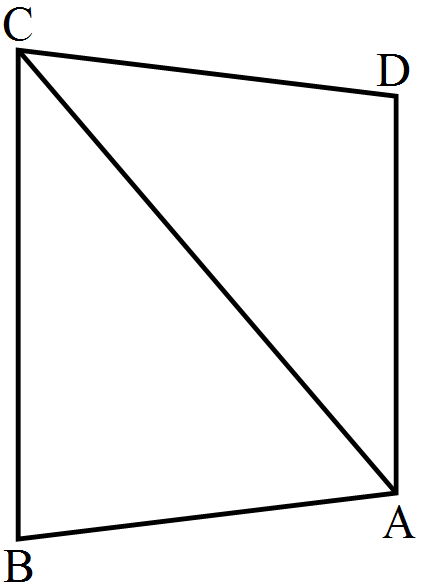
In Fig. prove that:
Points $A(5, 3), B(-2, 3)$ and $D(5, -4)$ are three vertices of a square $ABCD.$ Plot these points on a graph paper and hence find the coordinates of the vertex $C.$
From a tap of inner radius $0.75\ cm$, water flows at the rate of $7\ m$ per second. Find the volume in litres of water delivered by the pipe in one hour.
A total of $25 $patients admitted to a hospital are tested for levels of blood sugar, (mg/ dl) and the results obtained were as follows:
$87$
$71$
$83$
$67$
$85$
$77$
$69$
$76$
$65$
$85$
$85$
$54$
$70$
$68$
$80$
$73$
$78$
$68$
$85$
$73$
$81$
$78$
$81$
$77$
$75$
Find mean, median and mode (mg/ dl) of the above data.
A cube of side $4\ cm$ contains a sphere touching its sides. Find the volume of the gap in between.