Questions

4 Marks Questions

Take a timed test

4 questions · self-marked practice — reveal the answer and mark yourself.

Question 14 Marks
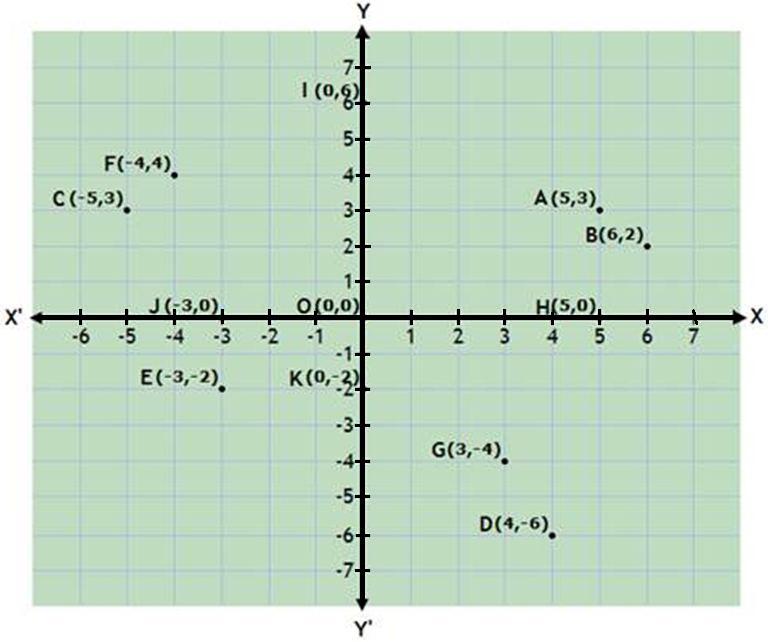
On the plane of a graph paper draw $X' OX$ and $YOY'$ as coordinate axes and plot each of the following points.
$i. A(5, 3)$
$ii. B(6, 2)$
$iii. C(-5, 3)$
$iv. D(4, -6)$
$v. E(-3, -2)$
$vi. F(-4, 4)$
$vi. G(3, -4)$
$viii. H(5, 4)$
$ix. I(0, 6)$
$x. J(-3, 0)$
$xi. K (0, -2)$
$xii. O(0, 0)$
Answer
The given points are plotted as follows:
View full question & answer
Question 24 Marks
Three vertices of a rectangle $ABCD$ are $A(3, 1), B(-3, 1)$ and $C(-3, 3)$. plot these points on a graph paper and find the coordinates of the fourth vertex $D$. Also find the area of rectangle $ABCD$.
Answer
Let $A(3, 1), B(-3, 1)$ and $C(-3, 3)$ be three vertices of a rectangle $ABCD$.
 Let the $y$-axis cut the rectangle $ABCD$ at the points $P$ and $Q$ respectively. (Image)
Abscissa of $D$ = Abscissa of $A = 3.$
Ordinate of $D$ = ordinate of $C = 3.$
$\therefore$ coordinates of $D$ are $(3, 3). AB = (BP + PA) = (3 + 3)$ units $= 6$ units.
$BC = (OQ - OP) = (3 - 1)$ units$ = 2$ units.
$Ar($rectangle $ABCD) $
$= (AB \times BC) = (6 \times 2)$sq. units
$= 12$sq. units
Hence, the area of rectangle $ABCD$ $12$ square units.
View full question & answer
Question 34 Marks
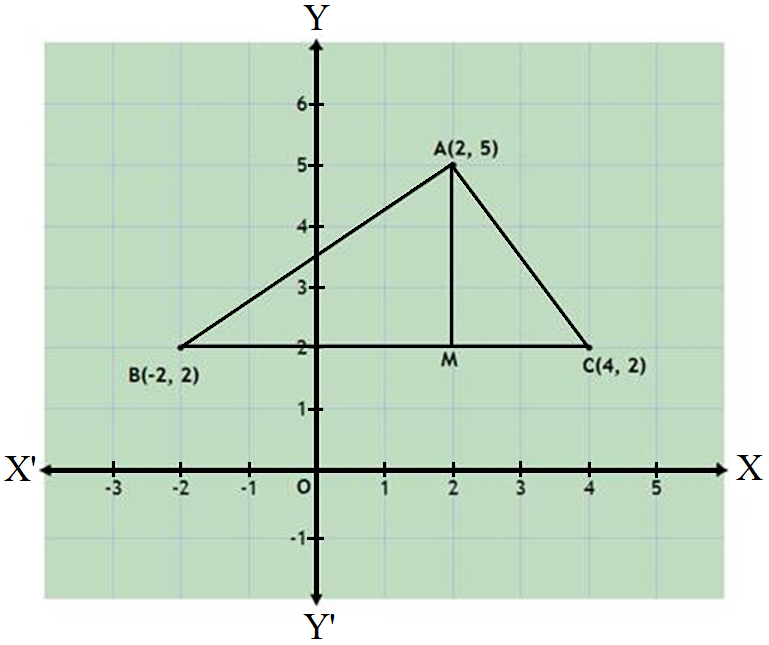
Plot the points $A(2, 5), B(-2, 2)$ and $C(4, 2)$ on a graph paper. Join $AB, BC$ and $AC$. Calculate the area of $\triangle\text{ABC}.$
Answer
The given points are plotted on the graph paper as follows:

Draw $\text{AM}\perp\text{BC}.$
Area of $\triangle\text{ABC}=\frac{1}{2}\times\text{Base}\times\text{Height}$
$=\frac{1}{2}\times\text{BC}\times\text{AM}$
$=\frac{1}{2}\times6\times3$ $= 9$ square units.
View full question & answer
Question 44 Marks
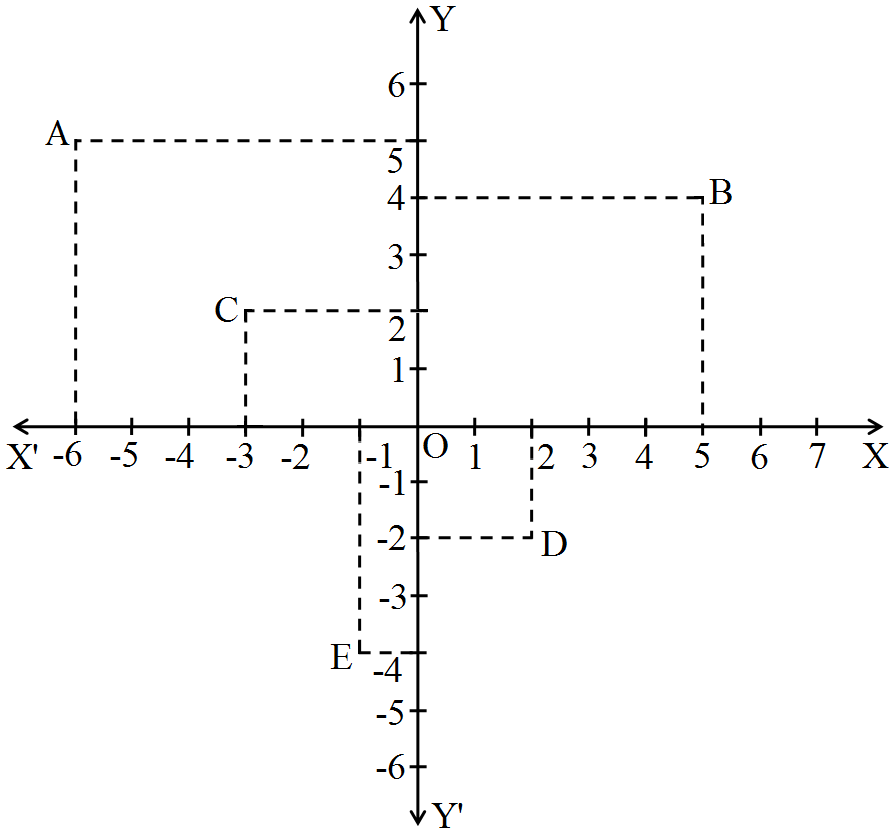
Write down the coordinates of each of the following points $\text{A, B, C, D,}$ and $E$.
Answer
Draw the perpendiculars from the $\text{AF, BG, CH, DI}$ and $EJ$ on the $x$-axis.
$1.$ The distance of $A$ from the $y-$axis $= OF = -6$ units
The distance of $A$ from the $x-$axis $= AF = 5$ units
Hence, the coordinate of $A$ are $(-6, 5)$
$2.$ The distance of $B$ from the $y$-axis $= OG = 5$ units
The distance of $B$ from the $x-$axis $= BG = 4$ units
Hence, the coordinate of $B$ are $(5, 4)$
$3.$ The distance of $C$ from the $y-$axis $= OH = -3$ units
The distance of $C$ from the $x-$axis $= HC = 2$ units
Hence, the coordinate of $C$ are $(-3, 2)$
$4.$ The distance of $D$ from the $y-$axis $= OI = 2$ units
The distance of $D$ from the $x-$axis $= ID= -2$ units
Hence, the coordinate of $D$ are $(2, -2)$
$5.$ The distance of $E$ from the $y-$axis $= OJ = -1$ unit
The distance of $E$ from the $x-$axis $= JE = -4$ units
Hence, the coordinate of $E$ are $(-1, -4)$
Thus, the coordinates of $A, B, C, D$ and $E$ are respectively, $A(-6, 5), B(5, 4), C(-3, 2), D(2, -2)$ and $E(-1, -4)$
View full question & answer