Question
Write down the Coulomb's law and explain its scalar form.

Answer

$\rightarrow $ Coulomb's law :
"The electric force $($Coulomb force$)$ between two stationary point charge is proporational to the product of the values of the charge and inversely proportional to the square of the distance between them the direction of this force is along the direction of the line joining the two charges."
$\rightarrow $Two point charges $q_1, q_2$ are separated by a distance $r$ in vacuum, the magnitude of the force $( F )$ between them is given by
$F =k \frac{q_1 q_2}{r^2}$
Where $k$ is constant $k=9 \times 10^9 Nm ^2 / C ^2$
$\rightarrow $ To simplify many formulas related to electricity $\frac{1}{4 \pi \varepsilon_0}$ is taken in place of $k$ in $SI$ system.
From equation $(1) F =\frac{1}{4 \pi \varepsilon_0} \cdot \frac{q_1 q_2}{r^2}$
Where, $\varepsilon_0$ is called the permittivity of free space.
$\varepsilon_0=8.85 \times 10^{-12} C ^2 / Nm ^2$
$\left( M ^{-1} L^{-3} T^2 Q ^2 OR M ^{-1} L^{-3} T^4 A^2\right)$
$\rightarrow $Because the coulomb's force acts between two charges only, it is also called two body force.
$\rightarrow $For coulomb's law F $\propto \frac{1}{r^2}$ that's why it is also called inverse square law.

Need a full question paper?

Generate a complete, print-ready paper with questions like this in minutes — across 16+ boards, with answer keys.
Start Generating Free

Similar questions

An athelete takes 2.0s to reach his maximum speed of 18.0km/h. What is the magnitude of his average acceleration?
Two 120V light bulbs, one of 25W and the other of 200W were connected in series across a 240V line. One bulb burnt out almost instantaneously. Which one was burnt and why?
Two protons are brought nearer; what will be the effect on potential energy of system?
Show that if the room temperature changes by a small amount from T to $\text{T}+\triangle\text{T},$ the fundamental frequency of an organ pipe changes from v to $\text{v}+\triangle\text{v},$ where-$\frac{\triangle\text{v}}{\text{v}}=\frac{1}{2}\frac{\triangle\text{T}}{\text{T}}.$
The potential difference across the terminals of a battery of emf 12V and internal resistance $2\Omega$ drops to 10V when it is connected to a silver voltameter. Find the silver deposited at the cathode in half an hour. Atomic weight of silver is 107.9g/mole.
If the potential difference used to accelerate electrons is tripled, by what factor does de Broglie wavelength of electrons beam change?
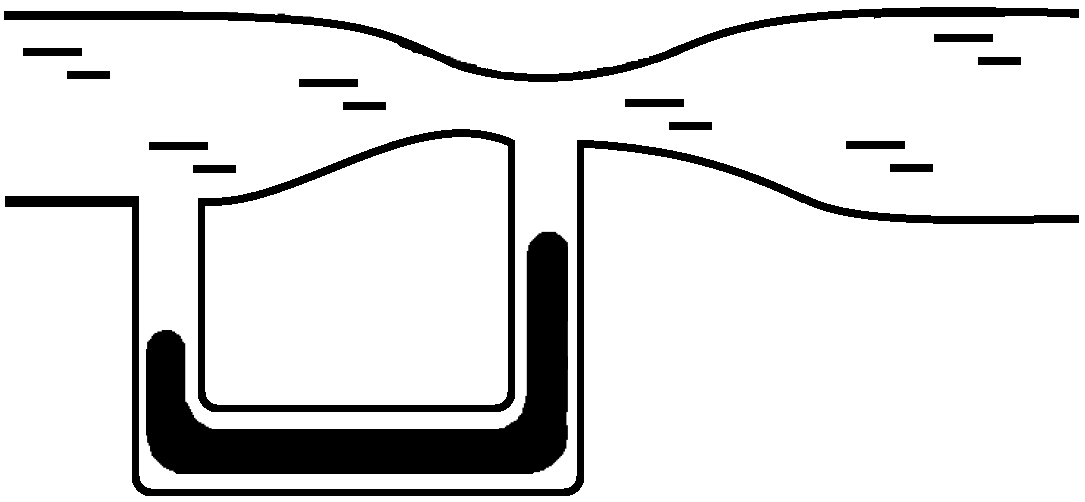
Water flows through the tube shown in The areas of cross-section of the wide and the narrow portions of the tube are $5 \mathrm{~cm}^2$ and $2 \mathrm{~cm}^2$ respectively. The rate of flow of water through the tube is $500 \mathrm{~cm}^3 / \mathrm{s}$. Find the difference of mercury levels in the U-tube.
Answer the following question:
As you have learnt in the text, the principle of linear superposition of wave displacement is basic to understanding intensity distributions in diffraction and interference patterns. What is the justification of this principle?
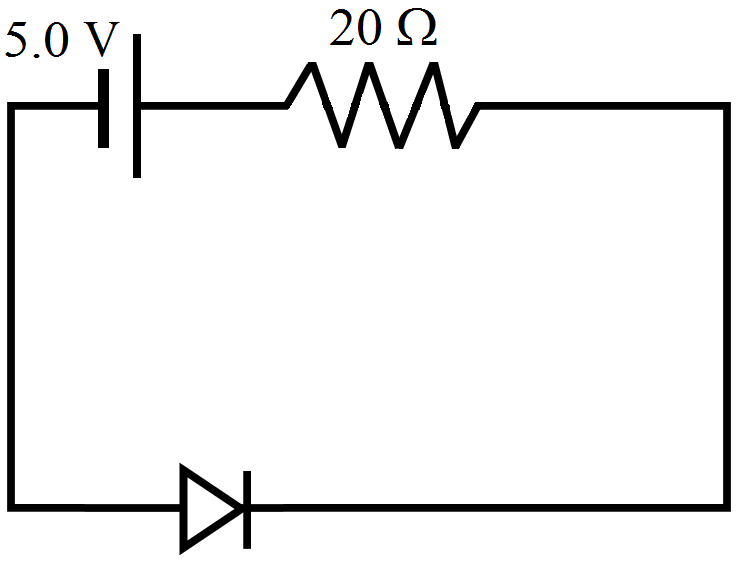
Calculate the current through the circuit and the potential difference across the diode shown in figure. The drift current for the diode is $20\mu\text{A}.$
A classroom demonstration of Newton's first law is as follows: A glass is covered with a plastic card and a coin is placed on the card. The card is given a quick strike and the coin falls in the glass.
  1. Should the friction coefficient between the card and the coin be small or large?
  2. Should the coin be light or heavy?
  3. Why does the experiment fail if the card is gently pushed?