Question
Write down the Coulomb's law and get the vector form of it.

Answer

→ The electric force (Coulomb force) between two point stationary charges is proportional to the product of the values of the charges and inversely proportional to the square of the distance between them. The direction of this force is in the direction of the line joining the two charges.
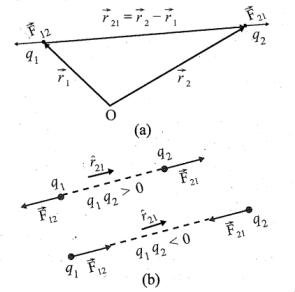
→ Let the position vectors of charges $q_1$ and $q_2$ be $\vec{r}_1$ and $\vec{r}_2$ respectively [see Fig. (a)].

Image


→ We denote force on $q_1$ due to $q_2$ by $\vec{F}_{12}$ and force on $q_2$ due to $q_1$ by $\overrightarrow{ F }_{21}$. The two point charges $q_1$ and $q_2$ have been numbered 1 and 2 for convenience and the vector leading from 1 to 2 is denoted by $\vec{r}_{21}$ :
$\vec{r}_{21}=\vec{r}_2-\vec{r}_1$

→ In the same way, the vector leading from 2 to 1 is denoted by $\vec{r}_{12}$ :
$\vec{r}_{12}=\vec{r}_1-\vec{r}_2=-\vec{r}_{21}$

→ The magnitude of the vectors $\vec{r}_{21}$ and $\vec{r}_{12}$ is denoted by $r_{21}$ and $r_{12}$, respectively $\left(r_{12}=r_{21}\right)$.
→ The direction of a vector is specified by a unit vector along the vector. To denote the direction from 1 to 2 (or from 2 to 1 ), we define the unit vectors:
$\hat{r}_{21}=\frac{\overrightarrow{r_{21}}}{r_{21}}, \hat{r}_{12}=\frac{\overrightarrow{r_{12}}}{r_{12}}, \hat{r}_{21}=-\hat{r}_{12}$

→ Coulomb's force law between two point charges

$q_1$ and $q_2$ located at $\vec{r}_1$ and $\vec{r}_2$, respectively is then expressed as
$\overrightarrow{ F }_{21}=\frac{1}{4 \pi \varepsilon_0} \frac{q_1 q_2}{r_{21}^2} \cdot \hat{r}_{21}$

→ Equation is valid for any sign of $q_1$ and $q_2$ whether positive or negative.
→ If $q_1$ and $q_2$ are of the same sign (either both positive or both negative), $F _{21}$ is along $\hat{r}_{21}$, which denotes repulsion, as it should be for like charges. If $q_1$ and $q_2$ are of opposite signs, $F_{21}$ is along $-\hat{r}_{21}=\hat{r}_{12}$, which denotes attraction, as expected for unlike charges.
→The force $\overrightarrow{ F }_{12}$ on charge $q_1$ due to charge $q_2$ is obtained from Eq. by simply interchanging 1 and 2 , i.e.,
$\overrightarrow{ F }_{12}=\frac{1}{4 \pi \varepsilon_0} \frac{q_1 q_2}{r_{12}^2} \hat{r}_{12}=-\overrightarrow{ F }_{21}$

→Thus, Coulomb's law agrees with Newton's third law.

Need a full question paper?

Generate a complete, print-ready paper with questions like this in minutes — across 16+ boards, with answer keys.
Start Generating Free

Similar questions

What length of a copper wire of cross-sectional area $0.01mm^2$ will be needed to prepare a resistance of $1\text{k}\Omega?$ Resistivity of copper $=1.7\times10^{-8}\Omega\text{-m}.$
What is the de Broglie wavelength of a nitrogen molecule in air at 300 K? Assume that the molecule is moving with the root-meansquare speed of molecules at this temperature. (Atomic mass of nitrogen = 14.0076 u).
Define nuclear fission reaction.
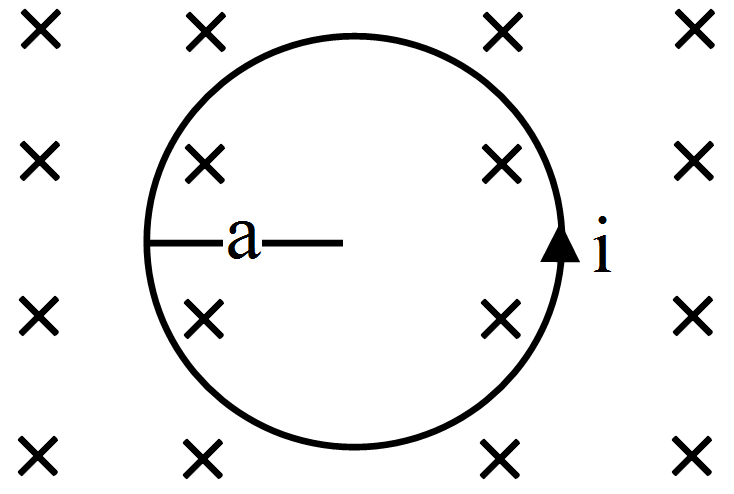
The shows a circular wire loop of radius a and carrying a current i, which is placed in a perpendicular magnetic field B.
  1. Consider a small part dl of the wire. Find the force on this part of the wire exerted by the magnetic field.
  2. Find the force of compression in the wire.
A heating element using nichrome connected to a 230 V supply draws an initial current of 3.2 A which settles after a few seconds to a steady value of 2.8 A. What is the steady temperature of the heating element if the room temperature is 27.0°C? Temperature coefficient of resistance of nichrome averaged over the temperature range involved is $1.70\times10^{-4}{^\circ\text{C}}^{-1}.$
Suppose while sitting in a parked car, you notice a jogger approaching towards you in the side view mirror of $R=2 m$. If the jogger is running at a speed of $5 m s ^{-1}$, how fast the image of the jogger appear to move when the jogger is (a) $39 m$, (b) $29 m$, (c) $19 m$, and (d) $9 m$ away.
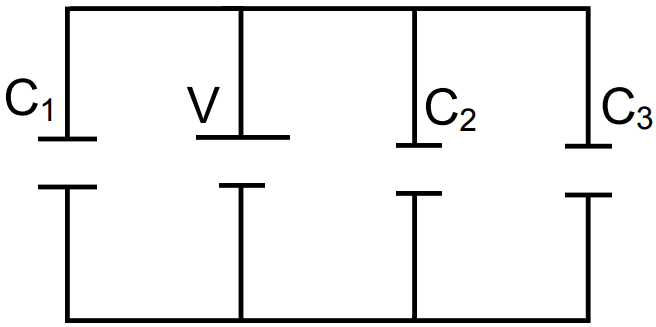
Find the charges on the three capacitors connected to a battery as shown in figure. Take $\text{C}_1=2.0\mu\text{F},\ \text{C}_2=4.0\mu\text{F},\ \text{C}_3=6.0\mu\text{F}$ and V = 12 volts.
At what temperature the mean speed of the molecules of hydrogen gas equals the escape epeed from the earth?
An electron and a photon each have a wavelength of 1.00 nm. Find:
  1. Their momenta,
  2. The energy of the photon, and
  3. The kinetic energy of electron.
Is $\text{p}=\frac{\text{E}}{\text{c}}$ valid for electrons?