Question
Is $\text{p}=\frac{\text{E}}{\text{c}}$ valid for electrons?

Answer

From Einstein's mass- energy equation,$\text{E}=\text{mc}^2$
$\Rightarrow\text{E}=\frac{\text{m}_0\text{c}^2}{\sqrt{1\frac{\text{v}^2}{\text{c}^2}}}$
Relativistic momentum,
$\text{p}=\text{mv}$
$\Rightarrow\text{p}=\frac{\text{m}_0\text{c}^2}{\sqrt{1\frac{\text{v}^2}{\text{c}^2}}}$
Combining the above equations, we get:
$\text{E}^2=\text{m}_0^2\text{c}^ 4+\text{p}^2\text{c}^2$
From the above equation, it is clear that for $\text{p}=\frac{\text{E}}{\text{c}}$ to be valid, the rest mass of the body should be zero. As electrons do not have zero rest mass, this equation is not valid for electrons.

Need a full question paper?

Generate a complete, print-ready paper with questions like this in minutes — across 16+ boards, with answer keys.
Start Generating Free

Similar questions

A parallel-plate capacitor of plate-area A and plate separation d is joined to a battery of emf $\in$ and internal resistance R at t = 0. Consider a plane surface of area $\frac{\text{A}}{2}$ parallel to the plates and situated symmetrically between them. Find the displacement current through this surface as a function of time.
  1. Define self-inductance. Write its SI units.
  2. A long solenoid with 15 turns per cm has a small loop of area $2.0\ cm^2$ placed inside the solenoid normal to its axis. If the current carried by the solenoid changes steadily from 2.0 A to 4.0 A in 0.1 s, what is the induced emf in the loop while the current is changing?
A traffic policeman sounds a whistle to stop a car-driver approaching towards him. The car-driver does not stop and takes the plea in court that because of the Doppler shift, the frequency of the whistle reaching him might have gone beyond the audible limit of 20kHz and he did not hear it. Experiments showed that the whistle emits a sound with frequency close to 16kHz. Assuming that the claim of the driver is true, how fast was he driving the car? Take the speed of sound in air to be 330m/s. Is this speed practical with today's technology?
A semiconducting material has a band gap of 1eV. Acceptor impurities are doped into it which create acceptor levels 1meV above the valence band. Assume that the transition from one energy level to the other is almost forbidden if kT is less than $\frac{1}{50}$ of the energy gap. Also, if kT is more than twice the gap, the upper levels have maximum population. The temperature of the semiconductor is increased from 0K. The concentration of the holes increases with temperature and after a certain temperature it becomes approximately constant. As the temperature is further increased, the hole concentration again starts increasing at a certain temperature. Find the order of the temperature range in which the hole concentration remains approximately constant.
  1. Explain the processes of nuclear fission and nuclear fusion by using the plot of binding energy per nucleon (BE/ A) versus the mass number A.
  2. A radioactive isotope has a half-life of 10 years. How long will it take for the activity to reduce to 3·125%?
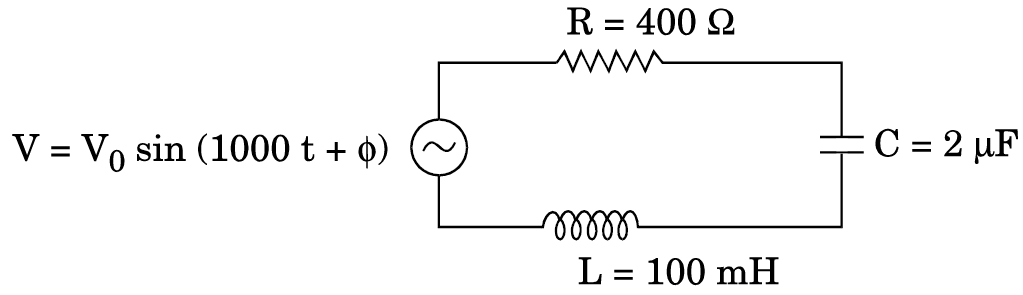
  1. Determine the value of phase difference between the current and the voltage in the given series LCR circuit.
  1. Calculate the value of the additional capacitor which may be joined suitably to the capacitor C that would make the power factor of the circuit unity.
Give a circuit diagram of a common emitter amplifier using an n-p-n transistor. Draw the input and output waveforms of the signal. Write the expression for its voltage gain.
Two blocks of masses 10kg and 30kg are placed along a vertical line. The first block is raised through a height of 7cm. By what distance should the second mass be moved to raise the centre of mass by 1cm?
Obtain the relationship between object distance $(u),$ image distance $(v)$ and focal length $(f)$ for a concave mirror.$\#\#\#$ Obtain $\frac{1}{f}=\frac{1}{v}+\frac{1}{u}$ formula for a concave mirror.
Energy of electron in hydrogen atom expressed by the following formula :
$E _n=-\left(\frac{13.6 eV}{n^2}\right) ; $ Where $,  n=1,2,3, \ldots$ by using this formula, proved that :
$(a)$ The energy of electron $-6.8 eV$ cannot be in $H -$ atom.
$(b)$ The distance of attached lines in spectrum of hydrogen.